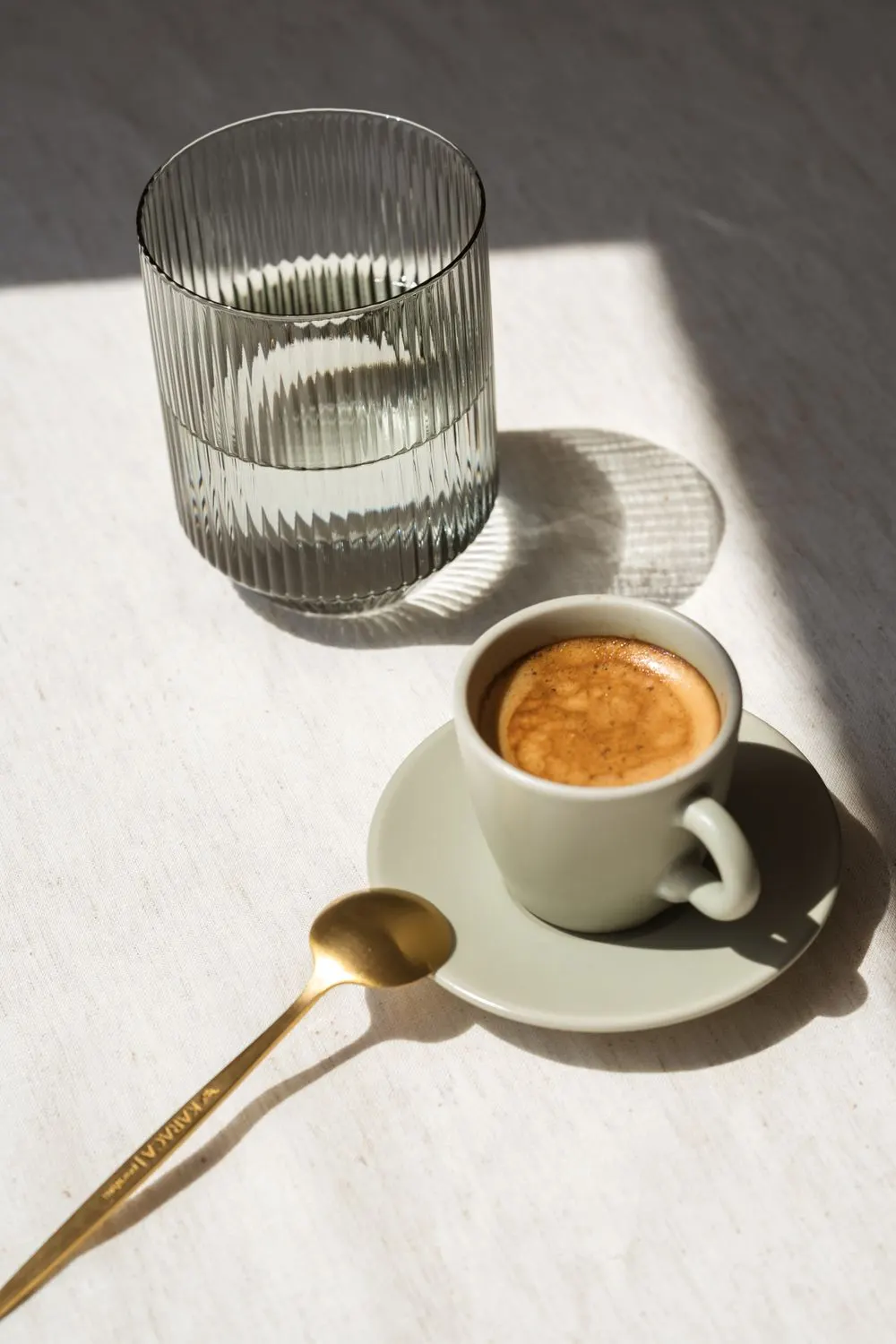
A morning coffee, a tea at work and a drink bought on the way home can be difficult to describe later. “Three cups” leaves out the size, the product and the time. A simple caffeine map replaces that vague total with information you can actually check.
Start with one ordinary day and the drinks you already have. Record their names, amounts and times, then separate the caffeine figures you can verify from the ones you cannot. The purpose is to understand your routine, rather than give yourself a score or discover a supposedly perfect cutoff time.
Why caffeine belongs in a sleep conversation
Caffeine is a stimulant that can interfere with sleep. The U.S. National Heart, Lung, and Blood Institute notes that its effects can last for hours, including into the night after an afternoon drink. This is a reason to notice the timing of your drinks, not a countdown that predicts exactly when an individual will be ready to sleep. NHLBI: Healthy Sleep Habits
The U.S. Food and Drug Administration also describes substantial differences in people’s sensitivity and how quickly they clear caffeine. A general adult figure is therefore not a personal target or a guarantee about sleep. This worksheet deliberately does not set a daily allowance. FDA: Caffeine
Look beyond the first coffee
Put the usual items on paper before searching for numbers. Include coffee, tea and caffeinated soft drinks, then check any other regular products whose ingredients you have not looked at recently. FDA notes that caffeine can also appear in products such as chocolate and some bars. Decaffeinated coffee and tea can still contain caffeine. FDA: Sources and Labels
Use the actual product name. “Black tea, the blend in the kitchen cupboard” is more useful than simply “tea.” If you switch between a café drink and a home-brewed mug, give them separate entries. You are describing what happened, not trying to make the list look consistent.
Do not add a product you rarely use just to create a comprehensive database. A short, accurate record of your ordinary choices is a better starting point than an elaborate list you never finish.
Read the amount and what it applies to
Look for a caffeine statement on the package or the maker’s page for that exact product. If a number is available, copy the unit and its basis: per serving, per bottle, per can or per specified volume. Keep a photograph or the source link beside the note so you can check it again.
U.S. labeling rules distinguish caffeine added as an ingredient from caffeine present within another ingredient. A caffeine amount is not always printed. An absent number is missing information, not evidence of zero caffeine. Label practices differ between countries. FDA: Check the Product Label
For a fictional arithmetic example, suppose a label says 30 mg per 100 mL and the bottle holds 250 mL. A whole bottle represents 75 mg according to that label. Half the bottle represents about 37.5 mg. These invented numbers illustrate the calculation; they do not describe a product or an appropriate serving.
If the package already gives a per-container number, do not multiply it again. When you are unsure which quantity the statement covers, leave the calculation unfinished until you can confirm it.
Be honest about brewed drinks
A café menu may name the drink and size without providing a caffeine figure. A home-brewed drink may not have a product-specific amount either. Ask the seller or manufacturer when that information matters, and keep an unknown as an unknown. FDA explains that amounts vary between products and suggests checking with manufacturers. FDA: Product Variation
Write a preparation note you can recognize next time: the mug size, the named drink, or the usual brewing method. Do not assign every cup an internet average and then present the resulting total as a measurement. A missing figure is still useful information: it identifies what you would need to find out.
Make one day’s map
Copy these fields into your notes. One line per drink is enough.
| Time | Product and amount actually consumed | Caffeine information and its basis | Source or uncertainty |
|---|---|---|---|
| Example: 08:15 | Home coffee, usual 300 mL mug | Not established | Exact preparation not measured |
| Example: 14:00 | Half of a fictional 250 mL bottled drink | About 37.5 mg using the example label above | Arithmetic example only |
| Example: 18:30 | Tea, one usual cup | Not established | Check product information |
| Your entry |
The examples are invented, not a recommended pattern. Beside the map, note when you intended to go to bed. If you later write down how the night went, keep it as an observation. A single good or difficult night cannot establish which factor caused it.
If exact tracking feels like more work than it is worth, use a shorter version: product, rough amount and time. You can learn that a drink routinely happens later than you thought without estimating milligrams.
Turn the map into one useful question
Choose the question the record actually raises. Perhaps you want to know whether a familiar drink has a decaffeinated version, whether a label refers to the whole bottle, or what is in a newly introduced product. Resolve that question before redesigning your entire day.
If you decide to reduce regular caffeine use, FDA advises making the reduction gradually. The map is not a tapering schedule or advice about changing a medicine. FDA: Cutting Back
For a separate planning task, use Make Room for Sleep in a Busy Week. To organize familiar evening steps, use Build Your Own Bedtime Checklist. Neither needs to become another tracking project.
Before you put the map away
- Have I recorded the drink I actually had, rather than a generic cup?
- Does each number say what volume or serving it covers?
- Have I kept missing information visible?
- Am I treating this as a record, rather than a diagnosis or a personal caffeine allowance?
- Is there one question worth checking, or am I finished for now?
A useful result can be quite small: a label understood, a familiar mug described, or one uncertain item marked for checking. You do not need a perfect total to make the record more honest.