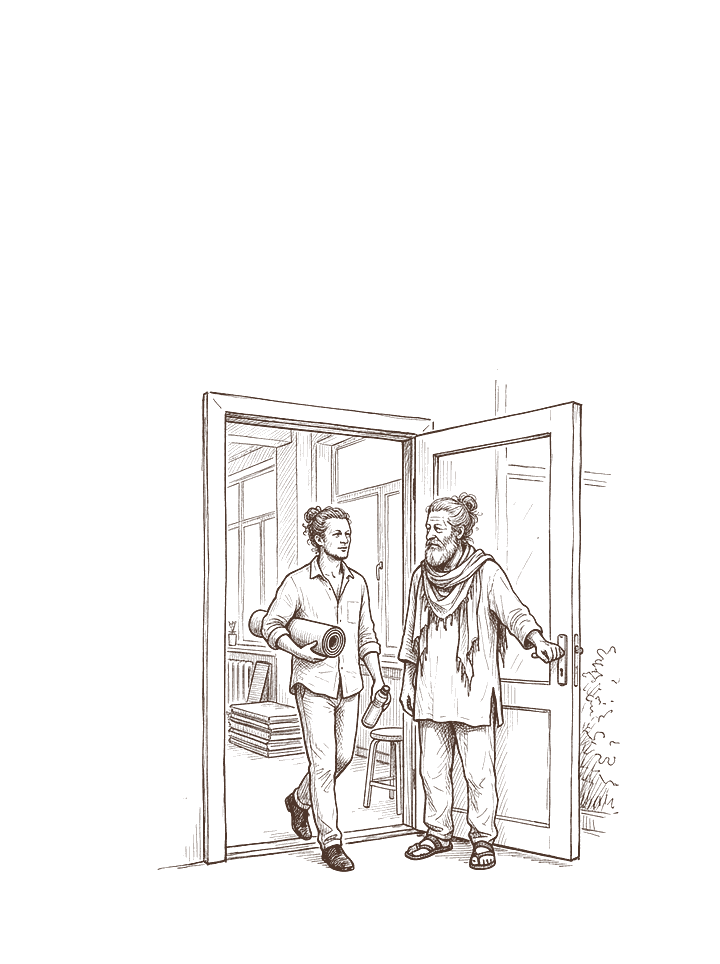
Find out what “beginner” means here
NCCIH describes yoga styles with differing physical demands. Rather than treating a class name as a complete description, ask the provider to explain the session you are considering.
Try: “I have not attended this type of class before. Is it intended for beginners, and what should I expect?” Ask whether instruction includes explanations for newcomers, whether the room is heated, and whether you are expected to know a sequence beforehand. You are gathering information about this particular class, not trying to pass an entry test.
Ask about the instructor
NCCIH’s guidance includes asking about an instructor’s training and experience. A practical version is: “What training do you have, and what experience do you have teaching this class format to newcomers?” If a credential is mentioned, ask how you can check it with the issuer. This guide does not set a universal certification requirement or endorse a provider.
What to bring: make a confirmed list
Ask what the venue supplies before buying a mat or props. Put confirmed items on the packing list and unanswered questions on a separate line, so a guess does not become a purchase.
Equipment and personal items
Ask whether a mat is supplied, whether you can bring your own and whether there are any rules for using shared equipment. Ask the same about props. If a towel, water bottle or another item is requested, add it to your list; these are questions for the venue, not universal requirements established by this article.
Clothing, belongings and the room
Check the provider’s clothing or footwear guidance, where belongings can be kept and whether changing facilities are available. Consider what you already own before deciding to buy something. Ask about any room arrangements that matter to your visit, such as temperature, toilets or a place to change.
For an online class, confirm the joining link, device requirements, whether a camera is expected and what the provider asks you to prepare in your space. An online format does not itself establish that an activity is appropriate for you.
Sort out arrival and access
Confirm the address or online joining details, start time, check-in process and the provider’s suggested arrival window. Ask about entry to the building, stairs or lifts and other access arrangements you need to know before deciding to attend.
Keep the description and instructions yourself even if someone else books. Check payment and cancellation terms too; if your schedule is uncertain, ask about moving a booking rather than assuming that a missed class can be rescheduled.
Ask how participation works
Questions, pauses and opting out
Before the class, ask how to signal that you need an explanation, want a pause or do not want to take part in an activity. Try: “Can you explain how I can ask a question during the session?” You can also ask what happens if you prefer to observe part of the class.
If hands-on guidance is used, ask how permission is requested and how you can decline. This is a question about communication; it is not a technique instruction or a claim that any particular approach is safe for everyone.
Keep medical questions outside a packing checklist
NCCIH notes that individual health circumstances can require discussion with health care providers and the instructor. It also cautions against delaying medical care because of yoga. If your question concerns a condition, injury or pregnancy, this preparation sheet cannot answer it or provide an adaptation. Take that question to an appropriate professional instead of using a class label or equipment list to decide.
Make the first step smaller if needed
Let the next step be the question that remains, rather than a booking made with missing information. For example: “The venue supplies mats. I still need to ask about access and how newcomers can ask questions.” Sending that message can complete the preparation for today.
My Week includes a yoga preparation option for reading a class description or writing a question for its instructor. Use the next-step button below to open My Week with that preparation offered. Keep the provider’s specific packing and arrival details on your prep sheet. The planner does not teach yoga or confirm that a class is appropriate for you. If a plan is already open, choose to start a plan with this action before it is applied. Opening the link alone does not replace the existing plan; saving the new plan is a separate choice.
Use the prep sheet without adding a pose plan
Print the page or copy the prompts that apply into your notes. Separate confirmed information from what you still need to ask; the sheet does not need every field filled.
NCCIH supports the limited context about class differences, instructor questions and medical boundaries. The packing prompts and worksheet are our own organizational format. No pose sequence, breathing technique, health benefit, injury-prevention promise or measure of flexibility is prescribed here.
When flexibility or floor transitions worry you
Name the practical concern: getting down to the floor, reaching your feet, changing position or keeping pace. “I am worried about getting down to the floor” gives the teacher a question to answer about this class. You do not need a home flexibility test to earn that conversation.
“Hello, I am considering your class and am new to this format. My main practical concern is [getting to the floor / following transitions / another concern]. Could you explain what the session involves and how you handle alternatives and questions? I would like to understand that before booking.”
Replace the bracketed phrase with your own concern. Keep the reply as the provider’s description of what is offered, without treating it as a clinical assessment or assuming every class has every alternative.
Prepared with AI assistance, including source comparison recorded on 19 October 2026. This practical guide is not individual health advice or an independent human or medical review. Editorial policy.
First Yoga Class Prep Sheet
Write here or print · Your entries stay on this page until you leave.
Make a short list of practical questions for the class provider. This sheet contains no poses, exercise sequence or suitability advice.
This is an organization sheet, not health advice. Entries are not saved or sent. Print the page to keep your answers; avoid sensitive personal or medical details.
Ask before booking
- Is this class intended for people new to the format?
- What does the provider ask attendees to bring?
- Are mats or props provided?
- What are the access, arrival and cancellation arrangements?
Make the visit simpler
- Location and a workable arrival window
- What I want to ask the instructor before the class
- How can I pause or opt out of an activity?
A smaller next step
- One question I can send before deciding whether to attend