A bag of tea contains a series of decisions. Someone chose the material, managed its moisture, worked or rested the leaves, and decided when to apply heat. Understanding a few of those decisions makes a product description much easier to read.
The useful starting point is a set of verbs: wither, roll, oxidise, fix, ferment, dry and roast. They describe different kinds of work. They are not a checklist that every tea must pass through in the same order.
Read the sequence, not just the colour
Green, black, white, oolong and dark tea are useful categories, but a line running from pale to dark cannot explain their manufacture. Taiwan’s Tea and Beverage Research Station describes several processing routes and notes that regional methods vary. Its account separates enzyme-driven oxidation from the microbial fermentation involved in making dark tea.[1]
For a particular packet, ask which steps were used and when. A maker’s short account of the batch is more informative than an isolated claim such as “lightly processed”. Light in what respect: the handling, oxidation, drying or final roast?
Withering and rolling change the working material
Withering lets fresh leaf lose moisture while other changes take place. It prepares the material for later work; it does not necessarily mean that the tea has already been dried to its finished state. The Sri Lanka Tea Board’s description of orthodox black-tea manufacture treats withering as a monitored stage involving both physical and chemical changes.[2]
Rolling also does more than make a tidy shape. In that black-tea process, it disrupts leaf cells and brings their contents into conditions where oxidation can proceed.[2] A tightly rolled finished tea and a loosely twisted one may therefore reflect different handling histories. Their silhouettes cannot tell the whole story.
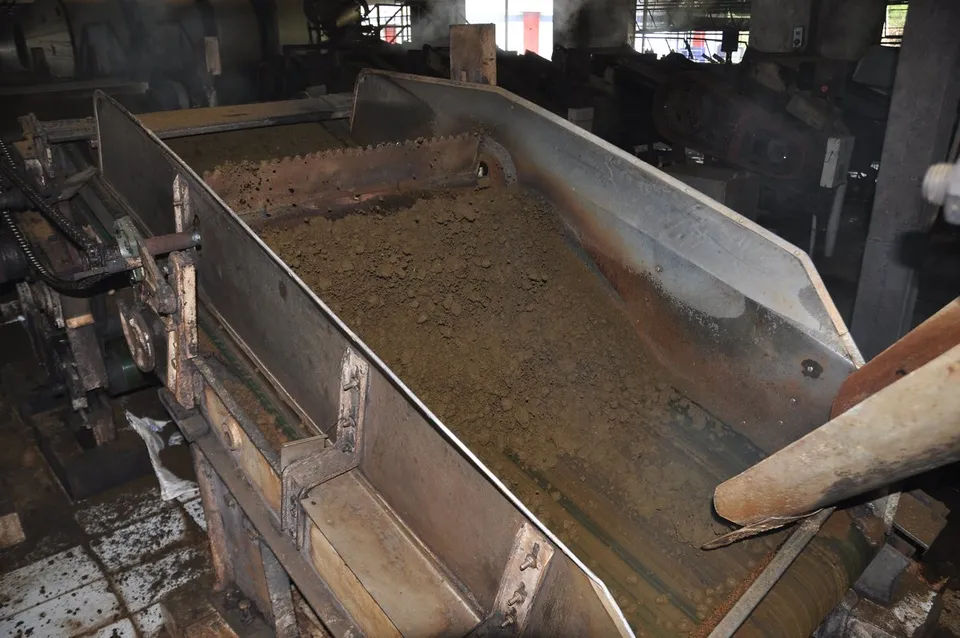
When looking at a process photograph, ask what stage it shows. Fresh leaves spread on a rack, rolled leaves awaiting further processing and finished dry tea may all look like “tea drying” to a casual observer. A useful caption names the actual operation and the tea being made.
Oxidation and fixation belong together
In tea making, oxidation commonly refers to reactions involving the leaf’s own enzymes and compounds, including catechins. Working the leaf helps those reactions occur. Fixation, often called kill-green, uses heat to suppress enzyme activity. Green-tea manufacture applies this control early; oolong production allows a managed period of change before fixation.[1]
The timing matters. Heating fresh leaf to control enzymes is a different decision from giving already-made tea a later roast. Both involve heat, which is why everyday descriptions can become confusing.
Black-tea production is often described as “fermentation” in traditional manufacturing language. The Sri Lanka Tea Board uses fermentation and oxidation for its aeration stage.[2] When reading that word, look at the process being described. It does not automatically mean that a maker has added a microbial fermentation stage.
Avoid treating an oxidation percentage on a shop page as a complete specification. Ask how the producer uses the number and what other processing information accompanies it. A percentage without its meaning leaves you with an impression of precision rather than a reproducible description.
Microbial fermentation is another kind of change
Shou pu-erh provides a clear example. Its manufacture includes a moist piling stage in which microorganisms participate. A study following ripened pu-erh through pile fermentation linked changes in microbial communities with the development of aroma compounds, and investigated those relationships further through fermentation experiments.[3]
This is why “fermented” needs context. Enzymatic oxidation during black-tea making and microbial activity in pu-erh are related to different production histories. Neither term tells you, by itself, whether you will enjoy the result.
Drying and roasting have different jobs
Drying reduces moisture in the leaf and helps produce a storable finished tea. A later roast can further alter aroma and taste. In a controlled Tieguanyin study, researchers kept the earlier processing the same and varied the roasting treatment. The resulting teas differed in sensory and chemical characteristics.[4]
That distinction makes “roasted oolong” more useful than simply calling a tea dark. It also explains why a roast description belongs alongside the tea’s identity, rather than replacing it.
Make a process card for one tea
Choose a tea already in your cupboard and try this small reading exercise. It requires the packet and, if available, the maker’s description.
- Write down the stated tea type, origin and cultivar or blend information.
- List the operations actually named. Leave gaps where the description gives no information.
- Circle ambiguous words such as “fermented”, “fired”, “traditional” or “light”. Write one question beside each.
- Separate observations from explanations. “The dry leaf looks dark” is an observation. “It must be heavily oxidised” is a proposed explanation that needs more evidence.
- Keep one question for the seller: “Was this tea roasted again after its initial drying?” is easier to answer than “How processed is it?”
You do not need a factory manual to enjoy a cup. A few clearly understood steps are enough to make the next description less mysterious and the next comparison more interesting.
Sources
- Taiwan Ministry of Agriculture, Tea and Beverage Research Station. Introduction to Taiwanese specialty tea classification and processing. Official technical account, updated 17 October 2024; Chinese-language source.
- Sri Lanka Tea Board. Manufacturing. Official account of orthodox black-tea production; used for the stated operations, not as a universal flow for all tea.
- Weng, Y., and colleagues. Keystone microbial taxa in the formation of stale aroma during pile fermentation of ripened Pu-erh tea. npj Science of Food, 2026, 10, 221. Pile-fermentation sampling and experimental investigation of microbial contributions to aroma formation.
- Cao, Q.-Q., and colleagues. Sensory and chemical characteristics of Tieguanyin oolong tea after roasting. Food Chemistry: X, 2021, 12, 100178. Matched processing with varied roasting treatments.
.jpg)