1. Understand sheng and shou
Pu-erh is associated with Yunnan, China, and traditionally uses large-leaf tea material. Both main styles begin with processed, sun-dried leaves. The early steps include heating and rolling; “raw” should therefore never be read as “an untouched leaf.” Finished tea may be sold loose or compressed into cakes and other shapes.[1]
Sheng, usually translated as raw, follows a route without the accelerated wet-piling stage used for shou. Its composition and character can continue changing during storage. Shou, often written shu and translated as ripe or ripened, goes through an additional moist piling process involving microorganisms. This method was developed in the 1970s.[1]
These names describe processing histories. An old sheng remains sheng. Dark liquor alone cannot tell you that a tea is shou, and a pressed cake can contain either style. Ask for the processing type rather than trying to infer it from color or shape.
Age adds another dimension, alongside storage conditions.[3] It is useful information, provided you also know something about the tea. “Twenty years old” leaves many questions unanswered.
2. Ask useful questions about origin
Origin deserves precision. UNESCO’s description of Jingmai Mountain, in Yunnan, documents a tea-growing landscape maintained by Blang and Dai communities, with long-established cultivation traditions.[2] A famous place name can be a reason to learn more about the people behind a tea.
For a purchase, start with the information that connects a particular packet to its source. Who made it? What year was the leaf harvested? Is it a blend, and is the claimed origin specific enough to check? If a tree-age claim contributes substantially to the price, what supports it?
Choose the questions that matter to your decision. A named producer, harvest information and an intelligible supply history give you something to follow. Pictures of impressive trees, on their own, leave the link between landscape and finished tea unresolved.
3. Treat age as a variable
Storage can change taste and aroma, but a date cannot specify the outcome. In a study published in 2026, researchers compared raw pu-erh samples after thirteen years of storage in contrasting environments. The resulting teas differed in sensory characteristics and chemical composition. Warmer, more humid conditions were associated with a mellower profile; cooler, drier conditions retained more astringency and umami in those samples.[3]
This is a useful demonstration of why storage history matters. It supplies neither a universal home-storage recipe nor a promise that a particular tea will improve. This was a limited comparison of stored teas, and “mellower” is a description you may or may not prefer.
Taste a sample in its current condition before paying for an aging forecast.
Ask where a tea has been stored, whether it moved between climates, and what the seller actually knows. An honest gap in the record is useful information. You can decide how much uncertainty you are willing to buy.
4. Give each sample a fair hearing
Expect differences within both styles. Research on five ripe pu-erh samples made from ancient-plant material, for example, found a mellow taste and pronounced mushroom-like aroma. Those findings describe the selected samples, not a compulsory flavor for every shou.[4]
Use descriptions as invitations to pay attention. Does an aroma remind you of fresh leaves, dried fruit, wood or mushrooms? Is the liquor light or substantial in the mouth? Does a drying sensation appear immediately, or build after several sips? Plain words are enough. You do not have to reproduce someone else’s tasting note.
Record both what you notice and whether you enjoy it. A drying sensation is an observation; whether it suits you is a preference.
Pu-erh also contains caffeine. Brewing research that included pu-erh found that temperature, time and repeated infusions changed extraction. Because that experiment used small-particle bagged tea, its measurements cannot predict the caffeine in your particular cake or session.[5] A dark color or smooth taste is no basis for assuming a caffeine-free drink.
5. Try a small comparison
Choose one clearly identified sheng and one shou. Loose samples or already separated pieces make preparation simpler. Use matching vessels if you have them, and the same water for both.
Sample-specific starting point: for each tea, try 4 grams of leaf with 100 millilitres of water at 95°C. Start with a 20-second infusion and drain fully. Try another 20 seconds, then 30 seconds. These are untested editorial settings to adjust for your samples, not a universally optimal recipe or laboratory standard. Compression, leaf size, equipment and your preference may call for substantial changes.
If a cup feels too concentrated, shorten the next infusion. If it seems thin, lengthen it a little. For a new session, change one variable at a time. You might keep the timing and reduce the leaf, or keep the leaf and try cooler water. Note the adjustment so you can repeat a result you like.
Give the cups time to cool to a comfortable drinking temperature. Record four things: aroma, texture, drying sensation and what remains after swallowing. Add one practical question: would I happily make this again tomorrow?
If you use a rinse as part of your usual preparation, apply it consistently and record it. The aim is a useful comparison you can repeat. It need not become a test of technique.
Reader takeaway: learn the processing type, ask about storage and taste a sample before committing to a cake. Sheng and shou offer different starting points; age and provenance add context. Your own repeatable cup is the best place to decide what comes next.
Sources
- Zhang et al. (2016), microbial communities and metabolites in raw and ripened pu-erh, PLOS ONE. Processing context and microbial analysis.
- UNESCO World Heritage Centre, Jingmai Mountain cultural landscape. Official heritage description.
- Zhang et al. (2026), raw pu-erh stored in contrasting environments, Food Research International, 238, 119427. DOI: 10.1016/j.foodres.2026.119427.
- Wang et al. (2025), sensory and chemical analysis of five ripe pu-erh samples, Food Chemistry: X, 26, 102278. DOI: 10.1016/j.fochx.2025.102278.
- Yang, Hwang and Lin (2007), steeping conditions and tea infusion composition, Journal of Chromatography A, 1156, 312–320. DOI: 10.1016/j.chroma.2006.11.088.
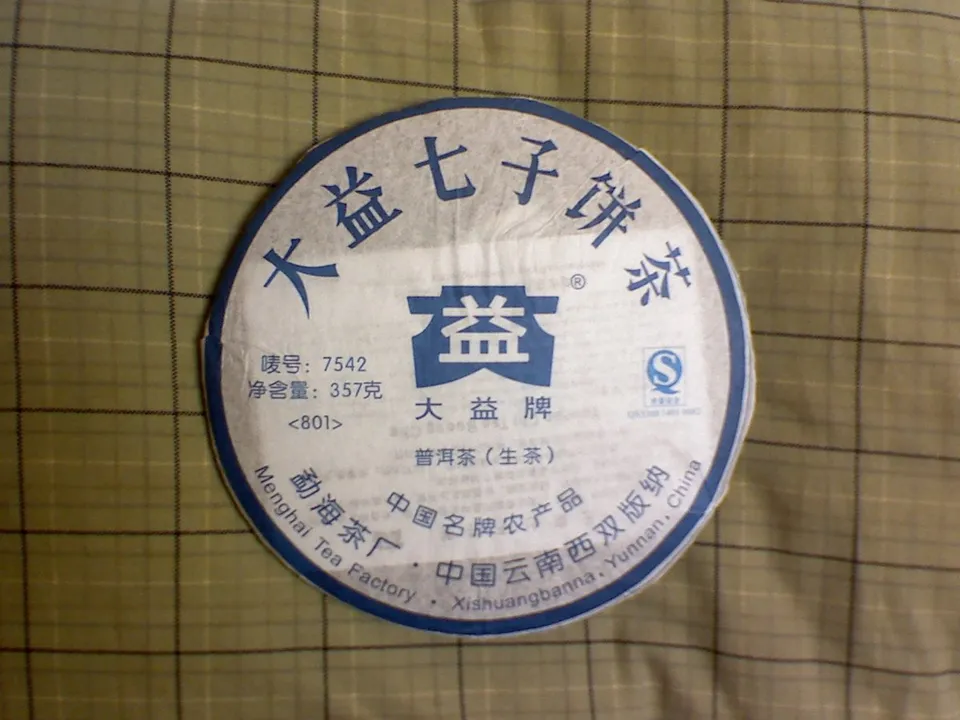
_Menghai_7542_357g.jpg)