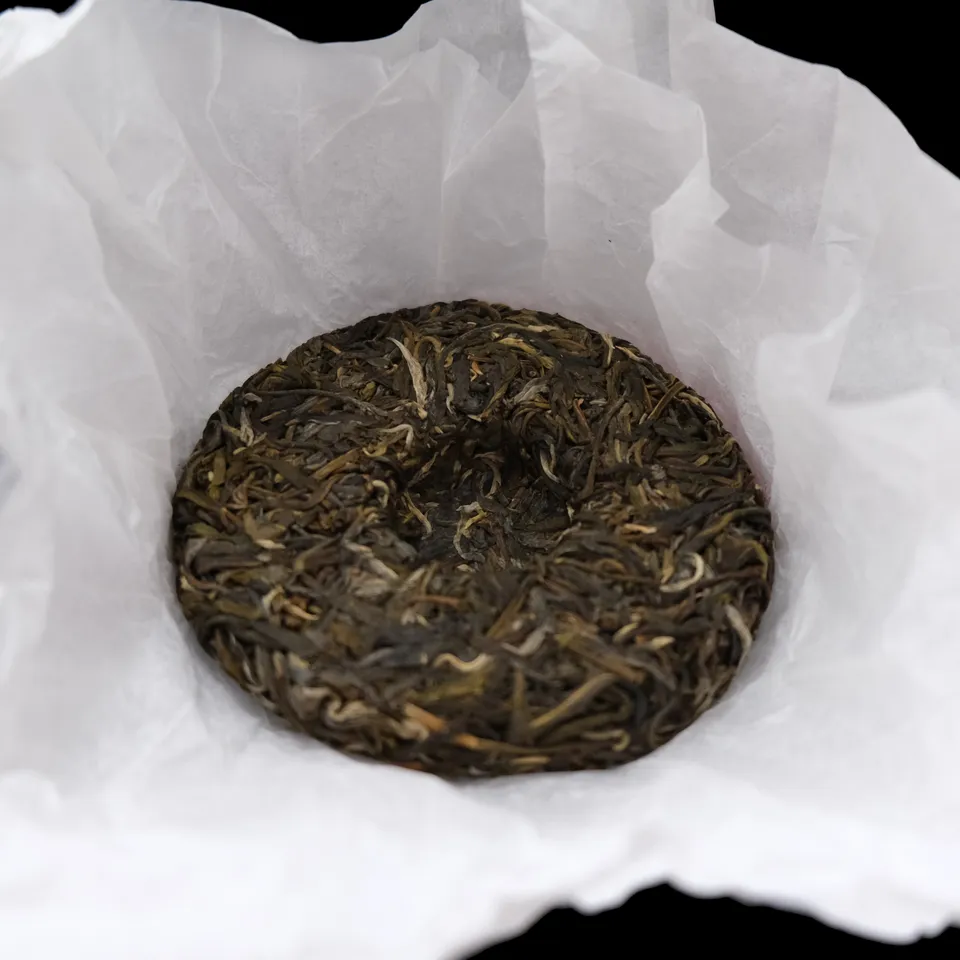
Unwrap the cake on a clean, dry tray or board with enough room around it. Keep the wrapper, any loose label and the product details together. Photograph them if that will help you match the tea to its listing later.
Look for loose leaves, already-separated pieces and visible gaps at the edges. Some material may lift away easily with clean, dry fingers. Start there. There is no advantage in making a harder opening simply because it looks more symmetrical.
Check the condition as well as the shape. If you find suspicious growth, wet patches or evidence that the tea has been contaminated, stop and contact the supplier. Opening it further or making a stronger brew is not a way to resolve uncertainty about its condition.
Arrange the work so a slip has somewhere safe to go
The UK Health and Safety Executive’s kitchen guidance emphasises a suitable tool, a stable surface and secure storage after use.[2] Its broader hand-knife guidance also highlights the danger to the other hand when a tool slips, and recommends working away from the body.[3] These are general safety principles, rather than a tea-specific technique.
For a cake, apply them before making any movement:
- Keep the work at a comfortable height, in good light.
- Give yourself clear space, with cups and other people out of the way.
- Keep your supporting hand and body out of the tool’s possible path.
- Work on the surface, never with the cake held against your palm, lap or chest.
- Stop if the cake slides, the tool bends or the grip feels uncertain.
A purpose-made tea pick or tea knife may be suitable, but the name on the tool does not make every movement safe. Follow its instructions and ask for a demonstration if you are unfamiliar with it. Do not improvise with a kitchen knife simply because it is within reach.
Separate a little at a time
For a cake that you can handle securely, the aim is to release a small section along an existing opening, rather than chop a slice across the whole disc. Inspect the edge for a workable gap and use the tool only in a controlled way that keeps its path clear of your hands.
There is no useful universal insertion depth or angle: cakes differ, and tools differ. If a section resists, withdraw the tool safely and reconsider the position. Do not respond by applying a sudden push or trying to wrench a large piece free.
Once a piece is loose, put the tool down securely before using your fingers to separate it further. Work over the tray so that fragments stay together. You can stop as soon as you have enough for the next session.
This is a cautious editorial approach, not a personally tested method for every cake. A very dense brick or rounded compressed form may need a different technique. If you cannot find a controlled opening, have someone experienced show you using that particular tea and tool.
Portion by weight, then look at the portion
Put a small dish on a scale, zero it and weigh the tea you intend to brew. Follow your chosen brewing method for the amount. A piece’s apparent size is a poor substitute for actually checking its weight.
Notice what the dish contains: loose leaves, small flakes, a dense chunk, fine fragments or a mixture. This is worth recording when you compare sessions. If one day’s portion is mostly crumbs and another is a single solid piece, you have changed more than the number of grams.
Try a simple preparation exercise. Make two dry portions of equal weight from the same cake, aiming for a similar mixture of pieces. Put them in separate labelled containers. The exercise is finished when you can describe both portions clearly. You are practising consistency without needing a new brewing recipe.
You need not discard every broken leaf for cosmetic reasons. Equally, do not insist on adding every last fragment to a portion just to empty the tray. Keep any clean, dry leftovers identified for another session.
Put everything away before boiling the kettle
Return the remaining cake and spare portions to their appropriate dry storage, keeping the tea’s identity with them. Avoid putting a damp scoop, wet fingers or used leaves into the dry supply.
Replace the tool’s protective cover and store it securely.[2] Check that no sharp item is hidden under the wrapper. Clear the tray, then prepare the tea.
A successful opening is an uneventful one: enough tea for your cup, a useful record of the portion and everything safely put away.
Sources
- Zhang, Y., and colleagues. The Microbiome and Metabolites in Fermented Pu-erh Tea as Revealed by High-Throughput Sequencing and Quantitative Multiplex Metabolite Analysis. PLOS ONE, 2016, 11(6), e0157847. Used only for loose and compressed product forms.
- UK Health and Safety Executive. Safe use of knives in the kitchen. General principles for suitable tools, stable surfaces and safe storage.
- UK Health and Safety Executive. Hand knives. General slip-risk, work-area and safe-direction guidance. Neither HSE source prescribes a tea-cake opening method.