A brisk breakfast cup and a delicate, aromatic afternoon tea can both be black tea. The category tells you something important about manufacture, but it leaves plenty of room for different origins, leaf forms and ways of drinking. To explore it well, separate three questions: how was it made, where did it grow, and how do you want to prepare it?
Food & Nutrition · Tea
Black tea: a process with many possible cups
Prepared by Good & Steady · Sources checked
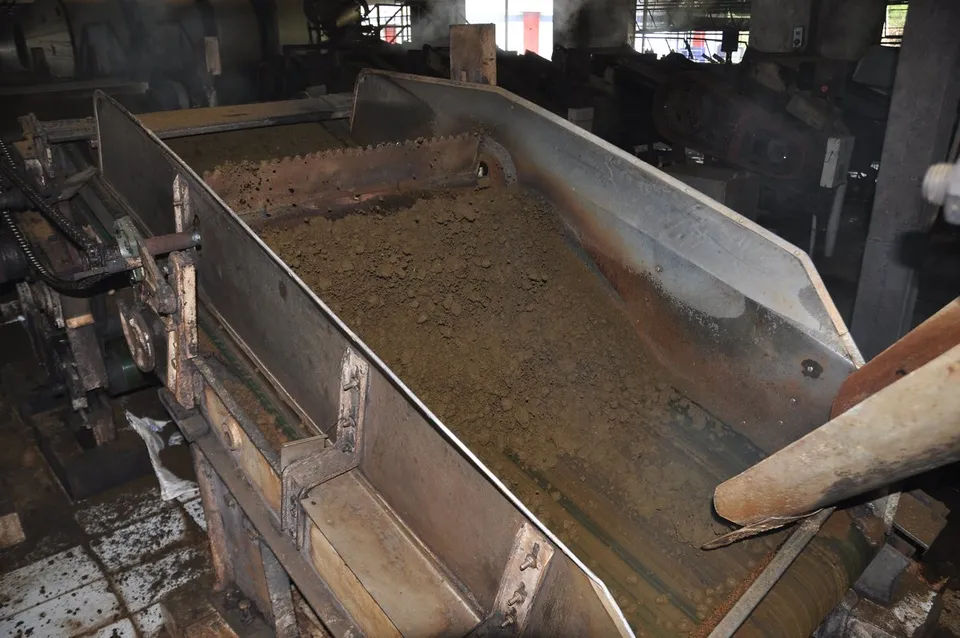
CTC tea at a factory in Kerala, India, in April 2016; process and location identified by the photographer. The image does not establish a commercial grade or document an entire manufacturing sequence.
CTC tea now comes off the line (28760903325) — shankar s.. CC BY 2.0. Proportional resizing and WebP conversion; no crop or retouching. The original licence also applies to these derivatives.
.jpg)
What oxidation does here
Black-tea processing brings the leaf’s enzymes into contact with compounds that were previously separated inside intact cells. In the presence of oxygen, reactions change the leaf’s colour and flavour. Tea Research Association at Tocklai explains that the leaf’s constituents occupy separate compartments until processing allows them to mix. Disrupting the cells intensifies that contact.[1]
You will often see this stage called “fermentation” in tea literature. In this context, the term refers principally to enzymatic oxidation; its appearance does not establish that microorganisms have fermented the tea. UPASI Tea Research Foundation describes these reactions and their use of atmospheric oxygen.[2]
That distinction is more useful than trying to judge oxidation from the cup’s darkness. A deep-coloured infusion also depends on how the particular tea was prepared.
From fresh leaf to finished tea
The broad sequence is withering, rolling or other leaf disruption, oxidation, and drying. Withering reduces moisture and makes the leaf suitable for subsequent work. Rolling breaks cells; the oxidation stage is managed to develop the intended character. Drying then arrests the process and produces a more stable finished tea.[2]
This is an outline, not a factory timetable. The Sri Lanka Tea Board emphasises that timing depends on the incoming leaf and processing conditions.[3] A fixed instruction such as “all black tea oxidises for two hours” would hide the decisions that tea makers actually have to make.
Orthodox, broken and CTC
Orthodox manufacture uses rolling that twists and disrupts the leaf. CTC, commonly expanded as crush, tear and curl, uses toothed rollers for much more extensive maceration.[2] These are production approaches; neither word tells you by itself whether a particular cup will suit you.
Orthodox processing can yield both leafy and broken grades. The Sri Lanka Tea Board’s product specification distinguishes orthodox, orthodox-rotorvane and CTC routes, with different resulting leaf forms.[4] “Orthodox” therefore does not guarantee an entirely unbroken leaf.
“Loose leaf” answers a packaging question. A packet of loose CTC granules is still loose tea. Similarly, a tea bag’s contents cannot be identified as CTC merely from the bag. When shopping, look for the actual leaf or manufacturing description rather than using the package as a shortcut.
Smaller, more fragmented material can make a quickly developing infusion; the Sri Lanka Tea Board specifically describes that behaviour for CTC.[3] If a sample tastes too forceful, reconsider how you brewed it before deciding that the entire method is uninteresting.
Use origin to choose a direction
Tea Board India describes Assam through its full body and malty, brisk character, and confirms that both orthodox and CTC teas are made there.[5] That makes Assam a useful place to compare processing approaches without immediately changing to a different region.
Darjeeling opens another direction. Tea Board India’s description encompasses infusions from pale lemon to rich amber, with considerable variation in body and aroma.[6] The word “black” is plainly not a requirement for every cup to look dark brown.
Sri Lankan teas, sold under the Ceylon name, add another origin and a substantial range of manufactured forms.[4] Rather than asking which region is best, choose the contrast you want to investigate: a different origin, a different leaf form, or a different harvest from a producer you already know. Changing everything at once makes a memorable tasting harder to interpret.
A tasting that separates character from strength
Choose three unflavoured black teas with clear identities. Ideally, give the set a purpose: three origins with similar leaf sizes, or three leaf forms from one region. Keep the packaging beside your notebook so that observations remain attached to the correct sample.
Prepare each using its own supplier’s directions for a first encounter. Record leaf weight, water volume, temperature and time. Use the same water throughout, strain fully, and let the cups cool enough to taste comfortably. This first round asks what each sample offers when prepared as suggested; it is not a controlled experiment isolating origin.
For each cup, write three separate observations:
- Aroma: what do you notice before and after sipping?
- Texture: does the drink feel light, rounded, drying or something else?
- Finish: what remains once you have swallowed?
Then add the most important note: would you like it stronger, gentler, or much as it is? For the next session, change one brewing variable for one sample. If you usually take milk, try an equal small addition to separate portions and record the result.
A useful black-tea collection need not demonstrate a hierarchy. It can contain different tools for different cups: something expressive on its own, something satisfying with milk, and something whose details reward another careful brew.
Sources
[1] Tea Research Association, Tocklai, Tea manufacture, chemical composition and cellular changes.
[2] UPASI Tea Research Foundation, Tea manufacturing.
[3] Sri Lanka Tea Board, Manufacturing.
[4] Sri Lanka Tea Board, Ceylon tea product specification, sections 3.1.2 and 4.4.1.
[5] Tea Board India, Assam.
[6] Tea Board India, Darjeeling.