A useful brewing method gives you a cup you enjoy and enough information to make it again. Start with the tea you have, measure a few things and change one variable at a time.
Food & Nutrition · Tea
Brew a cup of tea you can repeat
Prepared by Good & Steady · Sources checked
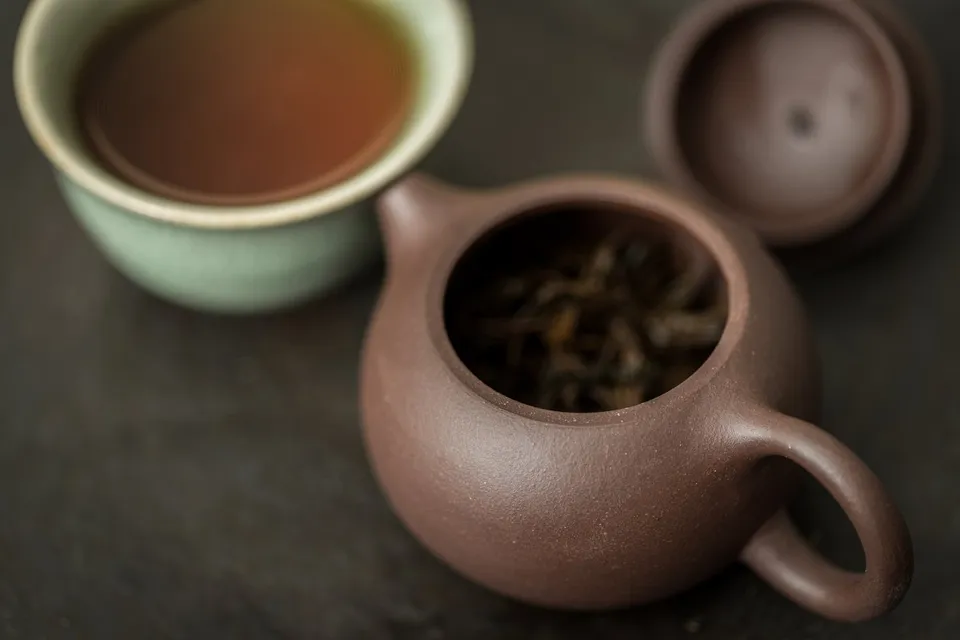
A teapot and cup; the photographer identifies the tea as Lapsang. Used here for general brewing context.
Yixing ware teapot and Lapsang tea — Markus Kniebes. CC0 1.0. Proportional resizing and WebP conversion; no crop or retouching. The original licence also applies to these derivatives.

Begin with the leaf and the vessel
The name of a tea is a starting point, not a complete brewing recipe. A tightly rolled oolong, a loose twisted leaf and a broken piece from a compressed cake behave differently in a pot. Tea-aroma research has tested how brewing time, temperature, leaf size and water hardness change what reaches the cup. In that green-tea experiment, broken leaves released aroma compounds faster than whole leaves early in brewing. [1]
Choose one tea and one vessel for your first few attempts. A mug with a removable basket infuser is enough. The basket should let you remove the leaves without needing to pour hot water through a complicated arrangement. A small pot with a comfortable handle is another option.
Measure the amount of water you actually use. A mug that holds 350 ml to the brim might be comfortable to brew in with 250 ml. Write down the working amount. Keep a little space at the top, especially when pouring or removing an infuser.
A small scale is useful because a spoonful of tightly rolled leaves and a spoonful of large twisted leaves can represent different amounts of tea. If you do not have a scale, use the same spoon and the same filling method for the same product. That is still more repeatable than an unrecorded handful.
Four things to record
You do not need a laboratory notebook. Put these four details beside the tea’s name:
- Dry leaf amount in grams, or your consistent spoon measure
- Water volume in millilitres
- Water temperature or the preparation instruction you followed
- Infusion time, including when you started counting
For timing, choose a convention and keep it. In a mug, starting when the water first touches the leaf is easy. In a very small pot, the time spent filling and emptying can form a noticeable part of the infusion. Note a slow pour if it changes your results.
The relationship between leaf and water is particularly helpful when changing vessels. If your method uses 3 g in 250 ml, keeping the same ratio in 500 ml means using 6 g. This is simple scaling, not a promise of an identical cup: a larger pot may retain heat differently and take longer to empty.
Try a modest starting recipe
The maker’s directions are the best first reference for an identified product. If you have a plain, whole-leaf oolong without directions, the following is an editorial starting experiment for mug brewing:
- Put 3 g of tea into a removable basket in a heat-safe mug.
- Add 250 ml of drinking water at about 90°C / 194°F.
- Infuse for two minutes, timed from the start of pouring.
- Remove the basket fully and let the drink cool to a comfortable tasting temperature.
- Write one sentence about what you would keep or change.
These numbers are deliberately a starting point, not a tested optimum for every oolong. A particular roast, leaf form or preference may call for a different method. Do not transfer this short, cooler recipe to dried herbal or fruit infusions: their preparation instructions can serve a hygiene purpose. BfR recommends rolling-boil water and at least five minutes for herbal infusions. [2]
Keep the kettle and cup on a stable surface, use a vessel designed for hot water and leave enough room to handle it comfortably. Brewing temperature is not drinking temperature.
Adjust the cup rather than chasing a chart
Ask a specific question after tasting. “Too strong” may mean that the whole cup is concentrated, that a bitter taste dominates, or that the finish is unpleasantly drying. “Too weak” may mean that the aroma is faint even though the cup has enough body. Those are different observations and may benefit from different experiments.
For the oolong starting recipe, try one of these next steps:
- If the cup is more intense than you want, try less leaf with the same water, temperature and time.
- If you want to see what a shorter infusion changes, keep the other settings and try 90 seconds instead of two minutes.
- If the cup seems faint, compare it with a new brew using a little more leaf, or a longer time. Choose one change, not both.
- If the taste is satisfactory but the aroma feels muted, explore temperature on a later attempt while keeping the other details fixed.
These are ways to investigate your preference, not guarantees. You can also dilute an already brewed cup with a little drinking water to see whether concentration is the problem. That cannot reverse everything that happened during brewing, but it may help you choose the next experiment.
Keep water steady for the first attempts
Water can change a tea’s appearance, extraction and sensory balance. Controlled studies have produced different preference results with different waters and teas, so neither “tap” nor “bottled” is a universal answer.[3, 4]
Use the same suitable drinking water while you learn how your leaf responds to time and temperature. Later, compare two waters with everything else unchanged. Record which cup you prefer rather than treating a mineral number or a clearer appearance as a quality score.
A small pot is a different method
Short repeated infusions are another way to explore tea. They often use a smaller vessel and more leaf relative to water than a mug method. For the exercise below, a separate serving vessel is a practical way to collect an infusion before dividing it among cups. This is an editorial suggestion, not a required equipment list for every tea drinker.
If you want to try it, use a small handled pot you can empty comfortably and begin with the supplier’s short-infusion directions. A gaiwan can also be used, but practise its grip and pour with cool water first. Choose a different vessel if handling the bowl and lid feels insecure.
Pour each infusion out completely into another heat-safe vessel before sharing it. Otherwise, leaves left standing in water continue steeping while the first person drinks. Record later infusions separately; the same leaves are changing as the session progresses.
Do not combine the high leaf loading of a short-infusion method with the long time of a mug recipe by accident. When comparing advice, check the leaf-to-water ratio as carefully as the number of seconds.
Keep one useful line
Standardized sensory tests and everyday preferences answer different questions. ISO 3103 specifies a method for preparing tea for sensory tests. Its purpose is consistent assessment; it does not select your favorite everyday cup. [5]
Your own short record can be much simpler:
Tea and batch | leaf | water | temperature | time | what changed | would brew again
Once you have a method you like, stop adjusting it for a while. The point of keeping a record is that an enjoyable cup becomes easy to repeat.
Sources
- Sánchez-López and colleagues. Extraction kinetics of tea aroma compounds as a function brewing temperature, leaf size and water hardness. Flavour and Fragrance Journal, 2020. Controlled extraction study; not a universal recipe.
- German Federal Institute for Risk Assessment. Boiling water a must for herbal teas. Published 2005; checked 16 October 2026.
- Franks and colleagues. The Influence of Water Composition on Flavor and Nutrient Extraction in Green and Black Tea. Nutrients, 2019, 11(1), 80. Sensory findings only; no health-benefit inference adopted.
- Cao and colleagues. Effects of brewing water on the sensory attributes and physicochemical properties of tea infusions. Food Chemistry, 2021, 364, 130235.
- International Organization for Standardization. ISO 3103:2019, Tea - Preparation of liquor for use in sensory tests. Public abstract and status; confirmed in 2025. The full paid standard was not obtained or reproduced.