Start with Wuyi rock tea
Da Hong Pao belongs to the Wuyi rock-tea tradition of northwestern Fujian, China. The Chinese term yancha means rock tea. Its home and its making belong together: the official heritage description connects Wuyi’s growing environment with a detailed sequence of withering, working the leaves, heating, rolling and drying.[1]
That context matters when looking at a bag of dark, twisted leaves. Da Hong Pao is an oolong. The appearance of the finished leaf does not, by itself, tell you its processing history. Nor does a dark infusion explain how much of the character comes from the raw material and how much from later roasting.
You may encounter yanyun, often translated as rock rhyme or rock resonance. It is a traditional quality description associated with Wuyi tea.[4] Treat it as an invitation to pay attention to the whole cup. Try writing down aroma, texture and the taste that remains after swallowing before deciding whether that word helps you. A sensory impression cannot verify a garden’s address.
Separate the bushes from the product
Three distinctions make the label more useful.
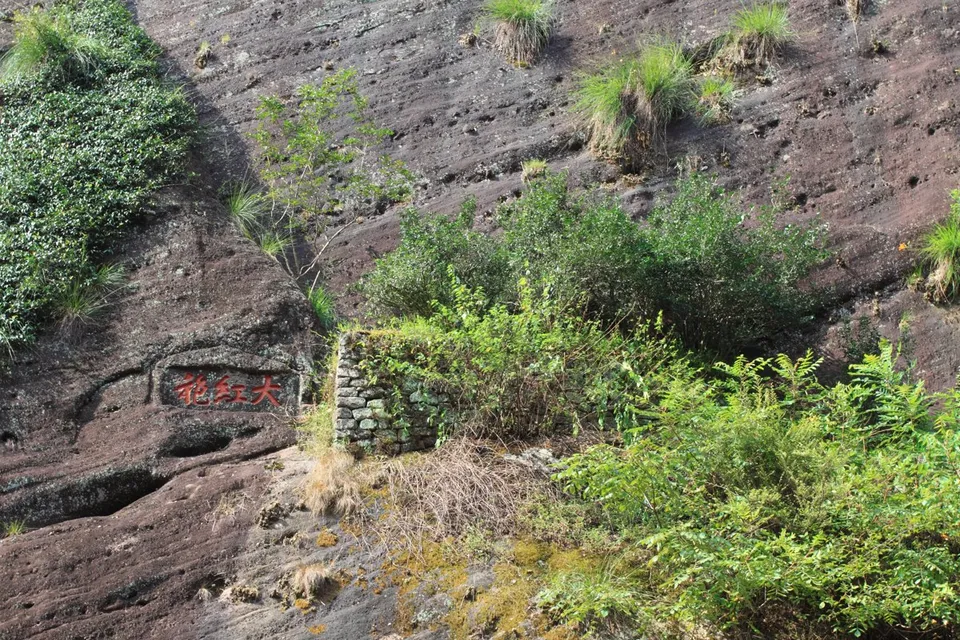
The protected mother bushes. These are the famous plants at Jiulongke in Wuyishan. The National Museum of China records that the local government stopped their commercial harvesting in May 2006 for protection.[2] A contemporary tea described simply as Da Hong Pao should not lead you to imagine that it was recently picked from those bushes. A claim of historical mother-bush material would need its own unusually strong documentation.
Named cultivar material. A cultivar is a cultivated plant selection. Qidan is an important name here: researchers describe Qidan as a pure-cultivar Da Hong Pao and study tea made from it as a defined material.[3] That gives “Qidan” a more specific botanical meaning than a generic product name. It still does not establish the origin or quality of an individual packet. Ask the seller whether the tea is entirely that cultivar and where it was grown.
A commercial blend. Regional reporting describes Da Hong Pao as both a cultivar name and a commercial name, including blends made to a producer’s intended style.[4] A blend is a legitimate thing to buy. Its value can lie in how well the components work together. You can judge it on clarity of description, consistency and enjoyment, without requiring it to imitate a historical rarity.
“Pure” can be a particularly slippery word. Ask whether it means a named cultivar, one production lot or something else. If a discussion introduces another name, such as Beidou, get the material identified rather than treating every name attached to the Da Hong Pao story as interchangeable. A family-tree claim and a finished-tea description answer different questions.
Keep the stories in their proper place
The familiar English rendering of Da Hong Pao is Big Red Robe. Stories explaining the name include a grateful scholar draping a robe over tea bushes and monkeys gathering tea from cliffs. A government-hosted cultural account presents these as competing traditions.[5]
They are enjoyable stories to tell over tea. They are poor evidence for a packet’s contents. The scholar story also includes healing, which should remain part of the legend rather than become a promise about the drink.
Give roasting its share of the credit
Roasting changes aroma, rather than simply turning up a single “roasted” flavor. In a study of Da Hong Pao roasted for different lengths of time, the researchers found that grassy character diminished while floral and fruity characteristics became more prominent under the conditions they tested.[6] A separate Qidan study tracked changes in aroma compounds and their precursors through roasting.[3]
Those results support a useful buying question: how was this particular tea finished? They do not supply a universal rule that longer roasting always produces a better tea. The starting leaves, temperature and handling belong to the explanation too.
When tasting, try separating strength from balance. You might enjoy an obvious toasted aroma, or prefer flowers and fruit to be easier to notice. Ask whether the first impression continues pleasantly through the cup. If a seller uses “light”, “medium” or “heavy” roast, treat that as a starting description and ask how it applies to this batch.
Try a simple brewing comparison
This is an editorial starting exercise, not a personally tested recipe or a universal optimum. It is intended for an ordinary loose-leaf Da Hong Pao sample; adjust it to the tea and your equipment.
Use a small teapot or a roomy infuser in a mug. Start with 3 grams of leaf and 150 millilitres of water at about 95°C. Infuse for 90 seconds, then separate the liquor from the leaves completely. Let a sip cool enough to taste comfortably.
Write three short observations: the first aroma you notice, how the tea feels in your mouth, and what remains after swallowing. Everyday words are enough. “Drying”, “rounded” or “toast” can be more useful than a borrowed tasting note you cannot actually recognize.
For a second, fresh portion, keep the leaf, water and temperature the same but shorten the infusion to 60 seconds. Compare the cups at a similar drinking temperature. Which is easier to enjoy? Which makes the flavor clearer? Change only the timing so that the comparison answers something.
After that, reuse the leaves from your preferred cup, extending later infusions as needed. Stop when the result is no longer interesting. There is no prize for reaching someone else’s infusion count.
What to take to the tea shop
Ask for a small sample with a stated growing origin, a clear description of cultivar or blend, and some information about the roast. Save the packet and your brewing notes so you can ask for the same batch again.
Sources
[1] China Intangible Cultural Heritage Network, “Wuyi rock tea making techniques”. Official description of the regional craft. https://www.ihchina.cn/project_details/14373/
[2] National Museum of China, report on the donation of Da Hong Pao mother-bush tea, 10 October 2007. https://m.chnmuseum.cn/fw/zx_1010/gbxw/200710/t20071010_1014.shtml
[3] Duan, Y. and colleagues, “Dynamic Changes of Aroma Compounds and Their Precursors During the Roasting Process of Qidan Variety Wuyi Rock Tea”, Food Science, 2025. https://www.spkx.net.cn/article/2025/1002-6630/2025-46-23-007.html
[4] Pei Lihui, Minbei Daily, “Blending brings Da Hong Pao into everyday homes”, 27 February 2025. Regional reporting on commercial naming and blending. https://mbrb.greatwuyi.com/pc/content/202502/27/content_119555.html
[5] Wu Yilong, “A cup of tea among remarkable mountains and waters”, People’s Daily, reproduced on a government cultural page, 21 March 2024. Used only for the existence of the legends. https://www.kflz.gov.cn/sitesources/nysjwjw/page_pc/xcjd/wh/article512bda44251b4156991617aeaa6a7576.html
[6] Xie, H. and colleagues, “Effects of Different Charcoal Baking Times on the Sensory Quality and Volatile Compounds of Dahongpao”, Journal of Tea Science 44(6), 2024, pp. 960–972. https://www.tea-science.com/CN/10.13305/j.cnki.jts.2024.06.011