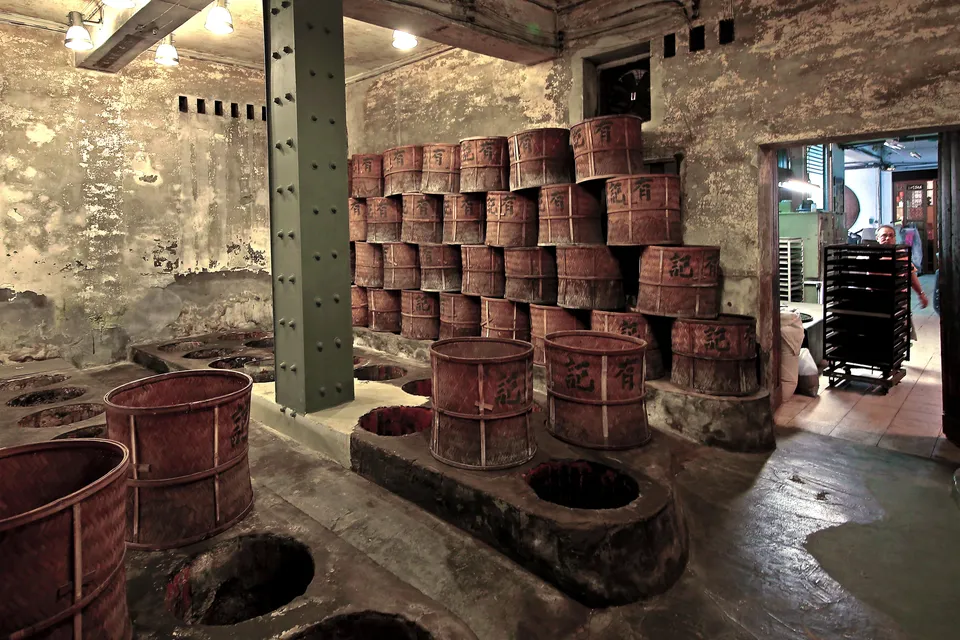
Start a note with three headings: cultivar or material, oxidation, and roast. Copy what the seller actually states under each. Leave a blank where the information is missing.
A cultivar name identifies the cultivated plant material. Oxidation concerns changes managed while the leaves are being processed. Roast concerns a heat treatment, whose place in the production history matters. Taiwan’s official processing account distinguishes fixation, drying and roasting as separate operations with different purposes.[1]
The distinction is visible in experimental work. In a Tieguanyin study, tea made from the same fresh material received the same earlier processing, while the final roasting treatment varied.[2] The roast was a variable that could be changed without starting with a different named tea.
When a listing says only “light”, ask which heading it belongs under. A lightly roasted tea, a lightly oxidised tea and a cup you find light in flavour are three different descriptions.
Aroma does not move along a single scale
In the Tieguanyin experiment, longer roasting reduced the panel’s floral-aroma scores and increased roasted-aroma scores. A higher-temperature finishing treatment intensified the changes.[2]
A separate study of Da Hong Pao found a different pattern within its tested charcoal-baking conditions: grassy character diminished and floral-fruity character became more prominent as baking continued.[3]
Together, these findings are a reason to ask about the particular tea. They do not support a rule that roasting always removes flowers, always creates sweetness or always improves quality. The starting material and the treatment belong in the explanation.
At home, use ordinary aroma words before reaching for a verdict. Toasted bread, nuts, fruit, flowers and wood can be useful prompts, provided you only record what you actually notice. “I cannot separate these aromas yet” is a useful observation too.
Ask what the roast label means for this batch
You do not need every minute of a producer’s heat programme. A few details make a comparison much easier:
- Is the roast description the producer’s wording or the retailer’s interpretation?
- Is this the initial finished tea, or has it received a later roast?
- When was the most recent roast?
- Is another roast level available from the same starting batch?
- What difference does the maker intend you to notice?
Treat “charcoal roasted” as a description to investigate rather than an automatic ranking. Ask about the maker and the batch. Likewise, a smoky impression in the cup is something to describe; it is not, by itself, a complete record of how the tea was heated.
If the seller offers two different teas as a light-versus-heavy comparison, note all the other differences. Different cultivars, harvests, origins or storage histories make an interesting tasting, but they make it harder to attribute the result to roast alone.
Make a roast comparison with a narrow question
The cleanest practical comparison is two roast treatments of the same starting tea, if a producer can supply them. Otherwise, choose two clearly identified samples and be honest about the differences. This is an editorial tasting exercise, not a laboratory test or a personally tested recipe.
Use a brewing method you already handle comfortably. For the first comparison, keep the water, vessels, leaf weight and timing the same and write them down. That gives you a starting comparison; it does not guarantee that both teas are at their best.
Before looking at the supplier’s tasting notes, write three short lines for each cup:
- First aroma: what is easiest to notice?
- Balance: does that impression leave room for other aromas and tastes?
- Finish: what remains, and do you want another sip?
Let both cups cool to a comfortable drinking temperature before tasting. Revisit them as they cool further. If you use repeated infusions, compare corresponding infusions rather than one tea’s first cup with the other’s third.
On a later session, adjust each tea to your preference. If one cup seemed too concentrated, explore a gentler extraction before concluding that its roast is the problem. Keep a difference you observed separate from the reason you think it happened.
Resting is a question for the particular tea
If a maker recommends waiting after roasting, ask for a batch-specific explanation and storage instructions. Neither of the experiments above establishes a compulsory resting period for every oolong.[2,3] A fixed number of weeks cannot account for every starting tea and finishing treatment.
You can make a modest observation of your own: record the opening date, keep the remaining tea under the recommended conditions, and taste it again later using the same method. Describe the change without assuming it proves a universal ageing rule. Do not leave the packet open in a humid room to hurry the process along.
Buy the description you can use again
Keep the batch, the latest roast date if known and one plain sentence about your preference. “I liked the toasted aroma but preferred a shorter first infusion” is more useful for the next order than “heavy roast is best”.
The aim is to recognise how a particular roast contributes to a particular tea. That leaves room for both a dependable favourite and a sample that changes your mind.
Sources
- Taiwan Ministry of Agriculture, Tea and Beverage Research Station. Introduction to Taiwanese specialty tea classification and processing. Official account, updated 17 October 2024; used for the distinction between fixation, drying and roasting.
- Cao, Q.-Q., and colleagues. Sensory and chemical characteristics of Tieguanyin oolong tea after roasting. Food Chemistry: X, 2021, 12, 100178. Controlled roasting treatments and sensory results, especially sections 2.1 and 3.1.
- Xie, H., and colleagues. Effects of Different Charcoal Baking Times on the Sensory Quality and Volatile Compounds of Dahongpao. Journal of Tea Science, 2024, 44(6), 960–972. Public English and Chinese abstracts; findings confined to the tested treatments.