How the flat leaf is made
The finished shape comes from processing. The Longjing Cha product specification published by the UK government describes an initial spreading or slight-withering stage, an initial pan-processing stage called qingguo, a resting stage, and further pan-processing called huiguo. It permits suitable machinery as well as traditional manual methods.[2]
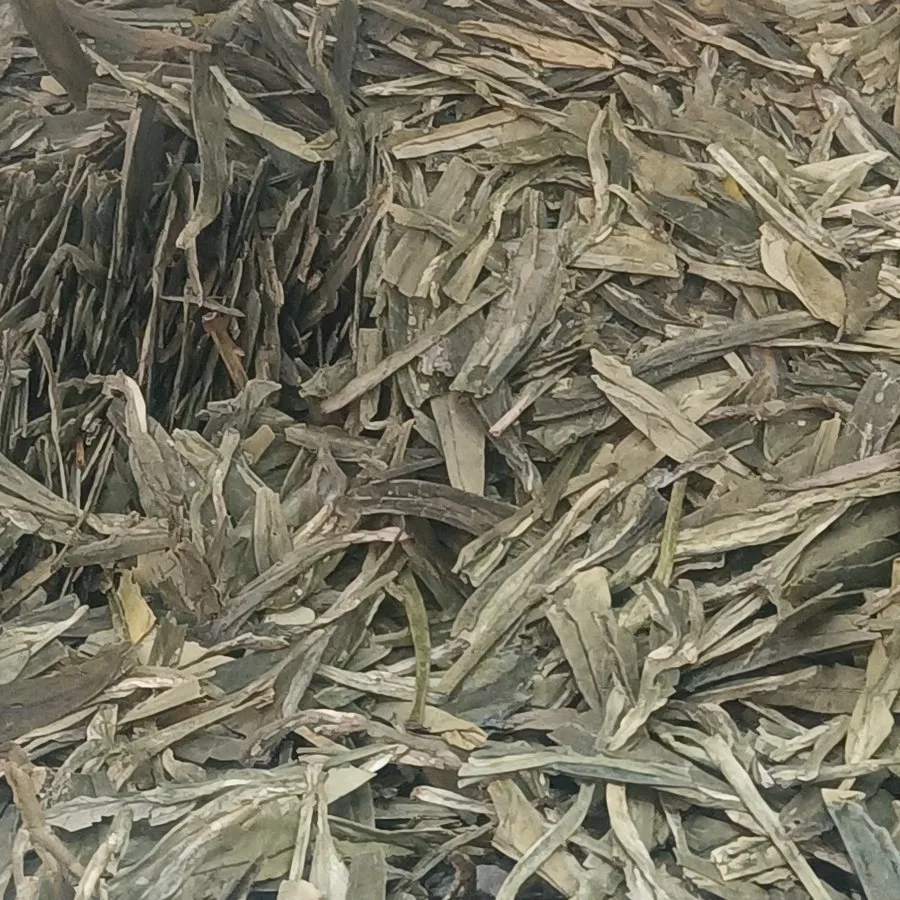
Hand processing involves a repertoire of movements rather than simply stirring a pan. At a 2024 tea-frying competition in Hangzhou’s Xihu district, the official city report described techniques that included shaking, tossing and pressing in iron woks.[3] Looking at finished leaves can help you appreciate that shaping work; it cannot tell you with certainty which person or machine performed it.
When a seller says “handmade”, ask what that means for this batch. Were all pan stages done by hand? Was machine processing followed by hand finishing? A clear answer is more informative than an image of somebody standing beside a wok. Mechanisation alone is not a verdict on whether you will enjoy the tea.
Longjing and West Lake Longjing
The product specification identifies three designated growing regions: Xihu, also known as West Lake; Qiantang; and Yuezhou. Its definition is tied to geography, plant material and production requirements.[2] West Lake is a more specific origin claim than the broad Longjing name.
This is worth slowing down over on a shop page. “Packed in Hangzhou”, “bought in Hangzhou” and “grown in the West Lake production area” describe different things. Likewise, a cultivar name describes plant material; it does not establish the location of the garden. Hangzhou’s 2025 harvest report, for example, identifies Longjing 43 as the variety being picked in a particular West Lake village.[1] The cultivar and the place are separate pieces of information.
China’s national standards platform currently lists GB/T 18650-2008, “Product of geographical indication — Longjing tea”, as active, with a 2025 review confirming continued validity.[4] The existence of a standard does not verify an individual retail packet. For that, the information must connect to the actual product being sold.
Description is not proof of origin
A useful product description might tell you the tea has flat leaves, a spring harvest and a fresh aroma. Evidence of a protected origin concerns the supplier, production location and traceable batch.
Hangzhou’s explanation of its West Lake Longjing protection system describes a specialised label carrying information about origin, varieties, picking and processing.[5] The broader Longjing specification also describes plantation certificates and purchasing records.[2] These are examples of the documentary chain behind an origin claim, rather than a promise that every sticker or QR code is genuine.
If you are paying a substantial premium for a specific place, ask the seller:
- What is the stated growing area for this batch?
- Who produced or supplied it, and can that information be traced?
- What harvest year and date range are being claimed?
- What origin label or supporting record belongs to the packet I would receive?
- Does “handmade” cover the complete process or a named stage?
You do not need to become an inspector to buy tea. You need enough information to understand what the price is asking you to believe. If a shop can discuss flavour but cannot support its precise geographical claim, keep those two conclusions separate.
A practical label-and-cup exercise
Before brewing a new Longjing, divide a page into three short lists: “seller states”, “I can observe” and “still unknown”. Put the claimed region and harvest into the first. Record the dry leaf’s shape, colour and degree of breakage in the second. Leave the third available for anything the packaging does not establish.
Then brew using the supplier’s directions for that sample, recording the leaf weight and water volume as well as temperature and time. Decant into a separate cup if you want to examine a particular infusion. If you drink directly from a glass containing the leaves, note that the contact time continues as you sip.
Describe the aroma and finish in your own words. You might notice a food association, a particular texture, or simply that you would prefer a shorter infusion next time. There is no need to force the cup into a familiar list of Longjing adjectives.
Finally, inspect the opened leaves. Their appearance can add detail to your tasting notes, but keep the growing location in the evidence column where it belongs. A beautiful leaf and an enjoyable cup are worthwhile discoveries. A well-supported origin claim is a separate one.
Sources
[1] Information Office of Hangzhou Municipal People’s Government, West Lake Longjing tea picking season begins, 17 March 2025.
[2] UK government-hosted Product Specification on Longjing Cha, especially sections 2–5.
[3] Information Office of Hangzhou Municipal People’s Government, Younger generation flocks to West Lake Longjing Tea competition, 28 March 2024.
[4] National Public Service Platform for Standards Information, GB/T 18650-2008: Product of geographical indication — Longjing tea. Status checked 16 October 2026.
[5] Information Office of Hangzhou Municipal People’s Government, Protection regulations on West Lake Longjing Tea to take effect on March 1, 21 January 2022.
.jpg)