A name on a tea packet can belong to the grower, a factory, an exporter, a blender or the shop selling it. Sometimes one business performs several of those jobs.
Understanding those roles makes a supplier’s story easier to read.
Food & Nutrition · Tea
Prepared by Good & Steady · Sources checked
A name on a tea packet can belong to the grower, a factory, an exporter, a blender or the shop selling it. Sometimes one business performs several of those jobs.
Understanding those roles makes a supplier’s story easier to read.
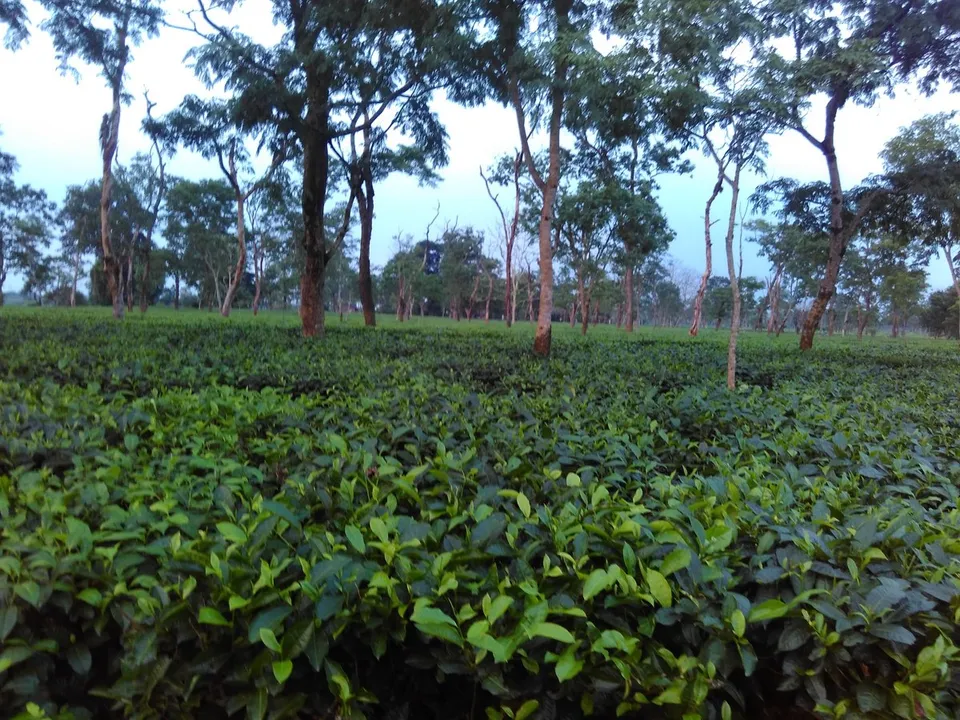
A tea garden in Assam, photographed in 2017. No estate name is supplied, and this scene does not document Good & Steady’s suppliers.
Assam's Tea Garden — Vespers 77. CC BY-SA 4.0. Proportional resizing and WebP conversion; no crop or retouching. The original licence also applies to these derivatives.
The grower manages the plants and the harvest. The processor turns fresh leaf into finished tea. Those roles can be combined on an estate, but a small grower may supply leaf to a separate factory. FAO’s research on India and Indonesia documents connections between smallholders, leaf agents and processing businesses. [1]
A leaf buyer or collector can sit between them, gathering fresh leaf and arranging its movement to a processor. That is different from a buyer selecting already-finished tea for a shop or blend. When someone says “we buy the leaf,” it is reasonable to ask which material they mean.
At a black-tea factory, work can include withering, rolling or other leaf disruption, oxidation, drying and sorting. Sri Lanka Tea Board describes these as distinct stages, followed by bulk packing. [2] A factory name therefore identifies important work, but does not by itself identify every farm that supplied a batch.
After processing, tea may be sold through an auction, a private trading relationship or a producer’s own sales operation. An FAO case study of Darjeeling describes several distribution channels rather than one fixed path, including producer-processors, brokers, traders, exporters and downstream sellers. It also records producers arranging processing with neighbouring estates. [3]
These are examples of possible structures, not a current map of every supplier. A named origin does not reveal the complete chain.
A blender selects and combines finished teas for an intended result. The components may come from different lots, seasons or origins, depending on the product. A packer puts tea into the format that is sold or shipped. An exporter organizes the business of selling and moving it to an overseas market. The retailer presents it to the final customer. FAO’s value-chain discussion treats blending and packing as activities beyond primary tea manufacture. [4]
An importer or distributor may also stand between exporter and retailer. A retail brand does not need to grow tea to do useful work; it should be able to explain the work it actually does.
Our editorial reading of “direct” is to treat it as an unfinished description. Direct from whom, to whom, and for which tea? A retailer buying from a factory is describing a different relationship from a grower selling a finished product from an on-site workshop.
Ask for that relationship in ordinary language. A short answer such as “we buy this lot from the processor, which takes leaf from several nearby growers” can be more informative than a dramatic story with no named role.
It is also unwise to infer payment or working conditions solely from the number of intermediaries. Fewer steps do not tell you what growers or workers receive. A longer chain does not establish unfairness by itself. Claims about those matters need their own evidence; a beautiful landscape and a retail price cannot supply it.
For a tea you are considering, start with these practical questions. They are an editorial checklist, not a demand that every small purchase come with a dossier.
Begin with the question most relevant to your purchase.
Take one packet and its product page. Write a line for growing, processing, blending, packing and selling. Under each, enter the named business or “not stated.” Add the lot reference and where each answer came from.
Keep three categories distinct: a fact printed on the packet, an explanation supplied by the seller, and your own inference. If a question remains unanswered, say so. Missing information is a limitation in what you know, not automatic evidence of wrongdoing.
That little record makes future purchases easier. It helps you identify a repeat purchase or changed blend and describe the tea accurately. The point is to see the work behind the packet more clearly, one answer at a time.
