Sencha, gyokuro and matcha often sit together on a shop shelf, but they answer different preparation questions. Two arrive as leaves that you infuse and strain. The third arrives as a powder that you mix into the drink. Before comparing tasting notes or prices, it helps to follow those different routes through the field, factory and kitchen.
Food & Nutrition · Tea
Sencha, gyokuro and matcha: three routes from leaf to cup
Prepared by Good & Steady · Sources checked
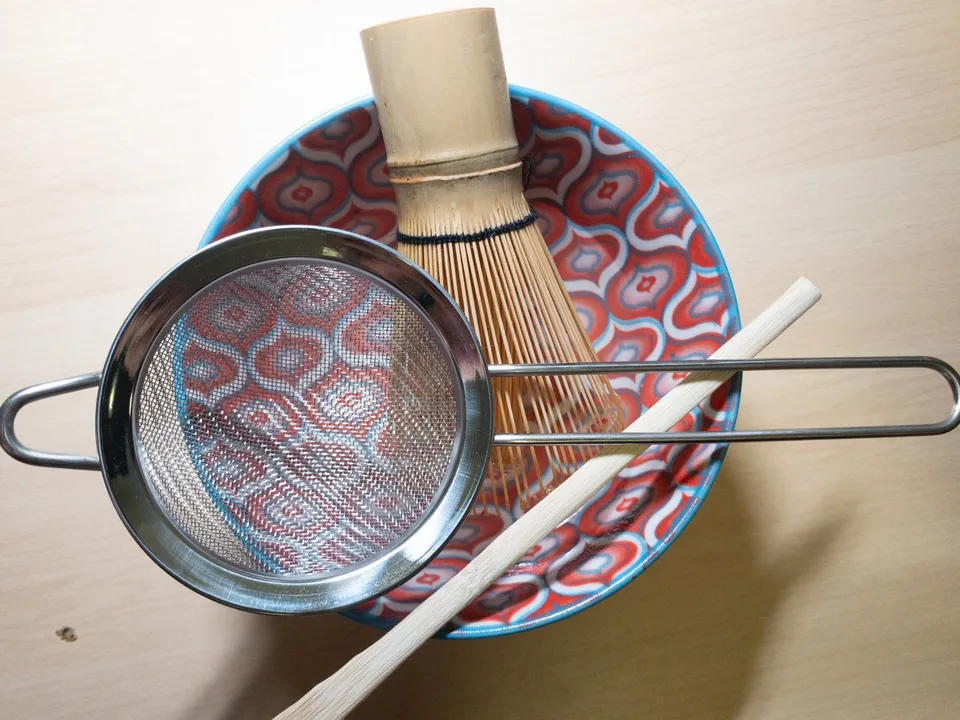
Tools for preparing matcha, identified by the photographer. Equipment context rather than evidence about a particular tea or producer.
Tools to make matcha — Akp1435. CC BY 4.0. Proportional resizing and WebP conversion; no crop or retouching. The original licence also applies to these derivatives.

Sencha: steamed, rolled and dried
Japan’s Ministry of Agriculture, Forestry and Fisheries describes sencha through its basic sequence: new shoots are steamed, rolled and dried.[1] In the Kyoto Prefectural Tea Industry Chamber’s manufacturing account, successive stages work moisture through the leaf and progressively shape it, including a stage that forms slender needles.[2]
Sencha is often introduced as sun-grown tea. That is a helpful broad contrast with gyokuro, but “sencha is never shaded” is too rigid. The Kyoto chamber notes that some sencha receives short periods of covering. It also distinguishes deeply steamed sencha, showing that the category contains variations in manufacture as well as cultivation.[3]
For shopping, the useful consequence is simple: ask what this sencha is. A producer, cultivar, harvest and steaming description offer more to work with than an elaborate name alone. You do not need every detail to enjoy a packet, but the details make a good cup easier to find again.
Gyokuro: shading changes the starting material
Gyokuro’s distinguishing cultivation step happens before picking, when the plants are covered to restrict direct sunlight. MAFF describes a covering period of approximately twenty days, followed by steaming, rolling and drying.[1] Treat that duration as a description of the method, rather than a universal timer that lets you classify any unfamiliar tea by counting days.
The leaf is still prepared for infusion. Gyokuro does not become matcha simply because both involve shading. Its production follows the rolled-leaf route, whereas the raw material for matcha follows a different drying route.[1]
It is also worth separating concentration from serving size. The Kyoto chamber’s gyokuro guidance uses small quantities of water and a cooler preparation than its sencha guidance.[4] That gives the drink a different context from a large mug. If you order gyokuro expecting the same volume and strength as your usual tea, the contrast may be confusing before you have tasted anything.
Matcha begins with tencha
Tencha is the leaf material used to make matcha. MAFF describes leaves from covered tea fields being steamed and dried without rolling, then milled to a fine powder.[1] In the Kyoto production account, the leaves are spread and dried open, and stems are separated during processing.[2] This is a distinct manufacturing path, not simply an extra grinding step added to finished sencha.
The Kyoto chamber’s definitions explicitly distinguish powdered tencha, called matcha, from other powdered teas. It also explains that modern grinding equipment can produce matcha; a traditional stone mill is not the only equipment covered by its definition.[3] “Stone-ground” may describe a particular product, but the absence of those words does not settle what the powder is.
Read the ingredient list as well as the front label. A sweetened matcha drink mix, a blend containing matcha and a packet of pure matcha are different purchases. They may all suit somebody’s kitchen, but the preparation instructions and amount of actual tea will differ.
Infusing leaves and whisking powder
With sencha and gyokuro, the usual task is to extract a drink from the leaves and separate the liquid from them. With matcha, fine leaf material is dispersed into the water and remains in what you drink. This is why “leave it to steep and strain” is the wrong starting instruction for a bowl of matcha.
For matcha, the Kyoto chamber lists a bowl, whisk and sieve, and describes first mixing the powder into the water before whisking back and forth.[4] Sifting and mixing deserve attention before you judge a powder’s taste: dry lumps are a preparation problem you can investigate separately from whether you enjoy the tea.
Try three preparations, not one recipe
A useful introduction is a small session with one clearly identified example of each tea. Give every sample its own preparation rather than forcing all three through equal leaf, water and timing settings.
- Copy each supplier’s instructions onto a card. Include the actual water volume, since a recipe for a few small servings can be misleading when read as one mug.
- Prepare the sencha in a pot or infuser that lets you remove the leaves. Record how much liquid you pour out.
- Prepare the gyokuro according to its own directions. Use a small cup so that you can consider texture and concentration without expecting a large serving.
- Sift and whisk the matcha according to its instructions. Check for unmixed powder before deciding you dislike its texture.
- Write one useful distinction for each: something about aroma, mouthfeel, serving size or the work of preparing it.
This is a guided comparison, not a laboratory ranking. The packets, water and preferences will vary. The outcome you want is practical: knowing which preparation you would choose for a particular moment, and which single detail you would adjust next time.
Sources
[1] Japan Ministry of Agriculture, Forestry and Fisheries, What types of green tea are there?, definitions of sencha, tencha and gyokuro; Japanese.
[2] Kyoto Prefectural Tea Industry Chamber, Tea manufacturing method, tencha, sencha and gyokuro production.
[3] Kyoto Prefectural Tea Industry Chamber, Types of tea, drawing on Japan Tea Association naming definitions.
[4] Kyoto Prefectural Tea Industry Chamber, How to brew and enjoy delicious Uji tea, gyokuro, sencha and matcha sections.