Tea culture becomes easier to understand when you look at the people who grow, make, serve and share the drink. A beautiful set of cups is one part of that picture. A family habit, a shop conversation or a farming landscape can reveal just as much.
Food & Nutrition · Tea
Chinese tea culture in everyday life
Prepared by Good & Steady · Sources checked
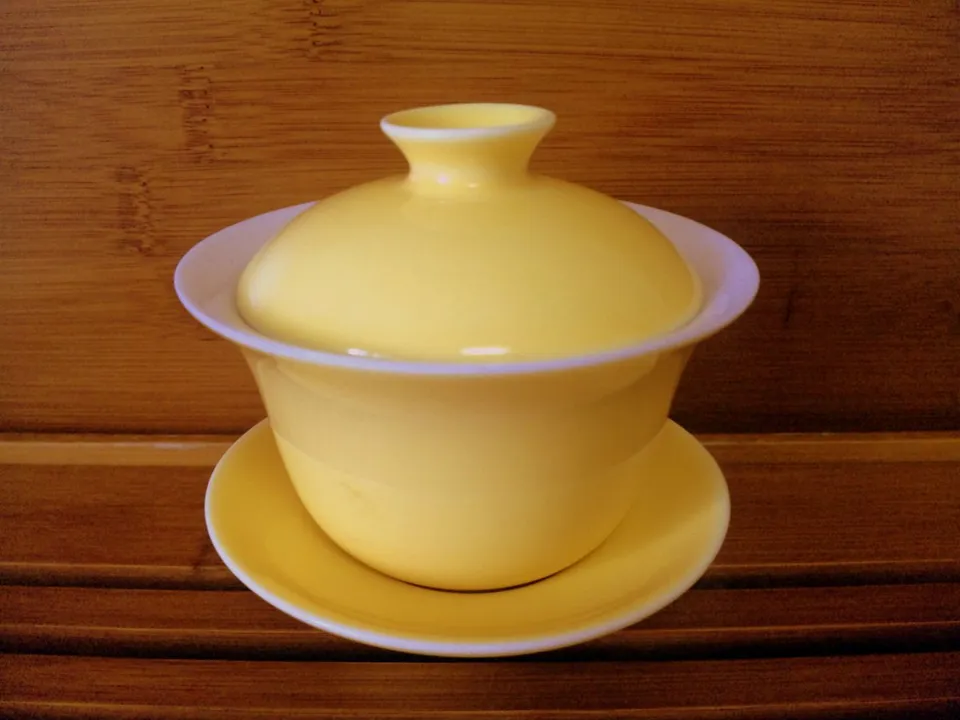
A gaiwan: bowl, lid and saucer. This illustrates the vessel, not a named tea.
Gaiwan yellow shizuhaused 01 — Shizuha. CC BY-SA 3.0. Proportional resizing and WebP conversion; no crop or retouching. The original licence also applies to these derivatives.

Start with a particular place
There is no single scene that can stand for all Chinese tea drinking. UNESCO’s description of China’s tea-processing techniques and associated social practices includes homes, workplaces, tea houses, restaurants and temples. It connects the drink with hospitality, relationships, ceremonies and the passing of knowledge through families and apprenticeships. The inscription recognizes a living range of skills and practices. [1]
You can begin learning without mastering a formal performance. Ask about the particular practice rather than assuming that “the Chinese tea ceremony” is one thing.
Ask where a practice comes from and what the occasion is. A family welcoming a guest and a teacher giving a public demonstration may make different choices.
The landscape is part of the story
At Jingmai Mountain in Yunnan, the cultural landscape recognized by UNESCO includes old tea groves, forests and villages. Its account identifies the Blang and Dai peoples and describes understorey tea cultivation together with local governance and beliefs. Tea there is connected with land use and community life, not only with the contents of an individual cup. [2]
A famous landscape can be a starting point for learning about a tea. It cannot authenticate an unrelated packet: a photograph of an old tree or a heritage designation is not evidence of a particular batch’s origin, age or quality.
Customs travel with people
The Hong Kong Museum of History has documented gongfu tea within the food culture brought to Hong Kong by people from the Chaozhou region. Its exhibition connected food practices with community identity and the experience of migration. This is a reminder that tea traditions do not remain fixed in one place. People carry them into new homes, shops and neighbourhoods. [3]
The word gongfu is often encountered by English-speaking tea drinkers alongside small vessels and repeated infusions. The equipment can make it easy to compare changes in one tea across a session. For the informal session below, collecting each infusion in a separate heat-safe vessel before sharing it is a practical option. This is an editorial hosting suggestion, rather than a claim that every tradition uses the same equipment.
If you share a method, be specific about where you learned it: a supplier’s demonstration, a teacher’s approach or a practice you use at home.
Objects hold stories too
Tea ware can tell a story about trade and adaptation as well as brewing. An exhibition at Hong Kong’s Flagstaff House Museum of Tea Ware examined Chinese export wares and their decorative influence in Southeast Asia and Europe. The objects showed how forms and designs travelled with changing markets and tastes. [4]
For an ordinary cup, ask who made it and how it came to be used this way. Choose a vessel you can handle, clean and pour from comfortably; leave unknown details of its history open.
Host a simple tea conversation
Here is a short, informal session you can arrange with a friend. It is an original hosting suggestion, not a reconstruction of a named ceremony.
- Make people comfortable. Choose one identifiable tea, a vessel you can handle and clean cups. Ask whether your guest wants tea, offer water too and keep any blend’s ingredients available. Refills are optional.
- Share what you know. Show the packet and name the stated origin and maker. Attribute a seller’s story to the seller. Invite your guest to smell a little dry leaf from a clean dish if they wish.
- Brew and notice. Use an appropriate method and explain your leaf amount and timing. Let the cups cool. Ask, “What do you notice?” before reading tasting notes aloud. A texture, an everyday aroma or simply a preference is enough; this is not an expertise test.
- Let the session find its pace. Offer another infusion if it suits the tea and everyone wants one. Compare what changed, or let the conversation move elsewhere. Keep one short note if there is something you want to remember.
Keep producers visible
Tea education can connect readers with working communities. The Pinglin Tea Museum in New Taipei City explicitly includes cultural exchange, education and the local tea economy in its mission. Its account places the museum within a region where Wenshan Baozhong production is important. [5]
For a publication, the practical lesson is to keep the maker visible whenever reliable information is available. Credit the person in a photograph. Explain whether they grew the leaf, processed it, blended it or sold the finished tea. Those roles may belong to different people.
The next time you make tea, choose one question beyond “Is this good?” It might be about the plant, the person who processed it, the cup or the way it is shared. Follow that question far enough to learn something specific. There is no need to turn every cup into a ceremony to take its culture seriously.
Sources
- UNESCO Intangible Cultural Heritage. Traditional tea processing techniques and associated social practices in China. Inscribed 2022; checked 16 October 2026.
- UNESCO World Heritage Centre. Cultural Landscape of Old Tea Forests of the Jingmai Mountain in Pu’er. Community, landscape and cultivation context; not a product authentication source.
- Hong Kong Museum of History. Chaozhou Food Culture in Hong Kong. Past exhibition, 2012; used for its documented cultural account, not current visitor information.
- Hong Kong Leisure and Cultural Services Department Museums. Behind the Art: Chinese Export Tea Ware. Past exhibition, 2018; object and cultural-exchange context.
- Pinglin Tea Museum of New Taipei City. Introduction and core mission. Page updated 2025; checked 16 October 2026. No unverified current attendance or economic statistics used.