Green tea is easier to understand when you stop expecting one flavour from it. A steamed needle-shaped leaf and a pan-fired, rounded leaf can belong to the same category while asking for different treatment in the pot. The useful starting question is: what happened to these leaves before they reached the packet?
Food & Nutrition · Tea
Green tea: start with how the leaf was made
Prepared by Good & Steady · Sources checked
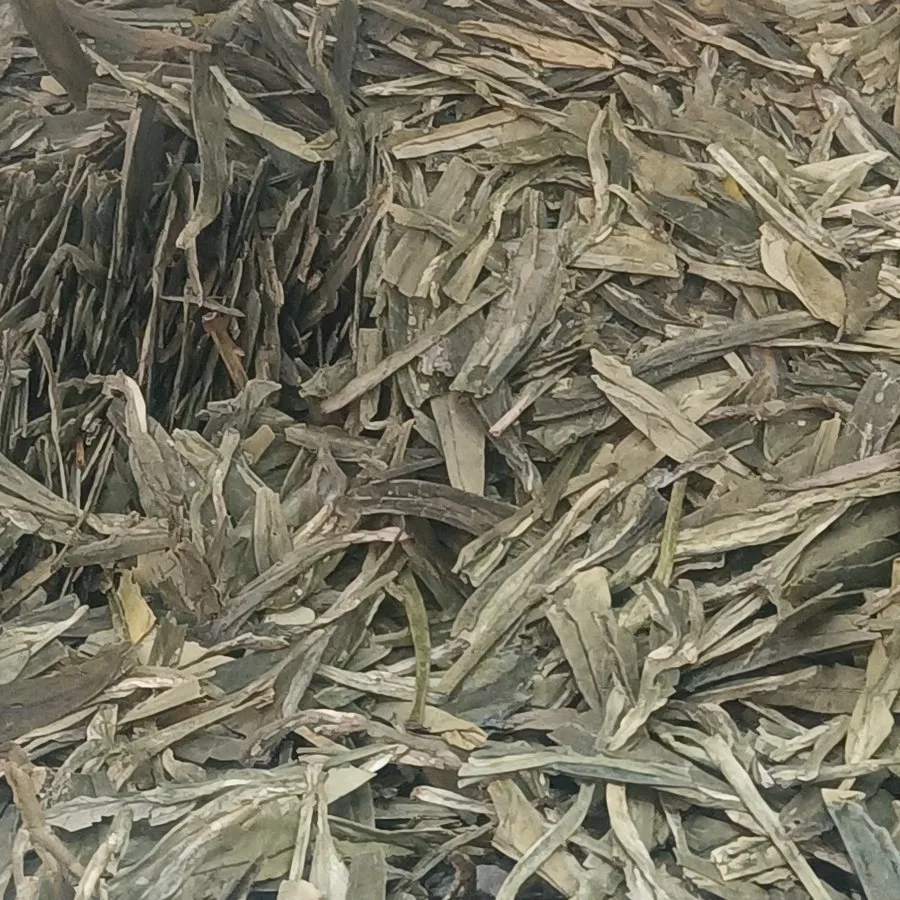
Dried tea identified as Longjing by the photographer. It illustrates leaf form; no West Lake or other certified origin is claimed.
Longjing tea (dried) — François Nguyen. CC BY 2.0. Proportional resizing and WebP conversion; no crop or retouching. The original licence also applies to these derivatives.
.jpg)
The early decision that makes a green tea
In green-tea manufacture, heat is applied early to inactivate the leaf enzymes responsible for much of its oxidation. Steaming and pan-heating are two ways of doing this. Rolling, shaping, drying and finishing then turn the heated leaf into a usable product. Green tea has undergone substantial processing; the aim is to control particular changes, rather than leave a plucked leaf untouched.[1]
Oolong takes a different route. Its manufacture allows withering and carefully managed leaf disturbance before the heat-fixing stage. Black-tea manufacture involves more extensive leaf disruption and enzymatic oxidation. Research presented at the International Conference on O-CHA describes these as different ways of using the leaf’s own enzymes during manufacture.[2] The familiar green–oolong–black sequence is therefore a useful outline, but it should not reduce three complex production traditions to a colour chart.
A green-looking oolong remains an oolong. A green tea that tastes strongly toasted has not become black tea. Ask about the process when appearance and category seem to disagree.
Steamed and pan-fired are starting points
Steaming supplies heat through steam; pan-firing uses contact with a heated surface. The World Green Tea Association describes both as ways of inactivating enzymes, with subsequent shaping and drying varying by tea.[1] These words tell you something practical about manufacture, but they do not provide a complete tasting note.
Nor do they divide the world neatly into two countries. Japan produces pan-fired tamaryokucha as well as steamed teas. A brewing guide hosted by Japan’s Ministry of Agriculture, Forestry and Fisheries treats pan-fired tamaryokucha separately from sencha and from deeply steamed fukamushi sencha.[3]
That last distinction matters. The same guide explains that longer steaming leaves fukamushi sencha more fragmented, with fine particles contributing to the drink’s appearance and texture. It recommends a shorter infusion than for ordinary sencha.[3] A packet of small pieces may be a characteristic of the intended production style. Judging every green tea by how many immaculate whole leaves it contains will lead you astray.
Buy a comparison you can explain
For a first useful comparison, choose two small packets with clear descriptions: one explicitly steamed, the other explicitly pan-fired. Record the tea name, origin and harvest information exactly as supplied. If the seller does not give a harvest date, leave the field blank rather than turning a packing date into one.
Read the brewing directions before buying. Are they for a small pot with repeated infusions, a large mug, or another method? Do they state the amount of leaf and water? A temperature without those details is an incomplete starting point.
Choose teas whose preparation fits what you already own. A fine-leaf sample calls for a strainer that will actually retain it. A tall glass may make it enjoyable to watch leaves open, but it also leaves them in contact with the water while you drink. That is a different experiment from fully decanting a pot at a fixed time.
Avoid deciding in advance that one tea must taste grassy and the other nutty. Those expectations can become the whole tasting. Write down what you notice before looking back at the product description.
A two-cup temperature exercise
The most revealing first experiment uses one tea, not two. This separates a brewing change from a change of leaf.
- Start with the packet’s instructions for that specific tea. Write down leaf weight, water volume, temperature and infusion time. If instructions are missing, ask the seller for a starting method before using an expensive sample.
- Prepare two equal portions in matching vessels. Use the same water and leaf weight for each. Keep the water volume, infusion time and pouring method the same.
- Brew one at the suggested temperature and the other about 10°C cooler. This is a comparison chosen for this exercise, not a claim that every green tea has a preferred ten-degree range.
- Strain both completely. Let them reach a comfortable drinking temperature before comparing aroma, savouriness, bitterness and the drying sensation in the mouth.
- Name the trade-off. Perhaps the cooler cup seems gentler but less aromatic; perhaps you prefer the original. Either result gives you a direction for the next pot.
If the difference is unclear, repeat on another day rather than changing four variables at once. You are learning the response of this packet, in your water, with your equipment.
The MAFF-hosted guide explicitly makes tea type, teaware, water and brewing technique part of preparation.[3] That is a more useful principle than memorising a single “green-tea temperature”. Once you have a reliable cup, comparison becomes enjoyable: change one thing, taste carefully, and keep the adjustment that makes you want another sip.
Sources
[1] World Green Tea Association, Japanese tea: the basic process.
[2] Kanzo Sakata, International Conference on O-CHA 2010, research proceedings on tea aroma formation and processing, especially the comparison of oolong and black-tea manufacture.
[3] Japan Ministry of Agriculture, Forestry and Fisheries, The proper way to brew Nihoncha, pp. 1–3 and preparation sections.