First, establish what is for sale
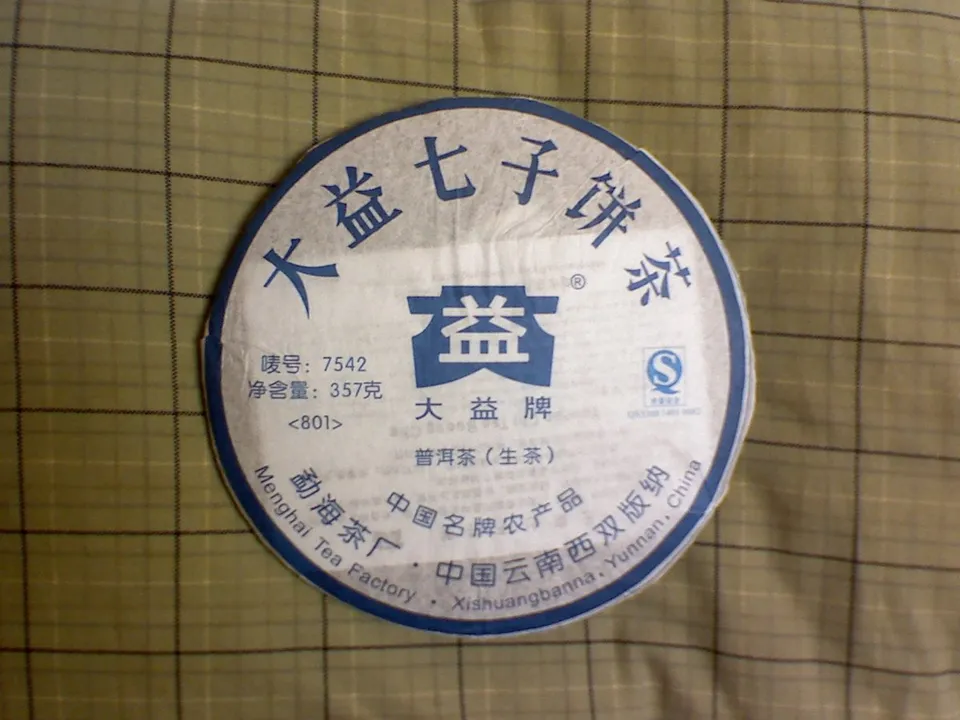
Before investigating the story, check the actual purchase unit. Is the price for a whole cake, a sample cut from one, several small pieces or loose tea? What weight will arrive? Does the photograph show the item being sold, a representative example or packaging from another production?
Record the seller, product name and batch identifier if one is supplied. Save the listing and photographs with the date. A memorable tea name is less useful later if you cannot connect it to the exact stock you bought.
Then confirm sheng or shou. These names concern processing. Shou includes moist pile fermentation; compression is a separate matter, and either type may be sold loose or pressed.[1] A cake photograph cannot settle this question for you.
Give the year a noun
“2014” looks precise, but start by asking what event it dates. Is it the harvest, the pressing, another production stage or the seller’s estimate of the tea’s age? If the listing mentions more than one date, keep both with their explanations.
Ask for a readable photograph of any date marking and its surrounding text. A cropped number loses context. Where older loose material is said to have been pressed later, ask how the seller knows the material’s earlier history. Where a blend is described, ask whether its components share the stated year.
A hypothetical description illustrates the distinction: “2014 leaf, pressed in 2018, purchased by this seller in 2022.” That gives you three claims to discuss. It does not prove them, but it is more useful than treating a single year as the complete biography of the tea.
Separate growing origin from business addresses
Make three spaces in your notes: where the leaf was grown, where it was processed, and who is selling it. Do not fill all three with a place name that appears only once.
If a listing names a mountain or village, ask how narrowly the seller means it. Does the description concern all the material, part of a blend or a broader sourcing area? Who supplied the leaf, and what connects this batch with that origin?
There is a practical reason for asking. A consumer warning from Yuxi’s market regulator and consumer association specifically cautions against unsupported or fabricated claims about pu-erh’s origin, year, processing and tree age.[2] The useful response is proportionate scrutiny: stronger claims and larger premiums deserve clearer evidence.
Read material claims without turning them into rankings
Words such as “ancient-tree”, “single-garden” and “spring” invite follow-up questions. Ask how the seller defines them, whether they apply to the entire batch, and what records support them.
For tree age, distinguish the estimated age of a planting from the age of every plant that contributed leaf. For a single-origin claim, ask what boundary is being used. For a seasonal claim, ask which harvest period is meant. An answer may remain approximate; retain the approximation rather than sharpening it yourself.
Also ask whether the tea is a blend. A clearly described blend gives you useful information. A description that leaves blending unresolved gives you a question to answer before deciding what the premium buys.
Ask for a storage timeline
Try to replace a broad phrase such as “dry storage” with a short history: where the tea was kept, for which years, and what the current seller knows directly. Ask about gaps, changes of owner and moves between storage locations.
Storage belongs in a buying decision because it can change tea’s appearance, aroma and taste.[2] A city name is helpful context, but it does not describe every cupboard or warehouse in that city. Ask whether the description is based on records, the supplier’s account or the seller’s interpretation of the tea.
If possible, buy a sample from the stock you are considering. Record whether it comes from the same batch and storage lot. Tasting helps you decide whether you want that tea; keep the separate question of provenance open.
Know what evidence can establish
Research into pu-erh authentication has used laboratory measurements and statistical models. One study examined mineral elements and stable isotopes in Xiangzhujing teas from five production years.[3] Its findings concern the tested material and models. They do not provide a visual age test for an online shopper.
Treat wrappers, invoices, production records and the seller’s explanation as pieces to compare. Ask whether they agree and how each connects to the tea offered. An attractive wrapper or an evocative flavour description cannot carry every claim alone.
Keep a six-line buying note
Before paying, complete this short record:
- Item: form, weight, seller and batch
- Type: sheng or shou
- Date: stated year and what it dates
- Origin and material: exact claims, including any blend
- Storage: known places and periods, with gaps
- Evidence and decision: what supports the description, and whether a matching sample is available
Leave “unknown” where it belongs. You can still choose the tea. The point is to know which parts of the purchase are documented, which are attributed claims, and which you are buying on trust.
Sources
- Zhang, Y., and colleagues. The Microbiome and Metabolites in Fermented Pu-erh Tea as Revealed by High-Throughput Sequencing and Quantitative Multiplex Metabolite Analysis. PLOS ONE, 2016, 11(6), e0157847. Processing distinction and loose/compressed forms.
- Yuxi Municipal Market Regulation Bureau and Yuxi Consumers Association. Pu-erh tea consumer warning, 26 November 2024. Used for provenance-claim cautions, storage relevance and keeping purchase evidence; Chinese-language source.
- Liu, H.-L., and colleagues. Monitoring the authenticity of pu’er tea via chemometric analysis of multielements and stable isotopes. Food Research International, 2020, 136, 109483. Public abstract; limited production-year authentication study.
_Menghai_7542_357g.jpg)