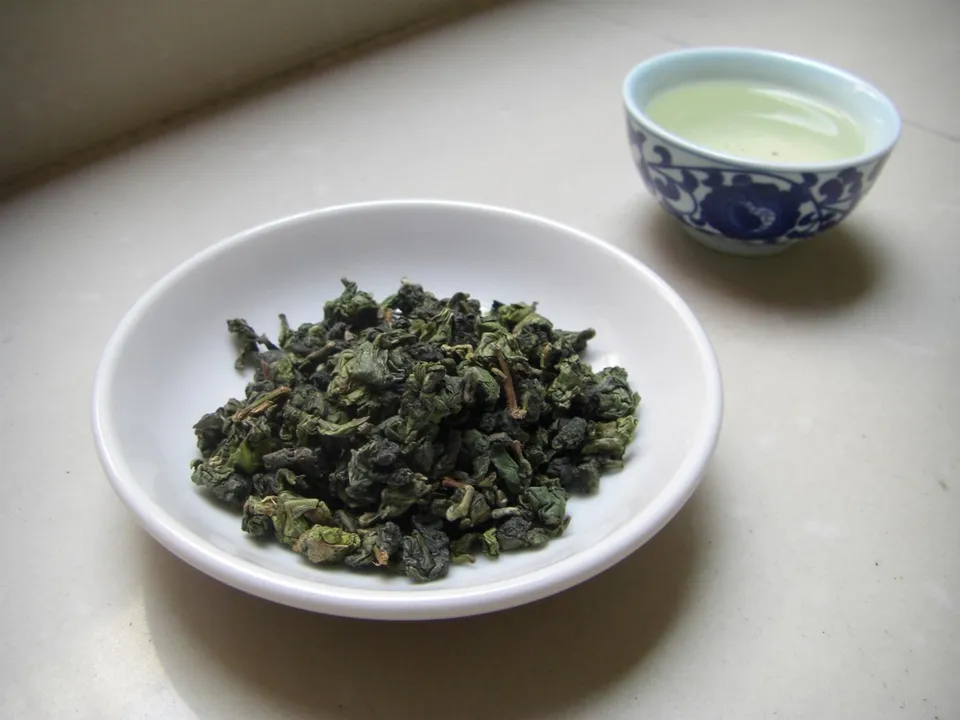
Begin with Anxi and the plant
Tieguanyin has a strong connection to Anxi County in Fujian, China. FAO’s description of the Anxi Tieguanyin Tea Culture System identifies Anxi as the place where the Tieguanyin tea-tree variety was discovered. It also describes a working agricultural landscape containing numerous tea varieties and a body of knowledge about cultivation, propagation and tea making.[2]
The distinction between a plant and a finished tea is useful here. A cultivar describes cultivated plant material. A tea’s processing describes what people do with the harvested leaves. “Tieguanyin” appears in both conversations, so the name alone does not answer every question about the product.
Start by asking where it was grown and which cultivar was used. Then ask about its style. This is especially useful when comparing Anxi tea with Taiwanese tea bearing the same name. It gives each sample an identity you can actually keep track of, instead of asking a single word to describe everything.
Understand the work after picking
Oolong production involves a sequence of handling and transformation. A study of Anxi Tieguanyin describes withering, bruising, partial oxidation, heat fixing, shaping and drying, followed by additional baking for the baked samples.[1] The study compared a jade-style tea with medium- and deep-baked versions supplied by one producer: the medium version was made by baking the jade tea, and the deep version by baking it again. Roasting was a separate finishing choice applied to the same starting tea.[1]
For a buyer, the practical consequence is that “light” needs context. Does the seller mean the degree of oxidation, the roast, the intensity of flavor, or simply the appearance? Ask them to describe the process in ordinary terms. A precise answer is more helpful than assuming these all move together.
A short note such as “Anxi-grown Tieguanyin cultivar, light-aroma style” gives you a useful comparison point; record the producer’s roast description alongside the origin.
Get to know the main style names
Qingxiang, nongxiang and chenxiang are useful terms to recognize. Research on Tieguanyin uses these names for light-aroma, strong-aroma and aged-aroma types.[3] They describe a range of products rather than three guaranteed tasting experiences.
Qingxiang, or light aroma. This is a sensible direction to explore if you are curious about fresh, floral character. “Light” does not mean the aroma must be weak. Taste the actual sample before deciding how delicate it is or how much leaf it needs.[4]
Nongxiang, or strong aroma. This points toward a fuller roasted expression. Fruit and roast can be prominent, although the exact balance varies. In one controlled study, increasing roasting time reduced floral aroma and increased roasted aroma in the tested Tieguanyin.[4] Those findings help explain the range; they do not make the strongest roast the best choice for everyone.
Chenxiang, or aged aroma. This is another recognized style name.[3] It invites a different set of questions: when was the tea harvested, how was it stored, and has it been roasted again? An age printed on a packet is something to document, rather than something you can verify just by finding a woody note in the cup.
Terms such as “traditional”, “jade” or “roasted” may also appear. Use them to begin a conversation. If you are buying two teas to compare, ask for clearly different styles with enough production information to understand the comparison.
Make room for Muzha
Muzha, in Taipei, has its own Tieguanyin tradition. Taiwan’s Tea and Beverage Research Station describes the introduction of Anxi tea plants to the area and characterizes Taiwanese Tieguanyin as a moderately oxidized, heavily roasted, ball-shaped oolong.[5]
The station also distinguishes tea made from the Tieguanyin cultivar, called zhengcong Tieguanyin, from tea made using the Tieguanyin processing style. This makes the cultivar question particularly useful when shopping for Taiwanese examples.[5]
Anxi and Muzha therefore give you related traditions worth describing separately. “Anxi equals green; Taiwan equals roasted” is too blunt a shopping rule: Anxi itself offers baked styles.[1] Keep the region, cultivar and finishing style together in your notes. If you prefer a Muzha sample to a light-aroma Anxi sample, that tells you about those two teas under your brewing conditions. It does not settle a contest between regions.
Try a two tea comparison
Choose a small light-aroma sample and a clearly described roasted sample. Ideally, keep their origin and cultivar similar, so that processing is easier to discuss. If they differ in several ways, simply record the differences rather than claiming you have isolated one cause.
Here is an original editorial exercise, not a personally tested prescription. Start with 3 grams of each tea in separate roomy infusers or small teapots. Use 150 millilitres of water at about 95°C for each and infuse for 90 seconds. Strain completely, then compare at a comfortable drinking temperature. These are adjustable starting settings for your particular samples.
Use the same water for both. Research using four waters with light- and strong-scented Tieguanyin found differences in sensory character and extracted compounds.[6] Keeping the water constant removes one avoidable complication; it does not guarantee that these settings suit both teas equally well.
Begin with three questions:
- What is easiest to notice in the aroma?
- Does the tea feel full, thin, smooth or drying?
- Which cup do you want another sip of?
You can prefer one tea’s aroma and another’s texture.
Next, brew each sample again with fresh leaves and adjust the time separately. If a cup was too forceful or drying, try 60 seconds. If it felt faint, try two minutes. Keep the other settings unchanged. Write down which adjustment improved your enjoyment. This second round treats each tea as an individual rather than requiring one recipe to flatter both.
Take away a clearer preference
At the end, keep a short record: origin, cultivar if known, style, batch information and the brewing setting you liked. Add one sentence in your own words about why you would or would not buy it again.
Sources
[1] Gao, Y. and colleagues, “Effects of the Baking Process on the Chemical Composition, Sensory Quality, and Bioactivity of Tieguanyin Oolong Tea”, Frontiers in Nutrition 9, 2022, article 881865. Used only for processing and sensory findings. https://www.frontiersin.org/journals/nutrition/articles/10.3389/fnut.2022.881865/pdf
[2] Food and Agriculture Organization of the United Nations, “Anxi Tieguanyin Tea Culture System, China”. Official GIAHS description. https://www.fao.org/giahs/giahs-around-the-world/china-anxi-tea-culture-system/en
[3] Wang, W., Jin, S. and Guo, Y., “Exploration of a Method of Distinguishing Different Nongxiang Tieguanyin Tea Grades Based on Aroma Determined by GC-MS Combined with Chemometrics”, Molecules 24(9), 2019, article 1707. https://pmc.ncbi.nlm.nih.gov/articles/PMC6539088/
[4] Cao, Q.-Q. and colleagues, “Sensory and chemical characteristics of Tieguanyin oolong tea after roasting”, Food Chemistry X 12, 2021, article 100178. https://pmc.ncbi.nlm.nih.gov/articles/PMC8651997/
[5] Taiwan Tea and Beverage Research Station, “Tieguanyin tea”. Official account of the Taiwanese style and cultivar distinction. https://www.tbrs.gov.tw/ws.php?id=3785&print=Y
[6] Ma, Y.-Y. and colleagues, “Effect of the type of brewing water on the sensory and physicochemical properties of light-scented and strong-scented Tieguanyin oolong teas”, Food Chemistry X 21, 2024, article 101099. Published online 23 December 2023. https://pubmed.ncbi.nlm.nih.gov/38235347/