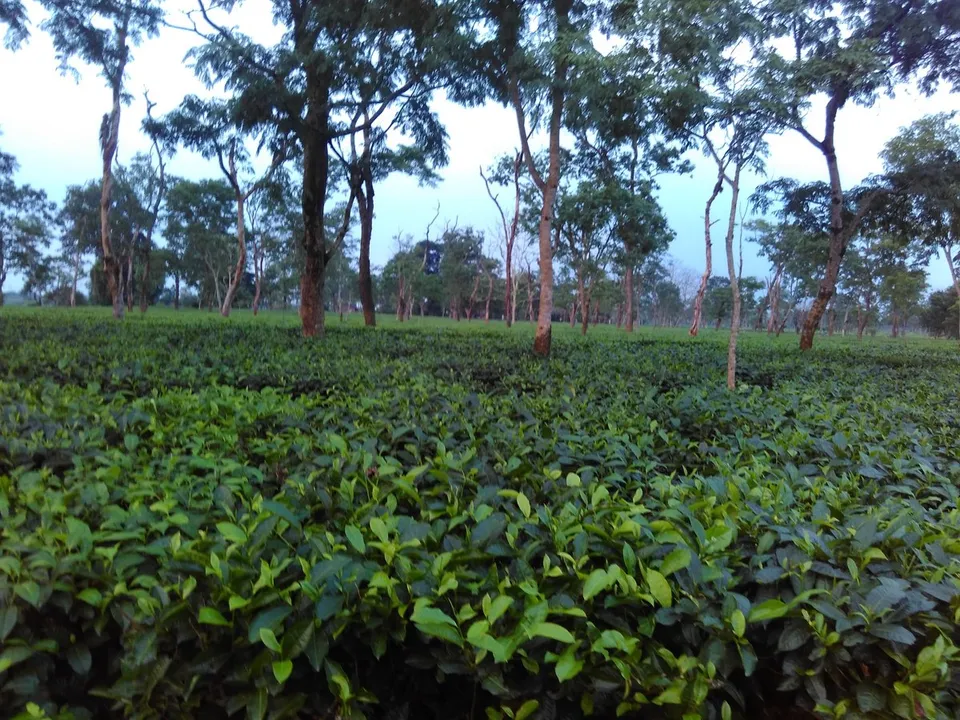
Two landscapes, many individual gardens
Assam is in northeastern India. Tea Board India’s regional account emphasizes the rolling plains around the Brahmaputra, plentiful rainfall and low elevations. It also makes an important practical point: Assam produces both orthodox and CTC tea. A place name does not identify a single processing method. [1]
Darjeeling tea comes from a defined growing area in the hills of West Bengal. The district government’s account describes substantial differences in elevation, temperature, rainfall and slope within the hill region. “Mountain-grown” therefore leaves a great deal unsaid about an individual garden or section. [2]
Use those geographical differences as context, rather than assigning an inevitable flavour to every leaf. Ask whether the description concerns a particular harvest and lot or summarizes the seller’s general idea of the region.
A flush is a harvest clue
In tea listings, “flush” commonly identifies a seasonal crop. Darjeeling descriptions distinguish first or spring flush, second or summer flush, monsoon or rain flush, and autumn flush. A FAO-hosted presentation sets out that sequence, linking the first two with spring and early summer, followed by the rainy period and autumn. [3]
These terms are more useful as seasonal context than as a rigid calendar you apply to every year. Ask for the harvest year and, where available, the month or picking period. A seasonal label without a year is incomplete.
You will also see “second flush” on Assam teas. Tea Board India specifically discusses second-flush orthodox Assam tea in its regional profile. [1] The shared phrase does not make Assam and Darjeeling equivalent products. Keep the origin, season and processing words together when you read the description.
Nor is “first” a quality score. It locates a tea within a growing cycle. Our editorial suggestion is to treat the flush as a way to choose a comparison, such as two seasons from one garden, rather than as a reason to assume the earliest tea must be your favourite.
Processing changes what the origin becomes
For black tea, the broad manufacturing sequence includes withering, leaf disruption, oxidation and drying, followed by sorting. In orthodox manufacture, rolling is an important stage; CTC machinery works the leaf into smaller particles. Sri Lanka Tea Board’s manufacturing explanation distinguishes these processes and explains that leaf size affects infusion behaviour without being a quality verdict in itself. [4]
That distinction helps when comparing Assam listings. “Assam orthodox” and “Assam CTC” tell you something different from “Assam spring harvest.” Neither replaces a usable brewing instruction.
Be equally careful with Darjeeling. An origin description should not make you assume that every product has the same manufacture or leaf appearance. Check the stated tea category and method. If the seller’s photograph looks greener than you expected, ask for clarification rather than deciding authenticity from colour alone.
When comparing two teas, note how many variables change at once. A finely divided Assam and a large-leaf Darjeeling, from different harvests and brewed identically, can be an enjoyable comparison. It cannot isolate the effect of geography.
What geographical identity can tell you
As checked in October 2026, Tea Board India describes Darjeeling’s protected geographical identity through a defined area, 87 registered gardens and processing within that area. Its certification framework concerns documented origin and specified characteristics. [5] Assam Orthodox also has a registered geographical identity; the Indian GI registry lists the Assam (Orthodox) Logo as registered. [6]
Those are specific identities. Do not collapse “Assam Orthodox” into a claim covering every tea described as Assam, or treat a picturesque photograph as origin documentation.
For a purchase, ask the supplier to connect the claim to the tea being sold: garden or producer, harvest, lot identifier and relevant origin information. A logo on a webpage is a starting point for that conversation. It does not independently verify the contents of a particular packet, and documented origin still cannot guarantee your personal enjoyment.
Read two listings side by side
Choose one Assam and one Darjeeling listing. Make a short note for each:
- Place: country, region and named garden or producer, if supplied
- Time: harvest year and flush or picking period
- Manufacture: tea category, orthodox or CTC where relevant, and leaf grade or size
- Identity: lot reference and the supplier’s basis for the origin claim
- Use: recommended leaf amount, water volume, temperature and time
Mark absent information as “not stated.” Do not fill it from a neighbouring product or a general regional article. Then write one question whose answer would actually change your decision: perhaps which harvest the packet contains, or whether the available sample matches the current lot.
Finally, keep the seller’s tasting language separate from your notes. “Malty,” “floral” and “muscatel” can help communicate an impression. They are neither an authenticity test nor a promise that you will perceive the same thing. Origin gives the conversation a place to begin; the identified tea and your own cup take it further.
Sources
- Tea Board India. Assam. Geography, orthodox/CTC production and second-flush terminology; checked 16 October 2026.
- Darjeeling District, Government of West Bengal. Economy. Hill geography and climatic variation; checked 16 October 2026.
- Tarit Kumar Datta. Darjeeling tea, FAO-hosted presentation, slide 7. Used for seasonal terminology, not its historical production figures.
- Sri Lanka Tea Board. Manufacturing. General processing and grading explanation; checked 16 October 2026.
- Tea Board India. Darjeeling. Current official origin/certification overview; checked 16 October 2026.
- Intellectual Property India. Assam (Orthodox) Logo, GI application 115. Registry status checked 16 October 2026.