A familiar tea can become surprisingly different when the water changes. Before replacing the leaves or adjusting every part of a recipe, it is worth asking what went into the kettle. The useful question is specific: which of the safe drinking waters available to you makes this tea more enjoyable?
Food & Nutrition · Tea
Choosing water for tea: make the comparison useful
Prepared by Good & Steady · Sources checked
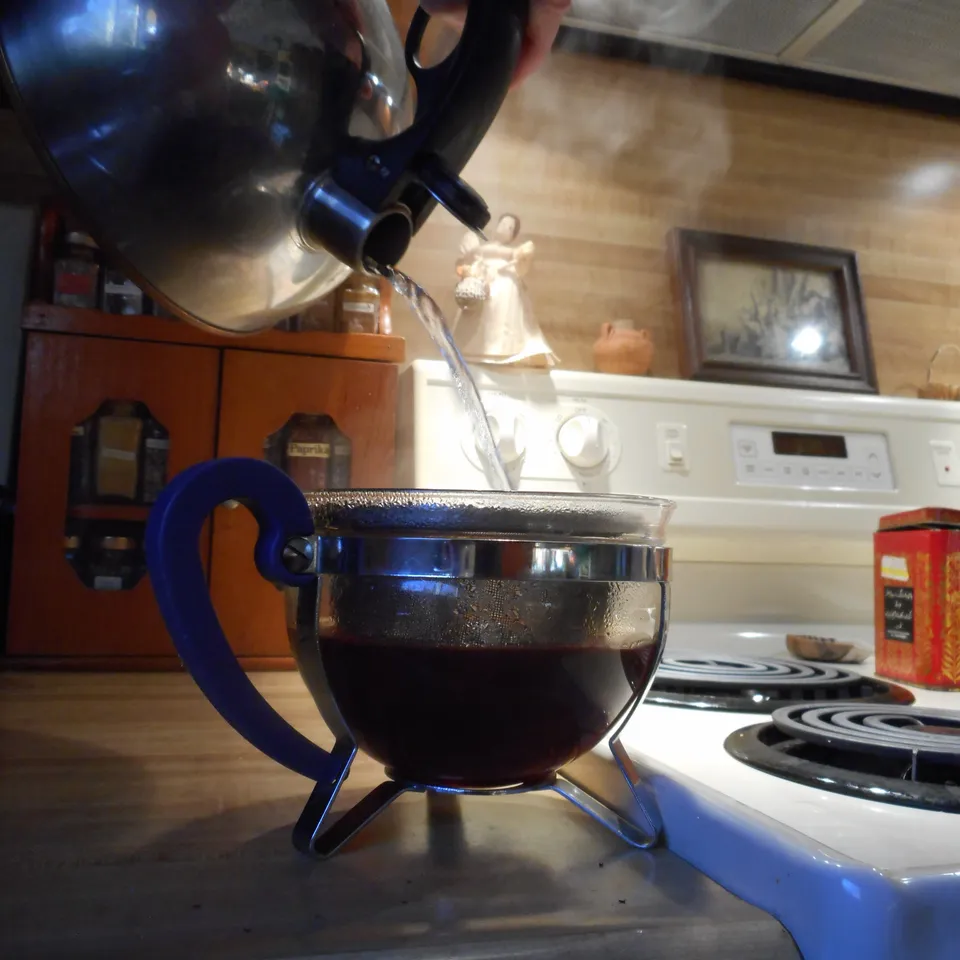
Water poured from a kettle into a glass teapot.
Household tool teakettle pouring water into teapot — Wuerzele. CC BY-SA 4.0. Proportional resizing and WebP conversion; no crop or retouching. The original licence also applies to these derivatives.

Start with drinking water
Use water already suitable for drinking. A pleasing taste, a clear appearance or a low mineral reading cannot establish that water is safe. The US Centers for Disease Control and Prevention makes this distinction explicitly: harmful substances need not change water’s appearance, smell or taste. Follow any local drinking-water advisory rather than treating tea brewing as a solution to a water-safety problem. [1]
For the experiment below, compare your usual drinking water with another suitable, still, unflavoured drinking water. There is no need to collect spring water, buy laboratory water or add mineral powders.
Four different things a label might tell you
Hardness mainly describes dissolved calcium and magnesium. It is often reported as an equivalent amount of calcium carbonate, rather than as the separate amount of either mineral. USGS explains that these minerals can also contribute to deposits when hard water is heated. A kettle that develops scale therefore gives you a reason to investigate hardness, but not a complete analysis of your water. [2]
Alkalinity describes water’s capacity to neutralize added acid and resist a change in pH. Bicarbonate and carbonate can contribute to that capacity. This is different from simply saying that a water has a high pH. [3]
pH describes how acidic or basic the water is at the time it is measured. It does not, by itself, tell you the amount of calcium, magnesium or bicarbonate present. USGS treats pH as a distinct water measurement. [4]
Total dissolved solids, usually shortened to TDS, describes the combined amount of dissolved material. USGS lists several common contributors, including calcium, magnesium, sodium, bicarbonate and chloride. A total does not tell you how those components are divided. Two waters with similar totals need not have identical compositions. [5]
For a practical record, copy the available information rather than trying to calculate a perfect profile. Note the water’s source, calcium, magnesium, bicarbonate or alkalinity, and TDS if reported. Keep the units. Leave missing entries blank. A number reported as “mg/L as calcium carbonate” should not be copied into a box labelled simply “calcium.”
More extraction does not necessarily mean more enjoyment
A controlled 2019 study compared particular green and black teas brewed in tap, bottled and deionized waters, holding brewing conditions constant. The water had a larger sensory effect on the green tea. For the green tea, bottled and deionized water produced higher measured levels of EGCG, a bitter catechin; the tap-water version was better liked. The work also documented differences in colour and cloudiness. [6]
This is evidence that water matters, not a verdict on every tap or bottle. “Tap water” describes a source category with considerable local variation. “Bottled water” is equally incomplete as a composition description. Nor does the clearest cup automatically win a taste comparison.
Our editorial recommendation is to record preference separately from appearance and intensity. A stronger aroma and a gentler taste can be separate preferences.
Try a two-water comparison
Use a tea you know reasonably well and a recipe you already enjoy. This is a home comparison, not a laboratory test.
- Set out two matching, heat-safe brewing vessels and two matching drinking cups. Prepare equal portions of the same tea. Keep the cups labelled A and B underneath or on a nearby card.
- Choose the same water volume, brewing temperature and infusion time for both. Record the water identities separately. If someone can code the waters without telling you which is which, that can help reduce expectations.
- Heat each water using the same equipment and target temperature. With one kettle, empty it between waters and rinse it with a little of the next water. Respect its minimum-fill instruction. Brew sequentially if that is the practical option and note the timing difference.
- Remove the leaves after the same infusion time. Taste when both cups are comfortably drinkable and as close in temperature as practical. Very different serving temperatures make the comparison less informative.
- Write separate observations for aroma, bitterness, drying sensation, body and appearance. Finish with “prefer A,” “prefer B” or “no clear preference.”
- Repeat another day, reversing the brewing order and swapping which vessel receives each water. A preference that disappears on the second attempt deserves a smaller conclusion.
If one water is consistently preferable, try it with a second tea before changing your whole routine. Your result belongs to the combinations you tested.
Decide whether a filter solves your problem
“Filtered” is not a single water composition. Check the particular filter’s documented purpose and maintenance instructions. CDC notes that pitcher and refrigerator filters commonly use activated carbon, often to improve taste and smell; their capabilities vary, and maintenance matters. [1]
Do not buy a system merely to reach somebody else’s favourite number. If your current water makes an enjoyable cup, that is a useful result too. The aim is a reliable everyday choice, with enough information to understand what changed.
Sources
- Centers for Disease Control and Prevention. About Choosing Home Water Filters. Drinking-water safety, filter capabilities and maintenance; checked 16 October 2026.
- US Geological Survey. Hardness of Water. Definitions and scale formation; checked 16 October 2026.
- US Geological Survey. Alkalinity and Water. Acid-neutralizing capacity; checked 16 October 2026.
- US Geological Survey. pH and Water. Measurement explanation; checked 16 October 2026.
- US Geological Survey. Chloride, Salinity, and Dissolved Solids. TDS composition; checked 16 October 2026.
- Franks and colleagues. The Influence of Water Composition on Flavor and Nutrient Extraction in Green and Black Tea. Nutrients 11(1), 80, 2019. Primary study; public abstract and figure descriptions. No health-benefit conclusion adopted.