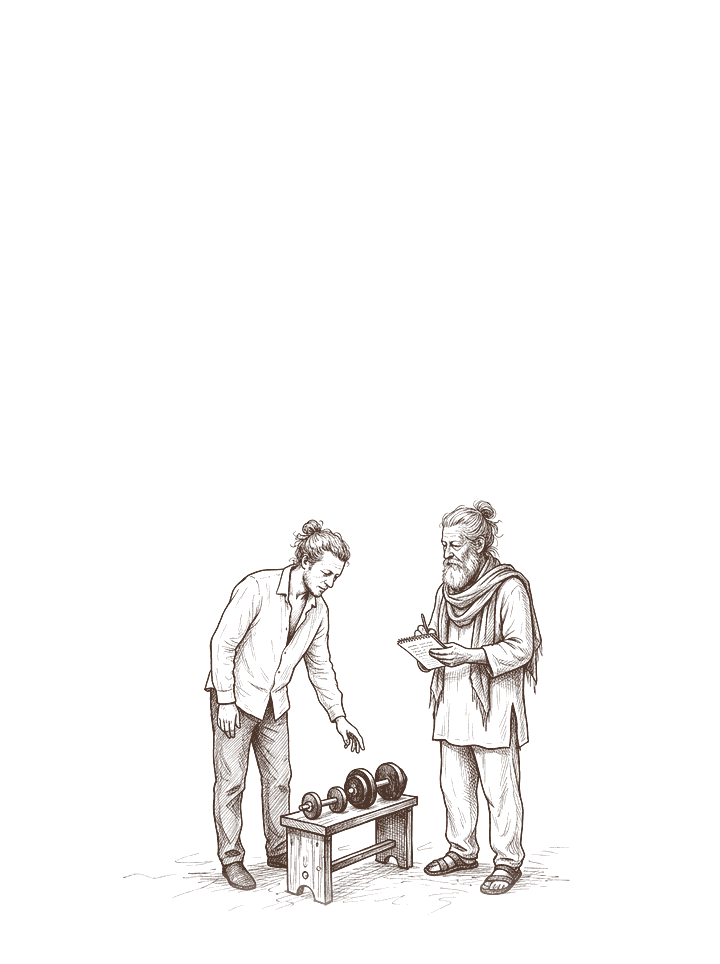
There is no fixed weekly percentage for when to add weight. Newcastle Hospitals’ exercise guide describes gradual development, the ACSM emphasizes matching training to goals, and more resistance is only one route: repetitions, sets, movement speed or the exercise variation can change too. Recording one change at a time shows what a proposed adjustment changes. If an exercise now feels less challenging, treat a change as a proposal to discuss; an instructor still needs your circumstances to evaluate it.
Making an exercise harder can mean several different things: more resistance, more repetitions, or a different movement. A clear record separates those changes instead of treating them as one vague increase. Here, changing one variable is a way to understand a proposed adjustment, not a universal training rule.
Identify the variable
Resistance, repetitions, sets, movement speed, and exercise variation are different variables. The ACSM explanation emphasizes matching training to goals. A method for maximal strength is not automatically a beginner's general-health routine. Start the comparison with the current instruction. Without that baseline, it is difficult to tell what the proposed adjustment changes.
Understand gradual progression
Newcastle Hospitals' exercise guide describes progressive overload and gradual development. That principle does not establish a fixed weekly percentage for every person. A movement can become more challenging through several routes. The appropriate route depends on the exercise, goal, and current ability.
Compare two editorial examples
These fictional records make two kinds of change visible. The numbers are deliberately specific for comparison; they are not starting amounts or approved progressions. An instructor would still need the person's circumstances before evaluating either proposal.
Example one: discuss resistance
The person knows the biceps curl and wants to review an instruction that now feels less challenging.
| Detail | Current record | Proposed change for discussion |
|---|---|---|
| Exercise | Biceps curl | Same exercise |
| Resistance | 4 kg in each hand | 4.5 kg in each hand |
| Repetitions and sets | Two sets of eight repetitions | Unchanged |
| Position, range, pace, and rest | Follow existing instructions | Unchanged |
| Question | Does the current instruction still fit the goal? | Would this resistance change be appropriate? |
Resistance is the only recorded variable that changes in this comparison. Adding repetitions or another set would introduce another change. Feeling less challenged does not, by itself, establish that the proposed increase is suitable.
Example two: discuss repetitions
The person knows the chair sit-to-stand and wants to review the repetition count without adding external resistance.
| Detail | Current record | Proposed change for discussion |
|---|---|---|
| Exercise | Chair sit-to-stand | Same exercise and chair |
| Resistance | Bodyweight, without an added weight | Unchanged |
| Repetitions | Six in each set | Seven in each set |
| Sets | Two | Unchanged |
| Position, range, pace, and rest | Follow existing instructions | Unchanged |
| Question | Does the current instruction still fit the goal? | Would one additional repetition per set be appropriate? |
Repetitions are the only recorded variable that changes in this comparison. A lower chair or an added weight would change the task further. Neither example establishes a weekly progression rule or proves individual readiness.
Keep a before-and-after record
| Detail | Current instruction | Proposed change |
|---|---|---|
| Exercise and variation | ___ | ___ |
| Resistance | ___ | ___ |
| Repetitions and sets | ___ | ___ |
| Other instructions | ___ | ___ |
| Reason for the change | ___ | ___ |
| Person or source confirming it | ___ | ___ |
If several entries change, ask why. A clear record helps avoid accidentally combining unrelated increases. It does not calculate whether the change is medically suitable.
Let symptoms interrupt the plan
Pain or feeling unwell is not a signal to increase the load. Ask about unexpected difficulties rather than treating every unfinished set as a motivation problem. A missed week also does not create an obligation to catch up.
A useful progression note makes the old instruction, proposed change, and reason visible. It supports a decision; it does not authorize an increase merely because another week has passed.
Frequently asked questions
When should I increase the weight I lift?
There is no fixed weekly percentage that fits everyone. If an exercise now feels less challenging, treat more resistance as a proposal to discuss rather than an automatic step, and change one variable at a time. Feeling less challenged does not by itself show that a heavier weight is suitable, and pain or feeling unwell is not a signal to increase the load.
How many reps and sets should a beginner do?
This guide does not set a number. The ACSM emphasizes matching training to your goals, and a method for maximal strength is not automatically a beginner’s general-health routine. The examples on this page are fictional records, not starting amounts; start from your current instruction and ask an instructor who knows your circumstances.
Should I add weight or reps first?
Both are ways to make an exercise harder, and the appropriate route depends on the exercise, goal and current ability. Changing only one keeps the comparison clear: adding repetitions or another set alongside more resistance would introduce another change.
How much weight should I add?
No universal amount applies. The fictional examples above are not starting amounts or approved progressions; an instructor would still need the person’s circumstances before evaluating a change.
What is progressive overload?
Newcastle Hospitals’ exercise guide describes progressive overload together with gradual development. That principle does not establish a fixed weekly percentage for every person.