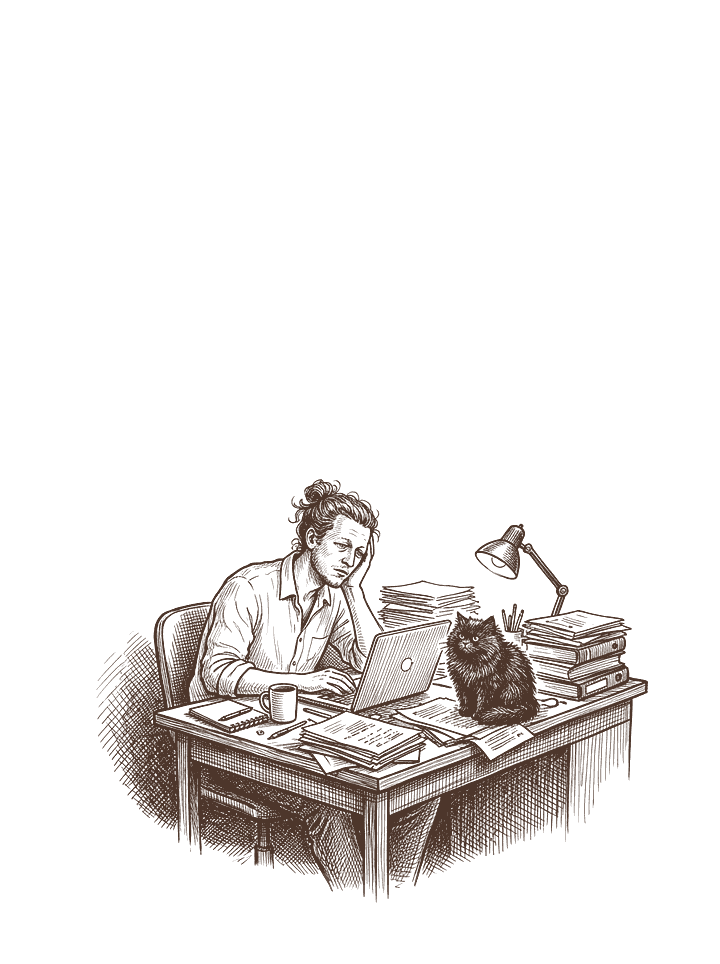
Burnout has a specific work-related meaning. The World Health Organization’s ICD-11 definition describes it as a syndrome resulting from chronic workplace stress that has not been successfully managed, with exhaustion, distance or cynicism toward work, and reduced professional efficacy. WHO classifies it as an occupational phenomenon, not a medical condition, so not every kind of exhaustion fits. NIMH’s help guidance recommends professional support when difficulties are severe, persistent or affect everyday functioning, whatever word you use.
Burnout has a specific work-related meaning. Using it for every period of exhaustion can hide the question of what is actually happening. The definition helps keep two issues visible: conditions at work and the person's own need for support.
The scope of the WHO definition
WHO classifies burnout as an occupational phenomenon. Its ICD-11 definition states:
“Burn-out is a syndrome conceptualized as resulting from chronic workplace stress that has not been successfully managed.”
Source: World Health Organization — Burn-out an occupational phenomenon.
ICD-11 does not classify it as a medical condition. The definition concerns exhaustion, distance or cynicism toward work, and reduced professional efficacy. It should not be extended to every area of life.
These dimensions define the phenomenon rather than provide a self-scoring diagnostic test. Someone can need support for exhaustion without first deciding whether burnout is the right word.
When the problem requires a work conversation
An unclear workload or persistent availability expectation may require an organizational conversation. A longer evening routine cannot automatically resolve staffing, control, or conflicting demands. Consider a hypothetical example: “Two teams expect priority work at the same time.” That description identifies a conflict to clarify. A request to “become better at relaxing” would leave the competing priorities unresolved.
A sheet for making the discussion concrete
| Area | Observation | Request to discuss |
|---|---|---|
| Demands | Competing deadlines: ___ | Clarify priority and capacity |
| Resources | Missing support or tools: ___ | Identify what is available |
| Control | Decisions I cannot influence: ___ | Clarify who can decide |
| Availability | Unclear response expectation: ___ | Agree the actual arrangement |
The sheet records observations and possible requests. It does not establish employment rights, allocate authority, or produce a diagnosis. Confidential work information belongs in approved systems.
The person's support needs remain separate
NIMH's help guidance recommends professional support when difficulties are severe, persistent, or affect everyday functioning. The label burnout does not exclude a mental-health or physical-health concern. Do not assume that changing jobs or completing a checklist will treat the cause.
A workload discussion can address work arrangements while a healthcare conversation considers the person's difficulties. One need not wait for the other.
From Pavel’s experience
Personal experience — Pavel Rachkouski, founder. One person’s notes, not advice.
Right after I finished my training, some days I had 5–6 clients, an hour each. At most there were 10 clients, 45 minutes to an hour each, one after another, and I just worked for 10 hours without a break. Then I burned out badly: my elbows, joints and hands hurt, and the skin on my hands started peeling from the oil. After those 10 hours everything was falling off: legs, arms, head, back. I understood I would not work like that again, and since then I have taken at most 6 people a day. I wouldn’t recommend anyone to work like that. These days I’m reachable until 7 in the evening; after 7 it’s home and the people close to me. My phone is on vibrate only, with no notifications at all.
I worked in Belarus, then in Turkey, then I came to Dubai. For a while people came and paid, people kept coming, and then it somehow faded away. Maybe it stopped being needed, or maybe my own inner world scattered a little. People may still need my practices, but I’m not ready to dive into that now, to give people the biggest part of my life. I have already given a lot to it. Maybe some people are glad I helped them, but for me it didn’t add up to anything.
And it isn’t that I’m not ready to give to people. I’m not ready to go looking for them. Nobody stands in a queue at your door. You have to look for advertising and promotion, and then still convince people that they need it. For now I’ve let all of that go. What I’d like one day is simpler: a person comes to me, I make them tea, take them to the banya, play them music, give them a massage. No treatment, no promises. I’m sure they would leave a different person.
Frequently asked questions
Is burnout a medical diagnosis?
No. WHO classifies burnout as an occupational phenomenon; ICD-11 does not classify it as a medical condition.
Can you have burnout outside work?
WHO’s definition concerns the work context; it should not be extended to every area of life. The label also does not exclude a mental-health or physical-health concern.
What can I do if work is causing burnout?
Concrete issues such as competing deadlines, missing resources or unclear availability may require a conversation at work; a longer evening routine cannot automatically resolve them.
When should I get help for exhaustion?
You do not need to decide whether burnout is the right word first. NIMH’s help guidance recommends professional support when difficulties are severe, persistent or affect everyday functioning.
Is it burnout or depression?
The words describe different things. WHO uses burn-out only for chronic workplace stress that has not been successfully managed, and does not classify it as a medical condition. The NHS says a low mood often gets better after a few days or weeks, but a low mood that lasts 2 weeks or more could be a sign of depression. Other signs can include losing enjoyment in life or feeling hopeless. You do not need to sort out the label yourself: the NHS advises seeing a GP if your low mood has lasted more than 2 weeks, you are struggling to cope, or what you are trying is not helping. If you are in crisis or cannot keep yourself safe, contact emergency services now.
What is the difference between burnout and stress?
The NHS describes stress as usually a reaction to mental or emotional pressure, and lists pressure at work as one possible cause among others. WHO’s burn-out definition is narrower: it covers chronic workplace stress that has not been successfully managed, with exhaustion, mental distance or cynicism about the job, and reduced professional efficacy. The NHS suggests seeing a GP if you are having trouble coping with stress or the things you are trying are not helping.