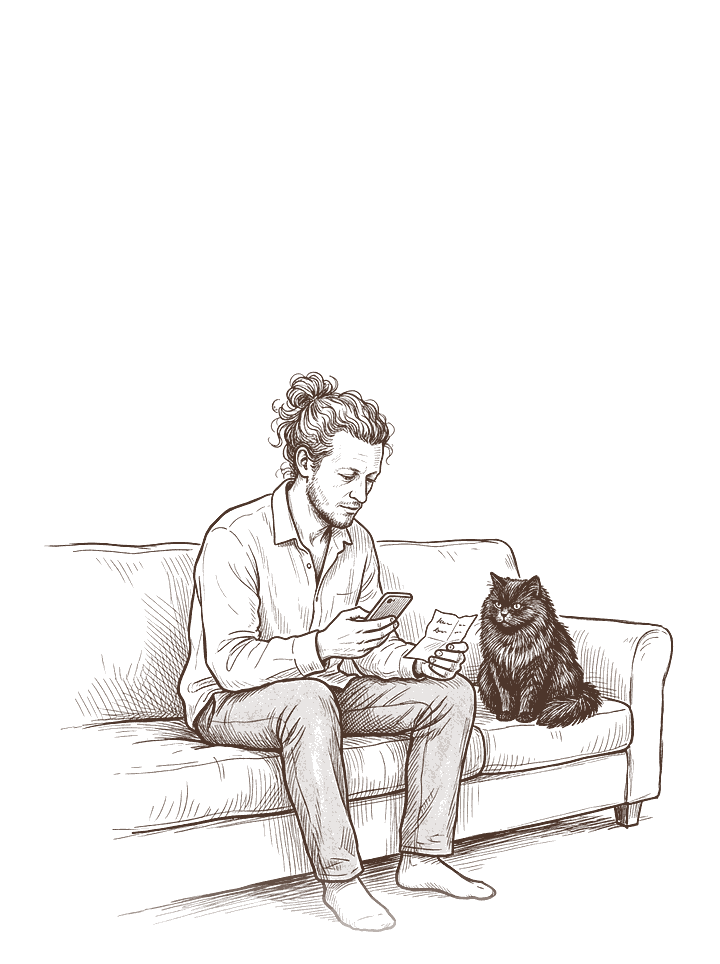
Self-help tools can organize a day or support a familiar routine. They cannot assess every reason that daily life has become difficult. Asking for professional help therefore does not require exhausting every tool first. It can begin with a description of what has changed.
Why the effect on daily life matters
NIMH's help guide considers severity, duration, and difficulties with daily activities. A checklist, exercise app, or planning tool cannot assess all those circumstances. If things are worsening, do not treat a public time threshold as an instruction to wait.
Changes in work, eating, sleep, relationships, concentration, or usual tasks can give the conversation a starting point. Those observations remain useful before anyone has chosen a clinical name.
Finding an access route
Primary care or an appropriately qualified mental-health professional can be a starting point. The practical questions include credentials, appointment format, cost, accessibility, and what the first conversation covers. A directory listing or social-media title does not itself verify qualifications. That makes the credentials question distinct from convenience or cost.
Wording for a first request
| Prompt | Words you can adapt |
|---|---|
| What is happening? | “I am having difficulty with ___.” |
| How long? | “It started around ___ and has changed by ___.” |
| Daily impact | “It is affecting ___.” |
| What I have tried | “I have used ___, but ___ remains difficult.” |
| What I want | “I would like an assessment and help choosing support.” |
| Access need | “Please explain costs and available appointment options.” |
The sheet helps formulate a request; it does not score symptoms or establish a diagnosis. If calling is difficult, a written request or help from a trusted person may be an option to ask about.
Urgent needs cannot wait for the worksheet
If you face immediate danger or cannot keep yourself safe, seek emergency help now. Do not wait to finish this sheet or receive a reply from a wellness website. This article does not provide crisis triage or a jurisdiction-specific helpline list.
Where self-help can still fit
A familiar routine may remain useful alongside an appropriate plan. Seeking support does not require abandoning every ordinary activity that helps. NIMH's guidance supports asking for help when difficulties persist or affect functioning. The request sheet has a narrower job: explain the concern and ask how to access support.
From Pavel’s experience
Personal experience — Pavel Rachkouski, founder. One person’s notes, not advice.
In Turkey I had agreed with a salon on a place to work, but they had few clients of their own. I had somewhere to work, and no idea where to find my own clients. About a week in, I understood I couldn’t pull it off on my own. I turned to my sister and to my old school teacher of Belarusian, who later worked as a psychologist at a school; we still keep in touch and send each other holiday greetings. I asked them both for help, and both met me halfway. That’s where it all started: she supported me while I was in Turkey, and I began trying things. Later we took her onto our team.
I have never gone to a specialist because there was something I couldn’t pull myself out of; I have a very strong psyche. But I have my mentor, my best friend, and he is like a psychologist too. I can discuss anything with him. Maybe there were times like that; those I talk through with him.
That is one person’s experience, not a reason to manage without help: the signs earlier on this page are the ones that call for support from a professional.