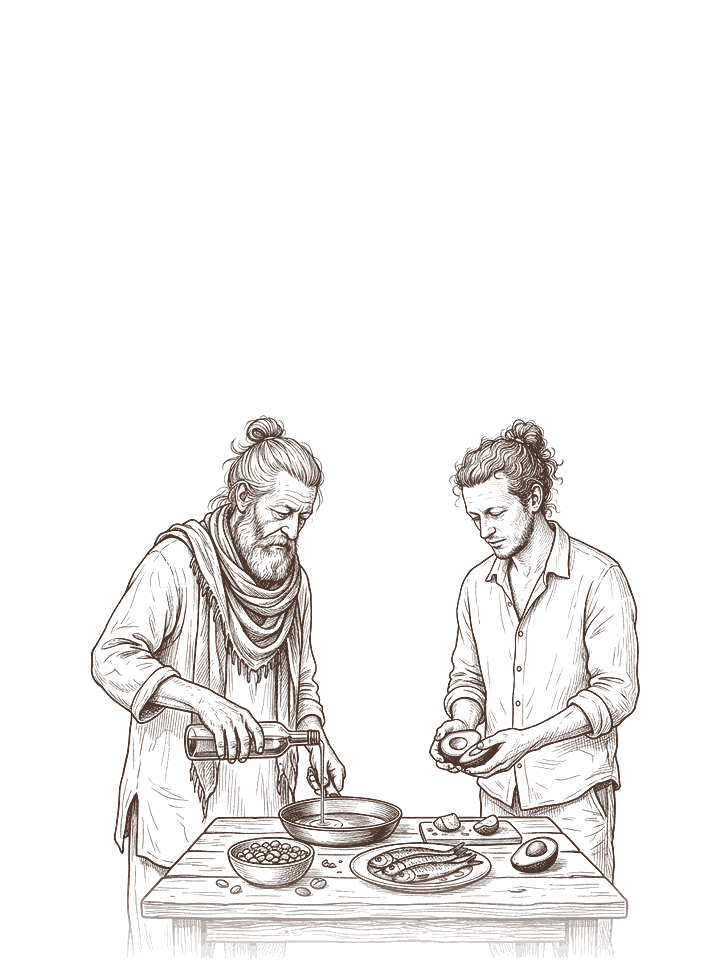
The fats that WHO and NHS guidance favour are unsaturated fats. The World Health Organization (WHO) says unsaturated fat is preferable to saturated fat, and that saturated and trans fat can be replaced with polyunsaturated or monounsaturated fat from plant sources.[1] The UK’s NHS says there is good evidence that replacing saturated fats with some unsaturated fats can help to lower cholesterol.[2]
The key word is replacing. The lists below are about which fat you choose, not about adding extra fat to meals.
Foods with unsaturated fat
Oils
- Olive oil
- Rapeseed oil (called canola oil in North America)
- Sunflower oil
- Soybean oil
- Flaxseed (linseed) oil
- Spreads made from olive or rapeseed oil
Nuts
- Almonds
- Brazil nuts
- Peanuts
- Walnuts
Fruit
- Avocado
Fish
- Oily fish: salmon, mackerel, sardines, herring, trout and kippers
WHO names fish, avocado, nuts, and sunflower, soybean, canola and olive oils as sources of unsaturated fat.[1] The NHS lists olive and rapeseed oil, avocados and some nuts as sources of monounsaturated fat, and oily fish as a source of omega-3 fats.[2]
Omega-3 sources suitable for vegetarians
The NHS says sources of omega-3 fatty acids suitable for vegetarians include flaxseed (linseed) oil, rapeseed oil, walnuts and egg enriched with omega-3.[2]
Two kinds of unsaturated fat
Most foods contain a mix of fats. The NHS says most fats and oils contain both saturated and unsaturated fats in different proportions, and MedlinePlus, from the U.S. National Library of Medicine, says the same of most foods. The lists above are the foods the guidance names as sources of unsaturated fat.
Monounsaturated fat is found in olive oil, rapeseed oil and spreads made from them, avocados, and some nuts such as almonds, Brazil nuts and peanuts.[2] MedlinePlus adds canola, sunflower, sesame, peanut and high-oleic safflower oils, and peanut butter.[3]
Polyunsaturated fat comes in two main types, omega-6 and omega-3. The NHS lists rapeseed, corn and sunflower oils, and walnuts, almonds and cashews, for omega-6, and oily fish for omega-3.[2] MedlinePlus lists walnuts, sunflower seeds, flax seeds or flax oil, fish such as salmon, mackerel, herring, albacore tuna and trout, and corn, soybean and safflower oils.[4] Some omega-3 and omega-6 fats cannot be made by the body, so small amounts have to come from food.[2]
Foods higher in saturated fat
These are the foods WHO lists as sources of saturated fat, the fat the guidance suggests replacing:[1]
- Fatty meat
- Butter
- Cream
- Cheese
- Ghee
- Lard
- Palm oil
- Coconut oil
Coconut oil is plant-based, but WHO places it with the saturated fats, not the unsaturated ones.
WHO also says industrially produced trans fats are not part of a healthy diet and should be avoided.[1]
Healthy fats are still high in energy
The NHS points out that all types of fat are high in energy: about 9 kcal per gram, compared with about 4 kcal per gram for protein and carbohydrate.[2] That is why the guidance is about replacing, not adding: WHO’s examples include replacing butter, lard and ghee with oils rich in polyunsaturated fat, such as soybean, canola (rapeseed), corn, safflower and sunflower oils.[1]
How much fat the guidance mentions
WHO says that for adults at least 15% of daily energy should come from fat, and that limiting total fat to 30% or less may help prevent unhealthy weight gain. It also says no more than 10% of energy should come from saturated fat and no more than 1% from trans fat.[1] UK government advice, as the NHS describes it, is that men should not eat more than 30 g of saturated fat a day, women not more than 20 g, and children less; adults should not have more than about 5 g of trans fats a day.[2] These are population figures, not a personal target.
Check the label
Packaged foods vary, so a food’s name doesn’t tell you everything. The NHS notes that nutrition labels on food packaging can help you cut down on total fat and saturated fat (sometimes listed as “saturates” or “sat fat”).[2] How to Read a Nutrition Label Without Overthinking It explains where to look, and Saturated and Unsaturated Fats: Make a Practical Food Swap walks through comparing two products at the same amount.
On a UK label, the NHS describes more than 17.5 g of fat per 100 g as high and 3 g or less as low. For saturated fat, more than 5 g per 100 g is high and 1.5 g or less is low. A product labelled lower fat, reduced fat or light must have at least 30% less fat than a similar product, but it can still be high in fat, and the NHS notes it is not necessarily lower in calories.[2]
Frequently asked questions
Do seeds count as a source of healthy fat?
Yes. MedlinePlus names sunflower seeds and flax seeds among the foods with more polyunsaturated fat.[4] Their fat still carries about 9 kcal per gram, so the replacing rule on this page applies to them too.
Which foods are high in saturated fat besides butter and cheese?
The NHS list adds sausages and pies, hard cheese such as cheddar, cream, soured cream and ice cream, some savoury snacks such as cheese crackers and some popcorn, chocolate confectionery, biscuits, cakes and pastries, and coconut cream.[2]
Is olive oil a healthy fat?
WHO and the NHS both place olive oil with the unsaturated fats.[1][2] Like every fat, it is about 9 kcal per gram, so the same replacing rule applies: in place of butter, lard or ghee, not on top of them.
If you’ve been given a specific diet for a health condition, ask the professional who gave it before making changes.