Begin with the person you would actually see
A business may advertise several practitioners under one brand. Ask who will conduct your appointment and look at that person’s information, rather than assuming the owner’s credentials apply to everyone working there. If a booking system assigns someone later, ask when you can see their professional details and whether you can change the booking before committing.
This matters especially when a service description emphasises particular training. You want to know whose training is being described. Keep spelling and location consistent when checking records. A matching first name or a similar business name is not enough to identify the practitioner.
Check the local route, not an international-looking badge
Regulation differs between places. A licence, a professional-association membership and a course certificate are different kinds of information. Do not treat the words as interchangeable. In the United States, the Federation of State Massage Therapy Boards provides a route to state licence lookups. Use the relevant authority’s result to check the person and status shown, rather than relying only on an image of a licence on the business website.
The directory is a checking route, not an endorsement of every advertised service. S15 Elsewhere, find the authority responsible for the location in which the person practises. If there is no applicable registration system, that is not a reason to invent one or accept any certificate as its equivalent. Ask more specifically about the training organisation and the service offered.
If a register shows a restriction or an unfamiliar status, read the authority’s explanation. Do not guess what it means from a colour, abbreviation or search snippet.
Is a massage therapist the same as a masseuse?
Both words have been used for people who give massage. The American Massage Therapy Association’s history of the profession says the titles masseuse and masseur became common in the 1880s, and that massage therapy and massage therapist began to replace them in the 1960s; the association itself began in 1943 as the American Association of Masseuses and Masseurs. A title does not tell you what someone is licensed or trained to do. Regulation differs between places, so check the person with the relevant local authority.
Match training to the advertised service
The question I use here is: “Which training prepared you to offer this particular service?” It connects the qualification to the advertised work. A general “Are you qualified?” can leave that connection unexplained. Ask for the programme name and issuing organisation. If specialist expertise is central to the advertisement, ask how that expertise was developed.
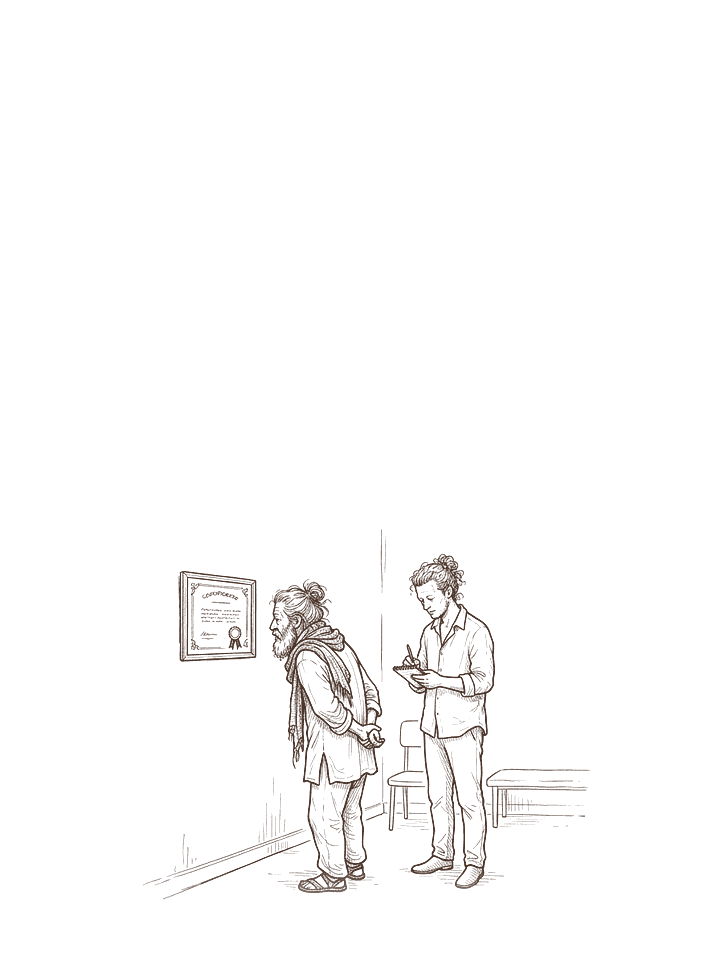
A certificate photograph can be a starting point for verification, but it does not automatically explain the course’s content, assessment or relevance. NCCIH specifically advises asking about a massage practitioner’s training, experience and credentials. Those are separate questions, not three ways of asking how many years someone has been working. S1 Someone can have extensive experience in one setting and little experience with another service.
Equally, a shorter biography is not proof of poor practice. Ask about the relevant work rather than using years as a complete quality score.
Listen for clear boundaries
Before booking, ask how the practitioner explains the proposed session and handles questions outside their role. A useful response describes what they can offer, what they cannot determine, and when another professional’s input may be needed. I include this question to clarify the service’s boundaries. A useful answer should leave you knowing which questions this practitioner can address. “I can explain the massage I offer, but that medical question belongs with your clinician” can be a clearer answer than an instant promise to solve everything.
Do not infer medical qualifications from words such as “holistic,” “expert” or “therapist” without checking the actual credential and its local meaning. Nor does a link to a doctor’s research establish that the doctor supervises this business.
Use reviews for the questions they can help answer
Reviews may suggest questions about communication, punctuality or how a booking problem was handled. They cannot independently establish a practitioner’s training or prove that a treatment caused a health improvement. A detailed review is still one person’s account. Look for information you can follow up, not a numerical threshold that makes someone automatically suitable. Awards and social-media popularity belong in the same category: potentially interesting background, not substitutes for the underlying checks.
Keep three small lists
Before deciding, record:
- Confirmed: the person’s identity and the relevant information you checked directly.
- Reported: details the practitioner supplied that you have not independently verified.
- Unclear: the remaining question that could change your decision.
Include the source link and the date of your check. Do not turn this note into a “safe practitioner” certificate. I have kept the three lists separate because a provider’s statement and a detail you checked independently are different kinds of information. The note should preserve that difference. You do not need a perfect biography. You need a named person, a credible explanation of their preparation, and a service whose boundaries make sense. If essential details remain vague, you can ask once more or choose not to book. A clear decision is more useful than collecting impressive claims you cannot interpret.
From Pavel’s experience
Personal experience — Pavel Rachkouski, founder. One person’s notes, not advice.
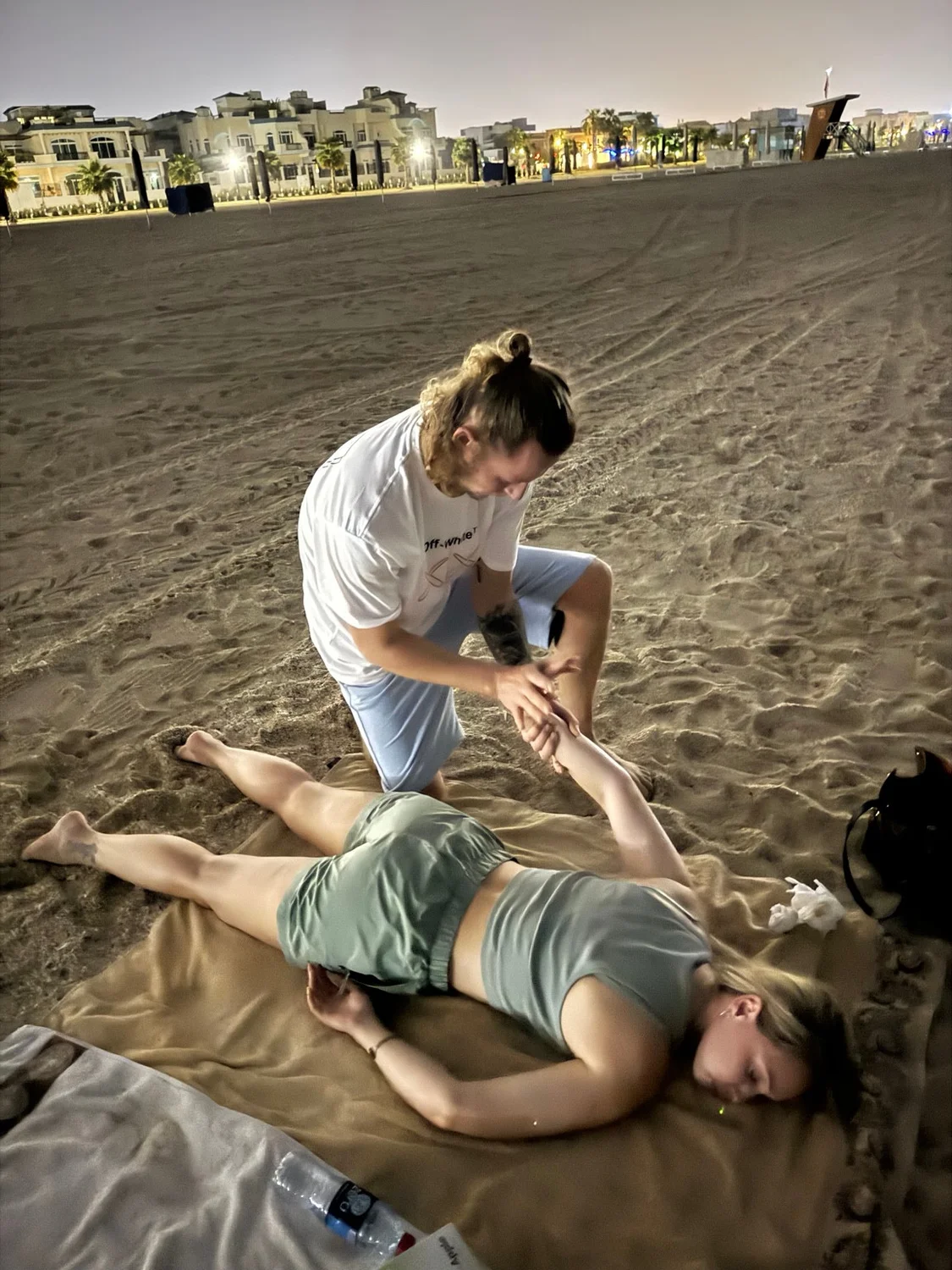
I have had about a thousand massages as a client: all over Turkey, in many places in Dubai, and at home. First I look at whether I like the person at all. For me the main question is not their qualification. It is whether I can relax with this person and let them see more than I might want them to see, because people open up during a massage. As a massage therapist, for a while I worked through pain: I found trigger points and pressed them until they gave in. That is how I explained it to myself then. After I met osteopaths in Turkey, I started working much more gently, with touch, looking at how and in what position a muscle is tense. I am not a doctor; I understand this through touching people, not through science. Every person needs their own approach.
Most of the therapists I have been to, 90%, I’d boldly say 97%, work from a template: same strokes, same count, everywhere, and off they go. They don’t sense where to stop, where to linger and work an area. I create a situation in which I catch the trigger points and work with them: on one side I can work for half an hour, on the other for 15 minutes if there’s nothing serious there.
Where would you be in Thailand without a Thai massage? In Bangkok I went to places for $5 and for $25. To put it mildly, I didn’t like them: the ones I went to all worked from a template, for tourists, so that you pay faster, leave, and they can seat the next person.