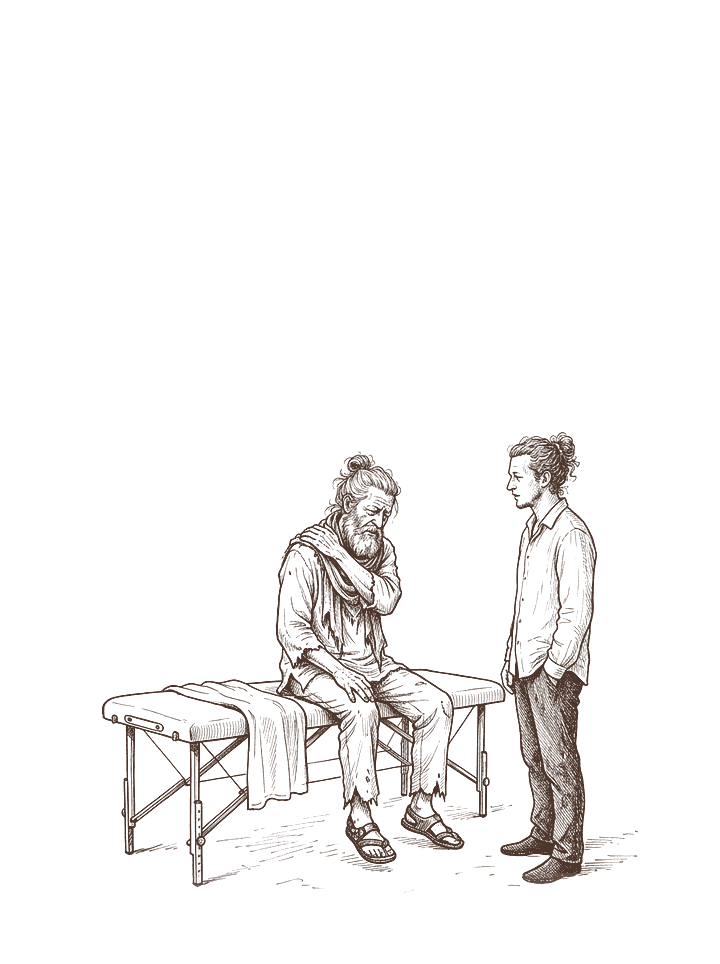
Feeling sore after a massage does not, on its own, show that the massage worked. “I noticed a sensation,” “the massage caused it” and “that proves the intended benefit occurred” are three separate claims: the first reports an experience, the second makes a causal claim and the third claims effectiveness. Ask the provider what result they are referring to and how it was evaluated. A symptom question belongs in an appropriate healthcare conversation.
“You will know it worked because you will feel sore” is a claim about how to judge a massage. It joins an experience to a conclusion about benefit without explaining how that conclusion was established.
I examine that link between sensation and claimed benefit here. I cannot explain a particular person’s soreness, classify symptoms or give aftercare instructions. My question is narrower: what evidence would support using a sensation as proof of the advertised result?
Define the promised result first
A provider may offer a quiet appointment, a particular massage format or a claimed change in a measured outcome. These are different promises. Before accepting “you will feel it” as an answer, ask what the service is actually meant to deliver.
For example, enjoying an unhurried appointment is an experience you can describe. A claim about treating a condition needs evidence that addresses that condition. An intense sensation does not fill the gap between those statements.
A useful question is: “What result are you referring to, and how was it evaluated?” The provider’s answer should identify the result rather than repeat that a technique is powerful or deep.
Separate an observation from its explanation
I separate the claim into three sentences: “I noticed a sensation after the appointment.” “The massage caused it.” “That proves the intended benefit occurred.” Each adds something to the one before it.
The first reports an experience. The second makes a causal claim. The third claims effectiveness. They cannot be treated as interchangeable descriptions simply because they appear together in a testimonial.
This distinction does not dismiss someone’s experience. It leaves the observation intact while asking what supports the additional conclusions. An account can be honest without answering every question about cause or benefit.
Read the comparison, not just the testimonial
When a service uses research to support a claim, ask which intervention was studied, who took part, what outcome was measured and what it was compared with. A named study is a starting point for checking the claim, not a substitute for those details.
The sports-massage review by Davis and colleagues separates performance and recovery outcomes instead of giving massage one overall score. S3 I use that structure to keep the advertising claim tied to the outcome actually measured.
A photograph, a review saying “I really felt it,” or a practitioner’s explanation does not become a controlled comparison by being persuasive. Ask for the source that addresses the particular claim.
Do not turn intensity into an obligation
In Mayo Clinic Health System’s article, licensed massage therapist Ivy Conrad explains that massage need not be painful to be effective. CONRAD I attribute that statement to Conrad; I am not offering it as my own clinical assessment or as an explanation of your symptoms.
The statement also does not mean that every comfortable massage is effective. Comfort and effectiveness remain different questions. A preference for less pressure does not need to be defended with a claim that one intensity is universally best.
The separate guide to pressure and consent supplies practical wording for changes and pauses. Ontario’s consent standard recognises that consent continues throughout the session and can be withdrawn. S11 It is a jurisdiction-specific professional standard, not a universal description of local law.
Keep a purchase decision separate from a health conclusion
You can decide whether you liked the setting, understood the service and want to consider another visit. Those observations can inform a personal preference without becoming evidence that a biological change occurred.
Before accepting a package justified by soreness or intensity, write down four questions:
-
What precise benefit is being claimed?
-
What evidence links the proposed service to that benefit?
-
Is the quoted outcome the same as the sensation being described?
-
What uncertainty is the explanation leaving out?
A clear answer should keep those distinctions visible. This article does not provide a score, a threshold or a rule for interpreting your own reaction to massage.
Keep the boundary visible
A symptom question belongs in an appropriate healthcare conversation; an advertising claim belongs under scrutiny. NCCIH advises against using massage to postpone attention to a medical problem. S1 Reading an explanation of evidence cannot determine what happened in an individual appointment.
Sensation alone is not a demonstration of the promised benefit. That is the limit of the conclusion I draw here. It gives you a reason to ask for a clearer explanation of the claim; it does not interpret your own reaction to a massage.
From Pavel’s experience
Personal experience — Pavel Rachkouski, founder. One person’s notes, not advice.
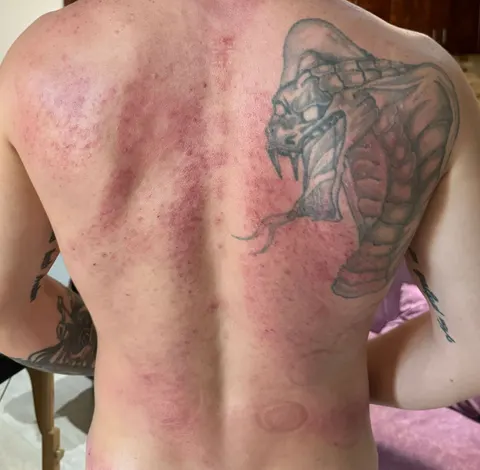
I have had a painful massage myself: gua sha, cupping and deep-tissue work, all in one session, from a person I trusted. I managed to switch off completely, almost like a trance. Afterwards he told me that in places he pressed so hard he couldn’t understand why I didn’t react. During the session I felt fine. Near the end I started shaking and felt cold; after a shower it passed. I felt as if another body’s worth of weight had been lifted off me, and I was light. The next day it hurt, and to me it felt like a “good” soreness: not because something broke, but because I had been worked hard. Still, I am not a supporter of this kind of massage now. I went only because I trusted that person. With someone I didn’t know I could not have relaxed, and it would only have hurt more.
After every session I always give the person a glass of water to drink; it feels good to have some water afterwards.
Frequently asked questions
Does a massage have to hurt to work?
No. In Mayo Clinic Health System’s article, licensed massage therapist Ivy Conrad explains that massage need not be painful to be effective. An intense sensation does not by itself show a benefit.
What should I ask if a therapist says soreness means it worked?
Ask what result they are referring to and how it was evaluated: which intervention was studied, who took part, what outcome was measured and what it was compared with.
Is it normal to be sore a day or two after a massage?
Mayo Clinic notes that some soreness can happen the next day, depending on the type of massage, and that you should not feel severe pain during a massage; ask for lighter pressure if anything feels too strong. It does not set a normal number of days. This article cannot explain a particular person’s soreness or classify symptoms. A symptom question belongs in an appropriate healthcare conversation.
Is this article medical advice about my soreness?
No. It cannot explain a particular person’s soreness, classify symptoms or give aftercare instructions. A symptom question belongs in an appropriate healthcare conversation.
Source-reading limit
The Davis paper has a 2021 correction concerning figure 3. The published abstract and the correction record were available, but the complete corrected figure was not independently inspected for this guide. We do not reproduce or derive estimates from that figure. This is a limited, attributed account of the authors’ reported findings, not a new analysis or a treatment recommendation.