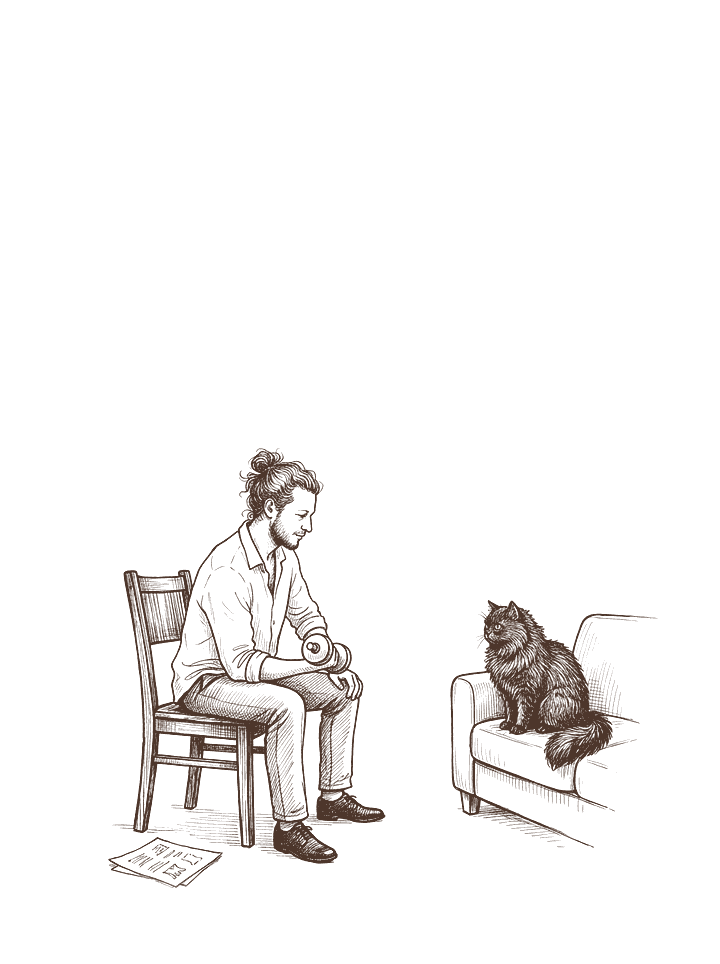
Four exercise names can look like a ready-made home workout. The missing details are the setup, movement, and appropriate amount. Here, four NHS examples show what to look for in a demonstration. They introduce different actions, rather than a complete program for every person or muscle group.
Set up before moving
Use a stable chair without wheels, a clear floor, and a solid wall. Wear clothing that allows comfortable movement. The NHS strength guide explains the starting positions and includes demonstrations under each exercise name. Read the full instructions alongside the summaries below. If a starting position is uncomfortable or unfamiliar, an exercise professional can help clarify an appropriate alternative.
Sit to stand
In the NHS demonstration, the starting position is near the chair's front edge, with feet hip-width apart. The movement involves leaning slightly forward, standing slowly using the legs, then returning slowly to sitting. The gaze stays forward; hands can guide the return if needed. Notice the controlled return as well as the rise. Difficulty standing without your arms is a reason to clarify the version.
Wall press-up
The NHS version starts about an arm's length from a wall. Palms are at chest height, with fingers pointing upward. The back stays straight as the arms bend slowly, with elbows beside the body. The return is controlled. Notice the starting distance and arm position. The demonstration describes controlled movement, rather than falling forward or pushing away abruptly.
Supported calf raise
This version starts behind a stable chair, with hands resting on its back. Both heels rise within a comfortable range and lower slowly. The chair support belongs to this version. Removing it changes the balance demand rather than simply improving the same exercise.
Biceps curl
The curl starts with light weights and arms beside the body. The elbows bend slowly, bringing the weights toward the shoulders, before the weights lower under control. The NHS also describes a seated version. Check which position the demonstration explains before comparing it with another version. These descriptions follow the corresponding NHS exercise sections, rather than introducing a new training method.
Record the version you learned
| Movement | Setup to remember | Record after instruction |
|---|---|---|
| Sit to stand | Stable chair; controlled return | Chair used: ___; support needed: ___ |
| Wall press-up | Solid wall; palms at chest height | Starting distance: ___; question: ___ |
| Calf raise | Chair support; controlled lowering | Support used: ___; question: ___ |
| Curl | Light resistance; controlled elbow movement | Weight and position taught: ___ |
The NHS examples use different repetition and set counts. Combining those counts does not automatically create your first session. An appropriately qualified instructor can help choose exercises, resistance, and amount when those details are unclear. The ACSM explanation emphasizes matching training to goals rather than requiring complex techniques.
Stop an exercise that causes pain or makes you unwell. Seek appropriate advice rather than repeating it to prove completion. Keep the demonstration and your setup notes together. A familiar exercise name alone leaves too much of the movement unspecified.
From Pavel’s experience
Personal experience — Pavel Rachkouski, founder. One person’s notes, not advice.
Every day I do exactly 20 push-ups and 30 squats. In one go I could surely do 50 to 70, but I haven’t tested it. I have been in sport since childhood: six years of taekwondo, six years of cycling, and all my life pull-up bars, parallel bars, push-ups and squats. Later came years of boxing and gym training. Now it’s tennis and the pull-up bar every day. All my life I have walked side by side with sport.
I don’t do sets: I hang from the bar. I keep checking myself: I can do 10 to 12 pull-ups steadily, but I don’t work on results. For me the bar is more about stretching my back and spine. I spent years training hard.