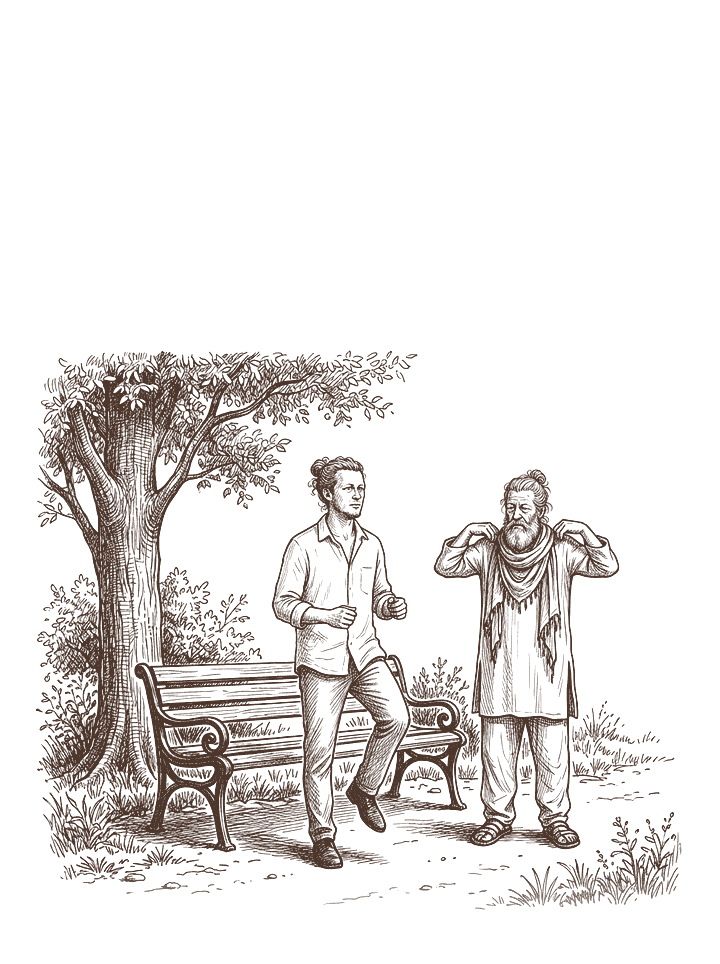
A warm-up eases you into exercise with an easier version of the activity before harder effort — for walking, starting more slowly before increasing the pace. A cool-down slows the pace gradually at the end. Stretching is a separate activity: MedlinePlus notes uncertainty about whether stretching specifically prevents injury, so it is not a guarantee against injury or later soreness.
Warm-up, cool-down, and stretching often appear together in exercise instructions, but each term needs its own explanation. The first introduces the activity gradually; the second brings the pace down afterward. Stretching is a separate activity, rather than another name for either transition.
Begin with an easier version
MedlinePlus describes warming up through easier movement before harder activity. For walking, that may mean starting more slowly before increasing the pace. The point is a transition into the activity, rather than collecting unrelated movements.
The NHS warm-up page gives examples including marching, heel movements, and knee lifts. Read that routine as a specific example. Its timing does not establish a universal minimum for every activity. Use movements you understand, with suitable instruction for anything unfamiliar.
Bring the pace down
MedlinePlus describes cooling down by slowing gradually. For a walking session, the final part can be easier than the main section. A strength class may have a different ending, so follow that session's instructions rather than copying a walking example.
Do not make stretching a guarantee
The NHS post-exercise guide illustrates controlled stretches. MedlinePlus notes uncertainty about stretching specifically preventing injury. Neither source supports promising that stretching removes later soreness or makes every session safe. Do not force a painful position to complete a cool-down checklist.
Keep a three-part session note
| Part | Walking example | Your actual instruction |
|---|---|---|
| Easier beginning | Start at a gentler pace | ___ |
| Main activity | Follow the suitable outing you planned | ___ |
| Gradual ending | Reduce the pace before finishing | ___ |
| Separate stretching question | Use only familiar, appropriate instructions | Provider or source: ___ |
Use this table to describe an existing session. The empty fields do not prescribe additional exercise. There is no need to invent a stretch simply because a box is blank.
If exercise causes pain or makes you unwell, stop and seek appropriate advice. The session note should explain how the activity begins and ends, with any stretching recorded separately. It cannot establish whether the underlying exercise is suitable for a medical condition.
Frequently asked questions
What is a good warm-up?
An easier version of the activity you are about to do. The NHS warm-up page gives examples including marching, heel movements and knee lifts; its timing is a specific example, not a universal minimum for every activity.
Is stretching the same as a cool-down?
No. A cool-down slows the activity down gradually; stretching is a separate activity, not another name for either transition.
Does stretching prevent injury?
MedlinePlus notes uncertainty about stretching specifically preventing injury. Do not force a painful position, and if exercise causes pain or makes you unwell, stop and seek appropriate advice.