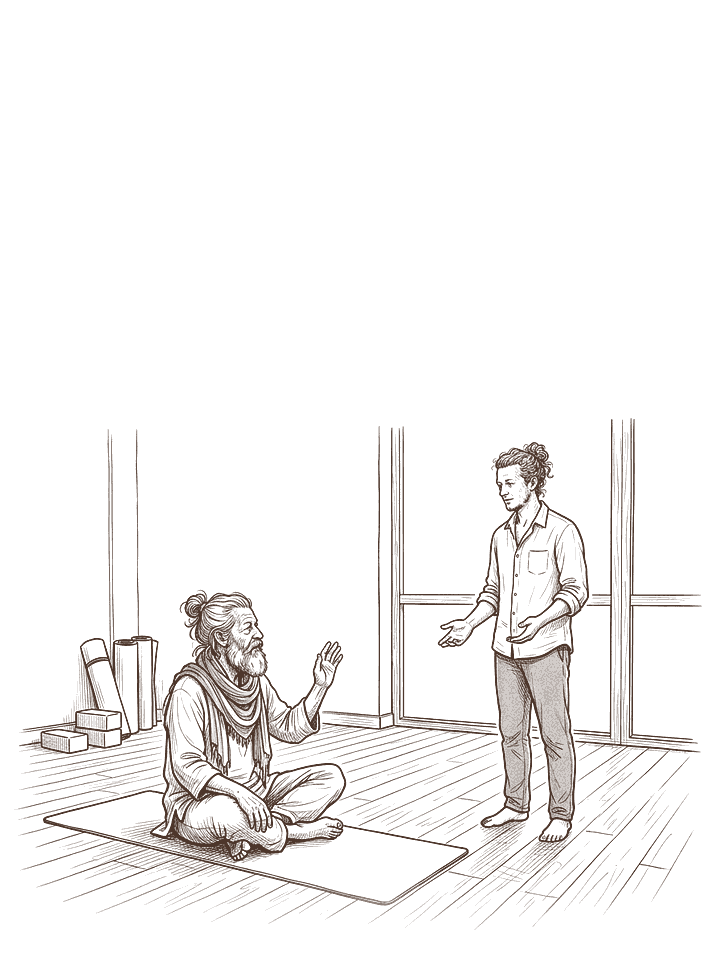
A hands-on adjustment involves two separate questions: what the teacher proposes, and whether you agree to it. You can ask for an explanation, decline touch, or change an earlier answer. Permission in a previous class does not settle your answer today.
Ask how the class handles touch
Before joining, ask whether the teacher uses physical adjustments and how permission is requested. The Yoga Alliance Code of Conduct, under “Consent-Based Touch,” requires explicit informed consent from its members. It treats consent as an ongoing process. This is an organizational professional rule, not a statement that every jurisdiction has identical law.
Use a clear sentence
You do not need an elaborate explanation. Choose wording that says what you want now.
| Situation | Words you can use |
|---|---|
| No touch today | “Please use verbal instructions only today.” |
| You need information first | “Please explain the adjustment before I decide.” |
| You want a demonstration | “Could you show me without touching me?” |
| You change your mind | “Please stop. I do not want this adjustment.” |
| You prefer to observe | “I would like to watch this part.” |
These phrases help make your current preference clear. They are not a legal consent form. A class's card system or sign-up process should not prevent you from changing your answer.
Separate consent from technique
Agreeing to touch does not establish that an adjustment is appropriate for an injury or medical condition. A teacher's association membership also does not establish medical qualifications. Ask suitable healthcare questions separately, as NCCIH's yoga guidance recommends for individual health circumstances.
Keep an alternative available
Ask whether the teacher can explain verbally, demonstrate nearby, or let you skip an adjustment. An alternative lets you discuss participation without assuming physical adjustment is required. If your boundary is ignored, stop participating in that interaction and seek an appropriate way to address it.
Before another class, decide whether you need a clearer conversation or a different provider. The conversation should leave no uncertainty about your current preference. A clear “no” needs no elaborate explanation.