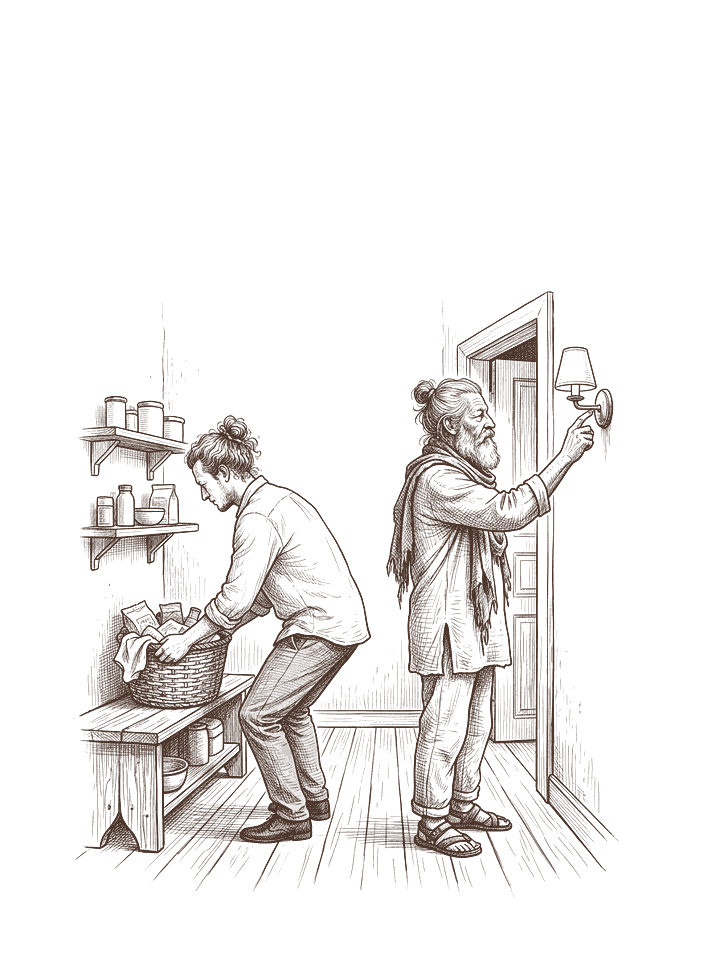
Pick one familiar route at home, such as front door to kitchen, and check three things: items left on the floor or across the route, everyday items stored where they are hard to reach, and the lights you use along the way. CDC’s home checklist names objects on floors and stairs, cords across routes, frequently used items on high shelves and light along the route to the bathroom. Sort each finding into arrange, ask or refer, and hand repairs, lifting and electrical work to the right person. A walkthrough like this is not a professional home-safety inspection.
Parcels beside the door and everyday mugs behind rarely used dishes are easy to stop noticing. Choose one such inconvenience and follow it through: where does the item belong, who uses that space, and does the change leave the route clear?
The walkthrough below separates things you can arrange from questions to ask and repairs to hand over. Work with one part of the day and the furniture and storage already available; a whole-house makeover is unnecessary.
Start with one ordinary journey
Follow one familiar journey in words: arriving at the front door, putting down a bag and going to the kitchen, for example. Note the items and controls used along that route before deciding what to rearrange.
Begin with one room or one familiar route. Note where everyday items and existing light controls are placed, then revisit the arrangement when your needs change. For broader background, see NIA: Aging in Place.
Look from places you already use comfortably. You do not need to test a difficult reach, walk in darkness or move heavy furniture to make a note. If you are helping someone else, ask which part of their day they want to make easier before rearranging their belongings.
Give the route priority over temporary storage
Notice what has acquired a place along the route without an actual storage decision: shoes, shopping bags, laundry, boxes or a charging cable. CDC’s home checklist identifies objects on floors and stairs, furniture in walking paths and cords across routes as things to address. CDC: Check for Safety
Give a small movable item a destination that leaves the route clear. Put a parcel on an existing shelf until opened, or return shoes to their agreed storage. Moving clutter to another doorway or leaving it on stairs carries the problem elsewhere.
Keep the solution usable by everyone sharing the space. A basket solves little if its new home blocks another person’s route. Where furniture needs moving, record the job and arrange suitable help rather than treating the walkthrough as a lifting session.
At a doorway, note any raised threshold, loose edge or damaged surface you want advice about. Do not improvise a covering or assume a furniture change resolves it.
Put frequent-use items where they are easy to get
Identify what you actually reach for each day—the mug, pan, glasses case or folder. Use that pattern to choose what belongs within easy reach; an old cupboard arrangement need not dictate the current one.
CDC’s home checklist draws attention to frequently used things stored on high shelves. Start with those items when deciding what to move. The NIA room-by-room guide offers additional background.
Choose a small set to reorganize. You might give everyday mugs an accessible existing shelf and keep occasional serving dishes elsewhere. Do not climb or balance on furniture to retrieve them; ask for help with the move. Leave unfamiliar equipment, medicines and anything with special storage requirements under their own instructions.
Agree on the new location with other users. “The two mugs we use each morning go here” is more useful than reorganizing an entire cupboard into a system only one person understands.
Notice how the lighting works during ordinary use
Find the controls you use when entering or leaving the space. Is a familiar switch hidden by stored items? Is a lamp’s control inconveniently placed? Is there a known lighting problem that needs reporting?
A route that is bright by day may use different lighting after dark. Identify the existing lights you normally need before starting that journey, and keep that route lighting available.
CDC’s checklist includes reachable bedside lighting and light along the route to the bathroom. CDC: Check for Safety
Check the ordinary arrangement around existing controls. Papers may simply need moving away from a switch. Keep lamp cables out of routes, and record a difficult reach without attempting it. Do not turn lights off to test how you navigate.
Electrical work, new outlets and faulty fittings are jobs to discuss with the appropriate professional or property manager, not tasks this article teaches.
Separate rearranging from repairs
Use three labels:
-
Arrange: an ordinary small-item change you can comfortably make and have agreed with anyone affected.
-
Ask: someone else’s belongings, a shared-space decision or a question about a better location.
-
Refer: lifting, repairs, electrical work, permanent alterations or anything needing assessment beyond ordinary organization.
A loose railing or damaged step is not solved by ticking a box. Report it through the appropriate repair route and do not attempt to test it. The official NIA and CDC resources cover broader home-safety matters; this walkthrough is not a substitute for those resources or a professional inspection.
Work through a before-and-after example
In this fictional household, Lee and Pat choose the route from their front door to the kitchen.
| Before | Agreed next step | What they check afterward |
|---|---|---|
| Parcels collect beside the entrance | Use an existing shelf for unopened parcels | The entrance and another route remain clear |
| Everyday mugs are behind serving dishes | Ask for help moving the mugs to a convenient existing shelf | Both people know where the mugs now belong |
| Stored papers obscure a light switch | Move the papers to their household folder | The switch is visible and available |
| A fitting needs repair | Report it to the property manager | Keep the repair request open until addressed |
The result is not a declaration that the home is safe. It is a clearer arrangement plus an unresolved repair with a known next step.
Copy a home-use note
Use one row per observation:
-
Route or ordinary task:
-
What I noticed, without testing it:
-
Item’s proposed home or question to resolve:
-
Arrange, ask or refer:
-
Person whose agreement or help is needed:
-
What is confirmed, and what remains open:
Check the change during ordinary use. If the parcel shelf has made another task awkward, reconsider its location with the household. Keep unresolved repairs visible even when the small-item arrangement now works.
For a broader discussion of the activities you value, see Everyday Abilities. For light and sound around sleep, use the separate bedroom review.
Prepared with AI assistance and compared with the linked primary-source guidance. This ordinary practical guide has not received independent human fact-checking or medical review. It is not a home-safety inspection, falls-risk assessment or assessment of anyone’s abilities.
Frequently asked questions
What should a home walkthrough check?
Start with one ordinary route and note what sits on the floor or across it, where the everyday items you use are stored, and which light controls you use along the way. You do not need to test a difficult reach or walk in darkness to make a note.
What does the CDC home checklist point out?
It identifies objects on floors and stairs, furniture in walking paths and cords across routes, frequently used things stored on high shelves, reachable bedside lighting and light along the route to the bathroom.
What should I do about a loose railing or damaged step?
Report it through the appropriate repair route, such as a property manager, and do not test it yourself. Lifting, repairs, electrical work and permanent changes are jobs to refer, not to improvise.
How do I rearrange things when other people share the home?
Agree the new location with everyone who uses the space, and make sure a new storage spot does not block someone else’s route. If you are helping another person, ask which part of their day they want to make easier first.
Does this walkthrough make a home safe?
No. It gives you a clearer arrangement and a list of open questions. It is not a home-safety inspection, a falls-risk assessment or an assessment of anyone’s abilities.