In short: Farmerleaf is one of the shops Pavel and a friend found when they went looking for tea from the farms themselves. The order arrived a while ago, nicely packed. Of its teas he has drunk the Spring 2024 He Kai, a pu-erh he liked very much; several bags are still unopened. This page does not give the shop a rating.
How we found them
It is the same story as with Taiwan Tea Crafts. Apart from Chaynaya Pochta and what I bought in Dubai, all the other teas we found exactly this way. I think we found them through GPT: we asked it to find us the best tea farms. It searched something for us, and we read the reviews.
How it arrived
Everything was beautiful. The boxes are long gone now; it arrived a while ago.
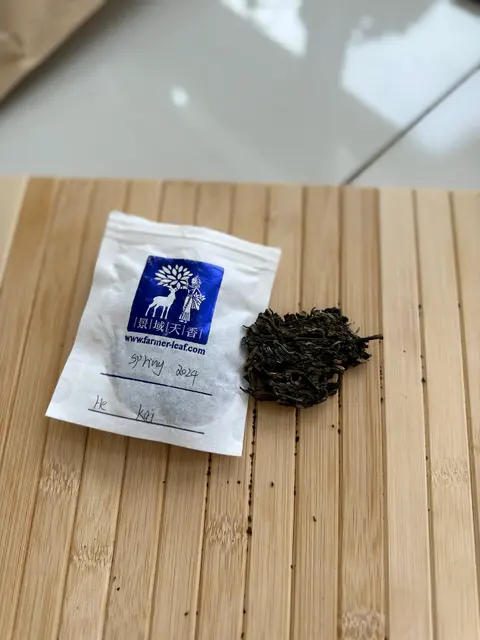
The one I have drunk: Spring 2024 He Kai
I have tried this one. It has a very interesting taste, by the way. I don’t know how to put it: either carbide or metal, but it is so tasty, grippy. I put in 10 grams. And it woke me up: a light, happy lift. It isn’t intoxication. It went down very well with me. It has that grip, a bitterness of its own, not like the one I described in my milk oolong: the grip is right there, then you go on feeling it along your tongue, you swallow your saliva, and for about an hour and a half you still feel as if you are drinking tea. That is roughly what this tea is like.
The seller describes this tea as a spring 2024 pu-erh from Man Nong village in Hekai, in western Menghai, picked from ancient tea gardens, small and big trees together. It calls Hekai one of the softer mountains of Menghai, with low bitterness and astringency, a medium body and “good minerality” [3]. These are the seller’s words about its own tea; we have not checked them.
What else is on my shelf
I still have some unopened. Tea keeps being brought to me all the time; physically I can’t taste that much of it.
The other Farmerleaf bags in Pavel’s collection are marked by hand: Spring 2025 Jingmai Mi Yun, Spring 2025 Ban Pen, and Spring 2025 Jingmai Ripe, a shu described on the shu pu-erh page. He has not described how the others taste, so this page does not either.
What the shop says about itself
Farmerleaf says it was created in 2016 and is based in Puer city, Yunnan, where it has its office and storehouse. It says it has a tea factory in a family house on top of Jingmai Mountain, where it makes pu-erh every spring and autumn, and that it also sells pu-erh cakes and loose-leaf black, oolong, green and white teas from other producers [1].
On shipping, its page says orders ship from Puer city, usually within 48 hours. Shipping terms are on Farmerleaf’s own site. It uses EMS e-packets where available, with about a week to the USA and two to four weeks to Europe, and otherwise China Post SAL, two to four weeks anywhere. It warns that some countries’ customs may stop tea parcels without export paperwork and that local taxes are the buyer’s [2]. How long Pavel’s order took, he did not say.
What this review does not cover
- Bought together with a friend. Payment, checkout and delivery time are not described here.
- One tea tasted so far. The other bags have no tasting notes on this page.
- No rating and no stars.
- The shop’s claims about its factory and gardens are its own (above), not checked by us.
Questions people ask
Where does Farmerleaf ship from?
From Puer city in Yunnan, China, according to the shop’s shipping page [2].
How long does Farmerleaf shipping take?
The shop gives about a week to the USA and two to four weeks to Europe by e-packet, and two to four weeks anywhere by China Post SAL [2]. Pavel’s order arrived a while ago, nicely packed; he did not note how long it took.
Is Farmerleaf legit?
We can speak only for what reached Pavel: it arrived, everything in it was beautifully packed, and the He Kai pu-erh from it was, in Pavel’s words, very tasty. The shop describes itself as based in Puer city with a tea factory on Jingmai Mountain [1].