In short: milk oolong usually means Jin Xuan, a Taiwanese oolong cultivar whose milky note is natural; some milk oolongs are flavoured with artificial flavourings, and reputable sellers say which [1]. I love it, and I keep running into ones that taste “not right”.
On a mountain above Fethiye
On 1 March 2025 I flew to see a friend in Fethiye, Turkey. He practises yoga. We sat on a mountain and drank tea. It was a clear day, the weather was good, and we looked down at the marina. (More of our tea walks around Fethiye are in my purple pu-erh notes.)
There he told me a story that stayed with me. It’s a real story, and it is about milk oolong. His milk oolong is, in his words, very close to the real thing, but he knows himself that it isn’t real. He has been chasing a real one for about ten years, and he says that in his whole life he has never tried a milk oolong that was truly real: without admixtures, without any junk.
At his place in Turkey I did try his milk oolong, and it had a clean milky taste.
A separate love
I really like milk oolong. It’s a separate love of mine. I try not to drink too much of it, so that I don’t get tired of it. What I love is that delicate milky taste, which you don’t find in every tea. I have a milk oolong in my collection now too. My other teas are gathered in my tea collection.
Three hours on a mountain in the UAE
I think everything depends on the person who brews: how the tea goes is up to them. Once three of us met in the mountains, at the restaurant on Jebel Jais, the highest mountain in the UAE, and we sat there for about three hours. We had milk oolong and plum GABA, with biscuits. I had a thermos of water, and in the restaurant we asked and they topped it up. I had brought a gaiwan and three cups; I have travel ones. I’m not exactly a serious tea person, but I do carry some gear. (More about that day is in what oolong is made from and on my GABA page.)
Why the milk oolong here tastes “not right”
A friend passed me a milk oolong from Moscow, from the shop I buy from, and I have bought it here in Dubai too. None of it is quite right. It’s as if there is a slight added scent. There is either a little bitterness or something else. The water seems right (see choosing water for tea), so I can’t tell what the problem is. Maybe they spray it with something. Maybe it isn’t real, in every one I come across.
How I brew it
For the first infusions I use 90–95 °C: I scald the leaf. Then, once the leaf has opened, I go down to about 80, around 85, give or take. A gaiwan or a small teapot suits it (see choosing tea ware).
An evening brew
On the evening of 15 November I brewed milk oolong. For the evening I weighed out this much leaf: 5.64 grams. I like it a little grippy, so normally I would put in more, but I was going to sleep soon, and I won’t drink strong tea at night.
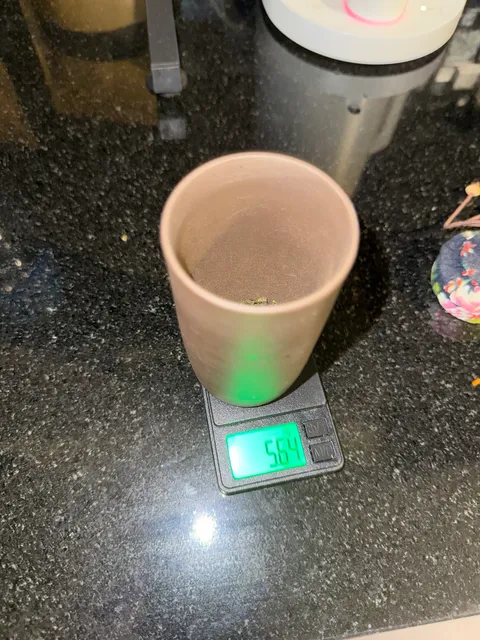
The kettle showed 97 °C. I pour the water into a thermos, the thermos cools it by another couple of degrees, and I pour it onto the leaf at around 95. I keep each infusion roughly a minute, a minute and a half, by eye. I was drinking it on the third infusion: excellent, soft, no bitterness at all.
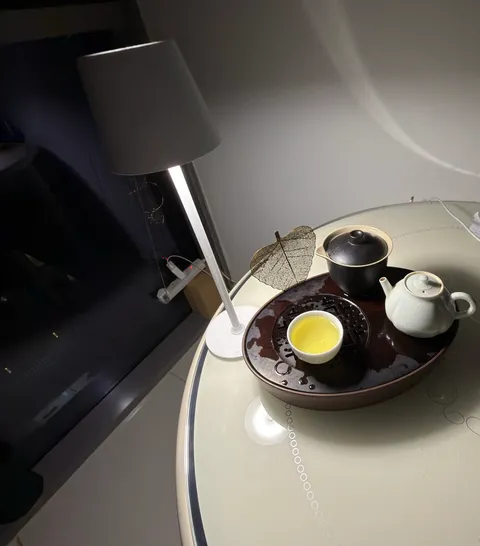
I bought this one at a tea mall, in the same shop where I bought my white teapot and a Da Hong Pao. I’d bet a hundred percent it has some admixture in it; it’s definitely not real. It’s all right: not the worst I’ve tried, not the best. There is a creamy note, a pleasant one. Basically, I like it. I wouldn’t say it’s bad.
On the fourth infusion I wasn’t paying attention for a moment, and the tea stood for about five minutes. And that is when it came: no bitterness, and a grip on the tongue appeared, such a pleasant one that my mouth started watering. A little later, in the same cup, a small, faint, delicate note of bitterness appeared, but not a bothersome one at all, as if it had been expected right there.
On the sixth infusion the milk oolong finished its taste. I was finishing the seventh: the colour holds, but the taste is only just there; by the sixth and seventh infusions it is very, very faint. And the bitterness that had appeared, the invited one, now overpowers this oolong, and it stops being much fun to drink.
What Jin Xuan is
Milk oolong is the English name often used for Jin Xuan (金萱, “golden daylily”), an oolong cultivar developed in Taiwan in the early 1980s [1]. It came out of agricultural research rather than an old local variety, and its development is associated with the tea researcher Wu Zhenduo. In 1981 it was officially named Taiwan Tea No. 12; before that it was experimental line 2027, which is why farmers nicknamed it “the twenty-seven one” [4]. Its main growing areas in Taiwan are Nantou and Chiayi [3]. The same plant can be made into lightly oxidised oolong, pouchong, roasted tea (see understanding an oolong roast) or black tea [4].
Wikipedia describes Jin Xuan as light, creamy and floral, with a natural milky character [1]; Chinese Wikipedia singles out a milk-candy aroma and a silky mouthfeel [3].
Where the milky note comes from
Taiwan’s Ministry of Agriculture says that Jin Xuan made from good fresh leaf under good processing into a partly oxidised tea carries a natural milky aroma as its signature [5]. The milky taste of genuine Jin Xuan is a trait of the cultivar, not the result of steeping or steaming the leaves in milk [1].
Some producers make flavoured Jin Xuan with artificial flavourings, and reputable sellers typically say whether theirs is natural or flavoured [1]. Outside Taiwan the label is looser. An anthropologist who studies Chinese tea culture writes that North American tea shops outside the Chinese community often sell a “Milky Oolong” that smells intensely creamy, and that the label can cover naturally creamy Jin Xuan, scented oolong and other teas sold on a general promise of milkiness [4]. The cultivar and the know-how have also travelled to mainland China, Vietnam, Indonesia and Thailand, so taste or cultivar DNA alone cannot show where a tea was grown. She stresses that this is not simply “real” versus “fake”: a tea grown in Vietnam can be botanically Jin Xuan and still be a product of Vietnamese land and labour [4].
The sources do not say why a particular cup tastes scented or bitter.
How to check a milk oolong
There is no home test, but the sources suggest three things:
1. Read the label. Look for the cultivar name (Jin Xuan, Taiwan Tea No. 12) and a clear word on whether it is natural or flavoured [1]; specialist shops are more likely to name the cultivar [4]. 2. Ask where it was grown, because taste alone cannot show it [4]. 3. Smell the wet leaf. The dry leaf gives little aroma; in Taiwan tea is usually judged by brewing it with boiling water, pouring the tea off and smelling the wet leaves, where the milky note is clearer [5].
Oolong in general is brewed at 80–95 °C; one common way is gongfu style, with more leaf in a small vessel and several short infusions [2].
Questions people ask
Is milk oolong made with milk?
No. In genuine Jin Xuan the milky note comes from the cultivar itself, not from milk [1; 5].
What does milk oolong taste like?
The anthropologist describes the “butter” as neither added dairy nor a single aroma, but a creamy fullness that comes up among sweetness, flowers and the warmth of the bowl [4]. For me it is a delicate milky taste that not every tea has.
Is milk oolong green tea or black tea?
Neither: oolong is semi-oxidised, with oxidation anywhere from 8% to 85%, and shares traits with both [2].
Is Jin Xuan grown outside Taiwan fake?
Not simply. A tea can be botanically Jin Xuan, made with methods brought from Taiwan, and still be a product of local land and labour [4].
Why does some milk oolong taste scented or bitter?
Some producers add artificial flavourings [1], and the English label also covers scented oolong [4]. The sources do not explain bitterness.
Is there an Alishan milk oolong?
Jin Xuan is grown mainly in Nantou and Chiayi [3], and Alishan is a mountain area in Chiayi County [6]. A name on a label does not prove where a tea was grown [4]. I have a GABA tea labelled “Ali Shan”; what its label and its seller say is on my GABA page.