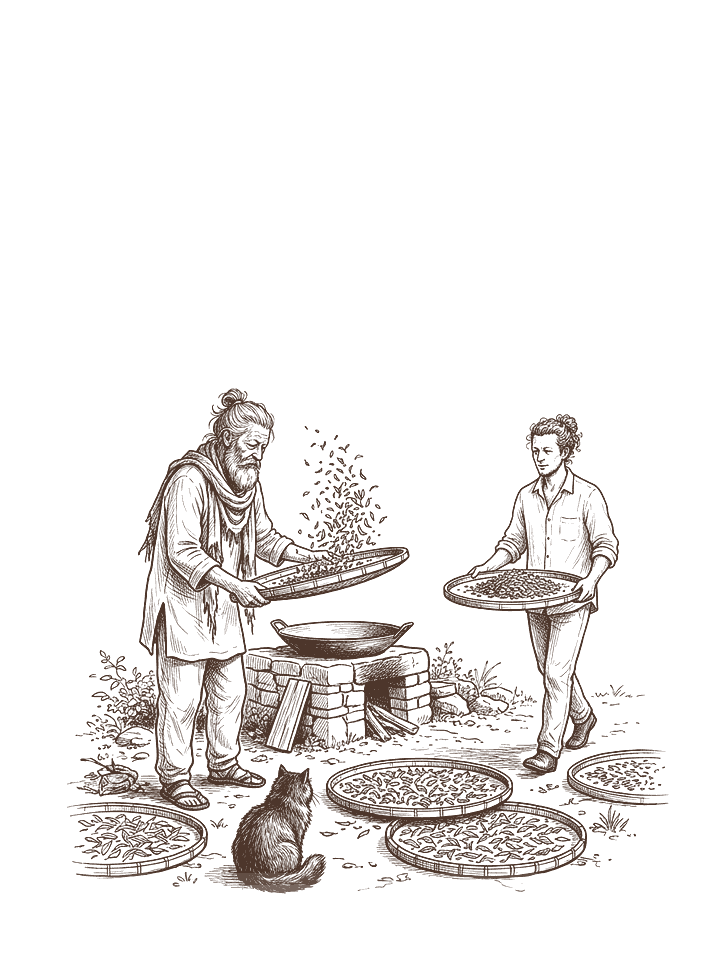
Personal experience — Pavel Rachkouski, founder. One person’s notes, not advice.
From Pavel’s tea table
I sort my teas simply. The pu-erhs, the heavier, dark ones, are my strong, heavy teas, half-joking: they’re more fun. GABA and the soft oolongs I put with green tea, the weaker ones. Two oolongs stay with me: a milk oolong, which is a separate love of mine and has a page of its own, and a plum GABA, on my GABA tea page. At home I also have Da Hong Pao, and next I’m planning to buy some Tieguanyin.
Three hours on Jebel Jais
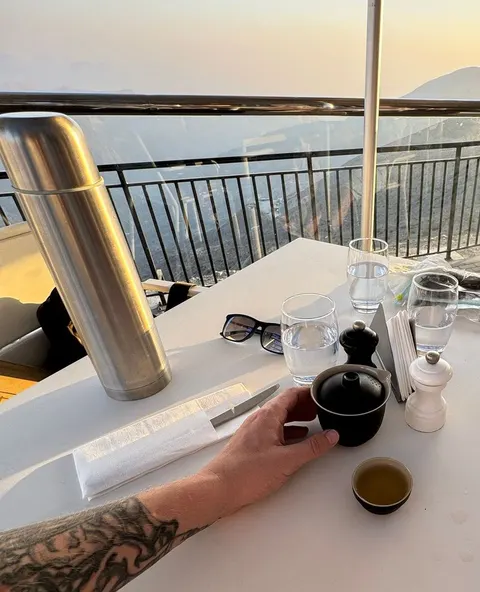
I once introduced a man to GABA. He had tried it many times in his life and never understood it. When he came to Dubai, we went up into the mountains, and I took a GABA with me: a decent one, not the best. We sat at the restaurant on Jebel Jais, the highest mountain in the UAE, for about three hours, with milk oolong, plum GABA and biscuits. I had a thermos, the restaurant topped up hot water when we asked, and I had brought a gaiwan and three travel cups. He loved it, and afterwards he found and bought his own tea set and a small teapot.
I think everything depends on the person who brews: how the tea goes is up to them.
How I brew an oolong
I brew Da Hong Pao at about 90–92 °C. I’m quite a tough tea drinker: I really like strong tea. I put about 10 grams into my teapot and pour it in steps. The first pour I drain completely onto the tea board, or warm a cup with it, washing off the dust. Then I pour, let it steep and drain: about half a minute, then a minute, then longer, like a ladder. I make about six pots like that. Around the third I hold it properly, so that it gets strong, and after that it eases off and turns gentle.
With milk oolong the first infusions get 90–95 °C: I scald the leaf. Once it opens, I go down to about 80–85.
To be honest, I brew all my tea the same way, by feel; it has been like that for all 15 years. I have scales, but I hardly know why: I pour by feel each time. Once I stopped at 7.49 grams for no clear reason; another time it might be 10, or 6, depending on my state and mood.
What follows is the reference part: what oolong is and how it is made, from the sources listed at the end.
What oolong is made from
Oolong tea is made from the leaves of the tea plant, Camellia sinensis: the same plant used for green and black tea. The U.S. National Center for Complementary and Integrative Health (NCCIH) puts it simply: the three come from the same plant “but are prepared using different methods”, and oolong is “partially fermented”.[1]
So the answer to “what is oolong made from?” has two parts: the leaf, and what is done to it.
“Partially fermented” means partly oxidised
In tea making, “fermented” is a traditional word for changes driven by the leaf’s own enzymes, often called oxidation. It doesn’t usually mean that microbes were added. Our guide From fresh leaf to finished tea explains the difference in more detail.
Green tea is heated early to stop those changes, so it is not fermented. Black tea is fermented. Oolong sits in between: the leaf is allowed to change for a managed period, and then heat stops it.
How oolong is made, step by step
Taiwan’s Tea and Beverage Research Station, part of the Ministry of Agriculture, describes oolong-type tea as partially fermented and lists these steps in order:[2]
- Withering. Fresh leaves are withered in the sun (or with warm air) and then indoors. They lose moisture, weight and stiffness, and the chemical changes that build aroma and taste begin.
- Resting and tossing. The leaves are left to rest and stirred in turns. Stirring bruises the leaf cells and spreads the moisture, and this is how the maker controls how far oxidation goes.
- Pan-firing (fixing). Heat stops the enzymes, softens the leaves and settles the colour and aroma.
- Rolling. The leaves are shaped, and broken cells bring their juices to the surface, which affects flavour in the cup.
- Drying. Moisture is brought below 5%, which stops the changes and helps the tea keep longer.
Some oolongs are roasted afterwards. The same source describes roasting as a separate step that removes leftover moisture and adds a roasted aroma.[2] Our guide Understanding an oolong roast looks at what a roast description on a packet can and can’t tell you.
Curls or beads: the shape of the leaf
Rolling gives oolong its look. Wikipedia says the leaves usually end up in one of two styles: long curly leaves, or little beads, each carrying a tail, made by what it calls wrap-curling. It names the curly style as the more traditional one.[5]
The beads take extra work. The Taiwanese station’s page calls ball-rolling the key step for ball-shaped oolong: after a first drying, the leaves are heated to 60–65 °C, wrapped in cloth and twisted into cloth balls, then rolled or pressed in a machine and loosened again. The round is repeated several times until the leaves curl gradually into balls.[2] The UK Tea & Infusions Association describes the greener oolongs in other terms: the withered leaf is wrapped in a big cloth and machine-rolled, then the bag is opened and the leaf lies spread out for a short spell, oxidising lightly. That cycle repeats until the leaf is about 30% oxidised, and then the tea is dried.[3] That account does not mention a pan-firing step, so the two descriptions do not match step for step. Read them as two accounts, not as one recipe.
A ball shape does not tell you the roast. In Taiwan’s own list, high-mountain oolong is the example of a light-aroma ball-shaped tea, while Dong Ding, Tieguanyin and red oolong are examples of roasted-aroma ball-shaped teas; Baozhong, in the same list, is a strip-shaped light-aroma tea.[2] For what a roast description can and cannot tell you, see Understanding an oolong roast.
How oxidised is oolong?
It varies a lot, which is why oolongs can taste so different. In Taiwan’s classification, approximate oxidation levels are:[2]
| Taiwanese tea | Approximate oxidation |
|---|---|
| Baozhong and high-mountain oolong | about 8–25% |
| Dong Ding oolong | about 25–30% |
| Tieguanyin | about 40% |
| Oriental Beauty | about 50–60% |
Where the percentages come from
The Taiwanese source explains its scale. It estimates oxidation from how far the catechins and other polyphenols in the leaf have been oxidised, and it sets the level in unoxidised green tea at 100%. White tea, the lightest of the partly oxidised teas it lists, still holds about 90% of that level, so it is rated at about 10%; the oolong figures in the table above are given on the same scale.[2]
Other sources count differently. The UK Tea & Infusions Association gives about 30% for the greener oolongs and 60–70% for the dark brown-leaf ones.[3] Wikipedia gives a far wider range for oolong as a whole, 8% to 85%, and says the figure is governed by how much time passes between picking and the last drying.[5] These figures describe different teas under different systems, so they should not be lined up against each other, and none of them measures the tea in a particular packet. If a seller gives a percentage, ask what it refers to.
What oolong can taste like
Reference works describe a range, not one flavour. The UK Tea & Infusions Association compares the light, floral liquor of the greener rolled oolongs to hyacinth, orchid, narcissus or lily of the valley, and gives the dark brown-leaf ones deeper, earthier flavours with a lingering suggestion of peach and apricot.[3] Wikipedia says oolongs can be sweet and fruity with a honey scent, woody and thick with a roasted one, or green and fresh with complex aromas, depending on how the tea is grown and made. Its summary is that oolong sits between green and black tea in flavour: light notes, often more complex than green tea but less strong than black tea.[5]
Oolong teas you may know
Tieguanyin and Da Hong Pao are both oolongs. Each has its own guide on this site about where it comes from and how to read its labels.
Wikipedia’s list of oolong varieties is grouped by region. The table shows the groups and some of the teas it names under each.[5]
| Region in Wikipedia’s list | Some oolongs it names |
|---|---|
| Wuyi Mountains, Fujian | Da Hong Pao, Shui Jin Gui, Tieluohan, Bai Jiguan, Rougui, Shui Xian |
| Anxi, Fujian | Tieguanyin, Huangjin Gui |
| Guangdong | Dancong, also called “Phoenix oolong” |
| Taiwan | Baozhong, Dong Ding, Alishan, Lishan, Oriental Beauty (Dongfang meiren), Jin Xuan, Sijichun |
Jin Xuan is also known as “milk oolong”.[5]
Frequently asked questions
Is oolong tea black or green?
Neither: it sits in between. Oolong is made from the leaves of the tea plant, Camellia sinensis: the same plant used for green and black tea. In tea making, “fermented” is a traditional word for changes driven by the leaf’s own enzymes, often called oxidation. Green tea is heated early to stop those changes, so it is not fermented. Black tea is fermented. With oolong, the leaf is allowed to change for a managed period, and then heat stops it.
Should oolong tea have milk?
The UK Tea & Infusions Association’s guide to tea types says that all oolongs are better drunk without milk. It describes oolongs as semi-oxidised teas ranging from greenish rolled oolongs with a light, floral liquor to dark brown leafed oolongs with deeper, earthier flavours.[3]
How many times can you steep oolong tea?
It depends on the tea; the source gives a reputation rather than a fixed number. Anxi County’s government describes top-grade Tieguanyin, an oolong, as famed for keeping its aroma through seven infusions. Its basic Anxi method uses 5 to 7 grams (about 0.2 oz) of leaf in a lidded bowl, boiling water, and a first pour after two to three minutes.[4]
Does oolong tea have caffeine?
Yes. Wikipedia says oolong contains caffeine and that the amount varies with the growing place, the time of picking and the way the leaf is processed.[5] For tea as a whole it says caffeine accounts for roughly 3% of the dry weight, which it puts at 30 to 90 milligrams in a 250 ml cup, depending on type, brand and brewing method.[6] That range covers all tea; these sources give no separate figure for oolong.
What water temperature and steeping time for oolong tea?
The sources give ranges, not one rule. Wikipedia says recommended methods vary widely. A common one is gongfu: a gaiwan or Yixing clay teapot, more leaf than usual for the water, and several short steepings. For a single infusion it suggests anything from 1 to 5 minutes, to taste, with water between 80 and 95 °C (180–205 °F).[5] The Anxi County account of Tieguanyin quoted above uses boiling water, which is hotter than Wikipedia’s range, so the two sources differ.[4] Pavel brews by feel and says so in his notes above. A repeatable routine is in Brew a cup of tea you can repeat.
What does oolong mean? Is wulong the same tea?
Oolong comes from the Chinese wūlóngchá (simplified 乌龙茶, traditional 烏龍茶), “black dragon” tea in Wikipedia’s gloss. Wikipedia writes the term as “wulong (oolong)”, so wulong and oolong are two spellings of the same word. It says there is no universally agreed explanation of the name; one account is that the name replaced an older title once loose tea became fashionable, the dark, long, curly leaf earning the nickname “black dragon”. It says the term was first used for a tea in Shi Hongbao’s Miscellaneous Notes on Fujian, from 1857, and adds that in Taiwan oolong is also called qingcha (青茶).[5]
Does milk oolong contain milk?
Traditionally, no. Wikipedia lists Jin Xuan, a Taiwanese variety also called “milk oolong” (Nai Xiang) for its creamy, smooth taste, and says traditional milk oolong does not contain milk. It also notes that some specialty companies now sell infused oolong, so read what the packet says.[5] Pavel’s notes on a milk oolong are on their own page.
About these sources
Anyone can edit Wikipedia, so its Oolong article (revision of 31 October 2026) and its Tea article (revision of 8 November 2026) are treated as general references, not trade standards. They are used here only for the leaf shapes, the oxidation range, flavour styles, the regional list, milk oolong, caffeine, brewing ranges and the name. The Taiwanese station’s page is in Chinese; the lines taken from it here are translated for this page. Where a general reference puts something differently from the Taiwanese station or the UK association, both are shown.