In short: GABA tea is tea whose fresh leaves spend 6 to 10 hours in an oxygen-free nitrogen chamber before the usual processing [1]. For me it sits with the soft oolongs, next to green tea: lighter and gentler than the heavy, dark pu-erhs.
My morning GABA
I drink GABA regularly. My morning GABA tastes like cookies.
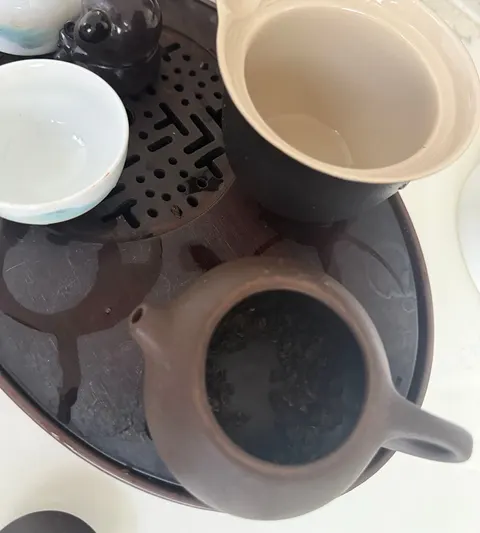
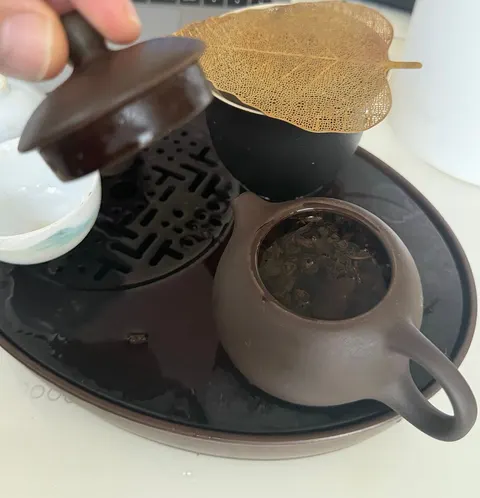
To be honest, I brew all my tea the same way, by feel. I make GABA a little weaker than pu-erh: on average about 5 grams of GABA against 7 grams of pu-erh, and a strong GABA is 8 to 9 grams. I brew it exactly the same way.
I can’t remember the names of most teas I drink, but two stay with me: a plum GABA and a milk oolong.
Sunset at Al Qudra lake
On 12 November we went to Al Qudra lake in Dubai with a travel set: my dark teapot and my camping cups made of titanium (more on vessels in choosing tea ware). We drank two GABA teas from Taiwan Tea Crafts.
I put in 6 grams. The first three infusions went down very softly. We held them for about 30 seconds, then a minute, then a minute and a half, then two minutes, and from the fourth the tea started to grip my tongue. It was tasty, fragrant and aromatic, it opened up nicely, and its aroma reminded me of flowers. We really enjoyed it.
The Organic GABA Green Tea (lot 1535) gave us six infusions, and the Organic High Mountain GABA Tea (lot 1527) five. The High Mountain one had a fun aroma of berries and jam, something sweet, really pleasant. I put in 6 grams of it too, but next time I would add a little more, for more grip in the taste.
Two days later we set off for Al Ain with a plum GABA and an Ali Shan GABA to drink tea in the mountains, and the heat stopped us (more in too hot for a tea picnic).
The man who boiled his tea
A man I know used to drink pu-erh and GABA his own way: he put half a cake into a litre of water and boiled it until all the juices came out. He had tried GABA many times in his life and had never understood it.
When he came to Dubai, we went up into the mountains, and I took GABA with me: a decent one, not the best. At the restaurant on Jebel Jais, the highest mountain in the UAE, we sat for about three hours with milk oolong, plum GABA and biscuits. He loved that GABA; he was thrilled. I showed him how you can drink tea beautifully, in short infusions, and he found and bought himself a tea set and a small travel teapot. When he came to Dubai again recently, we drank from his cups, and he treated me to GABA.
I think everything depends on the person who brews: how the tea goes is up to them.
Evenings, a neighbour, and after a massage
I used to drink a light GABA before bed, about 5 grams, and only a little. These days I don’t drink tea right before bed; if I have a light GABA, it’s earlier in the evening. GABA calms me down.
My best friend lives in my building. He comes up to my place, and we regularly drink GABA together.
After a massage I have brewed a very weak GABA, just a couple of grams. But usually I suggest the person calm down and rest after a massage rather than drink something that tones you up.
My six GABA teas
I have six GABA teas in my collection. The taste notes below are the sellers’ words, not mine. Four come from the shop in Minsk that I wrote about in my review [3]; its pages give no garden or harvest year. The other two are the Taiwan Tea Crafts teas from the lake.
- Plum GABA “AAA”, Chaynaya Pochta. Thailand; the 35 g pack says 85–90 °C (dark purple-blue nuggets; sponge cake, plum jam and strawberry; sweet and slightly sour). The seller suggests 88 °C, a porcelain vessel, 5 g per 100 ml in short infusions, and pouring off the first water (more on water in choosing water for tea).
- Ali Shan GABA “AA”, Chaynaya Pochta. Taiwan; the 35 g pack says 85–90 °C (honey, sweet pastry, a little apple sourness). The seller describes Ali Shan as a mountain with a national scenic area and peaks of 2,663 metres.
- Gui Fei GABA “AAA”, Chaynaya Pochta. Thailand; the 35 g pack says 85–90 °C (biscuits and baked goods; caramel, buckwheat honey and nougat).
- Taoyuan GABA “AA”, Chaynaya Pochta. Taoyuan is only in the name; the 35 g pack says 85–90 °C (berries, sweet pastry and cookies; soft but dense).
- Organic High Mountain GABA Tea, Taiwan Tea Crafts. Produce of Taiwan; 50 g, lot 1527, May 2026, best before May 2029.
- Organic GABA Green Tea, Taiwan Tea Crafts. Produce of Taiwan; 50 g, lot 1535, June 2026, best before June 2029.
How GABA tea is made
Fresh leaves are kept for several hours, usually 6 to 10, in a chamber without oxygen, filled with nitrogen, and almost all of the glutamic acid in the leaf turns into GABA (gamma-aminobutyric acid). Then the leaves are processed in the usual way. The method was developed in Japan in the 1980s and later taken up in Taiwan, where GABA oolong is a common kind [1].
Oolong is a semi-oxidised tea: the leaves are withered in strong sun and left to oxidise partly before they are rolled and twisted [2]. So a GABA oolong is an oolong with that extra oxygen-free step. Pu-erh is different: it is fermented by microbes, as I describe on my pu-erh page [4].
Questions people ask
Does GABA tea contain caffeine?
Yes. It is made from the tea plant, and the extra step does not remove caffeine; Wikipedia’s summary of the research says caffeine and catechin levels stay the same [1].
Is GABA tea the same as a GABA supplement?
No. It is tea made from tea leaves; the GABA comes from the leaf, not from a capsule.
Does GABA tea work for stress or sleep?
This page is not medical advice. A 2020 systematic review of 14 trials of oral GABA found limited evidence for stress and very limited evidence for sleep benefits. It was not about tea, and more studies are needed [5]. For health questions, ask a doctor.
Which teas can be GABA teas, and is it always oolong?
No. The Japanese researchers who developed the method tried green, oolong and black tea made without oxygen, and GABA built up in all of them [1]. On my shelf, the Minsk shop lists its GABA teas as oolongs [3], while one of my Taiwan Tea Crafts teas is a green tea: its pack says Organic GABA Green Tea.
What is GABA tea called in Chinese?
Wikipedia lists the other names Gabaron, Jia Wu Long cha, Jing Bai Long cha and 佳叶龙茶 [1].
Read next: What Is Oolong Tea Made From? The Leaf and the Process · Understanding an oolong roast.