This page is about Organic High Mountain GABA Tea, lot 1527 from Taiwan Tea Crafts, that we drank at Al Qudra lake in Dubai on 12 November. The wider picture is on my GABA tea page.
Sunset at Al Qudra lake
We sat by the water at sunset with my camping set: my dark kettle and titanium cups. The second tea of that evening, GABA Green Tea from the same seller, has its own page.
That night, in a voice note, I said: we drank tea today and really liked it. Tasty, fragrant, aromatic; it opened up nicely, and the aroma reminded me of flowers. We held the infusions for about 30 seconds, a minute, a minute and a half, then two. We’re planning to make many reviews like this: honest ones, about whether a tea is tasty or not, whether we liked it, whether the leaf falls apart. (The note doesn’t say which of the two teas the timings and the flowers were about, so I don’t tie them to one of them.)
Berries and jam
We made five infusions of this one. The aroma was a fun one: some berries, jam, something sweet. It was a really pleasant tea. We put in 6 grams, as for the other tea, but for more grip in the taste I would add a little more leaf next time.
The water temperature that evening isn’t recorded, so there is none on this page (what I know about water is on my water for tea page).
What is on the pack
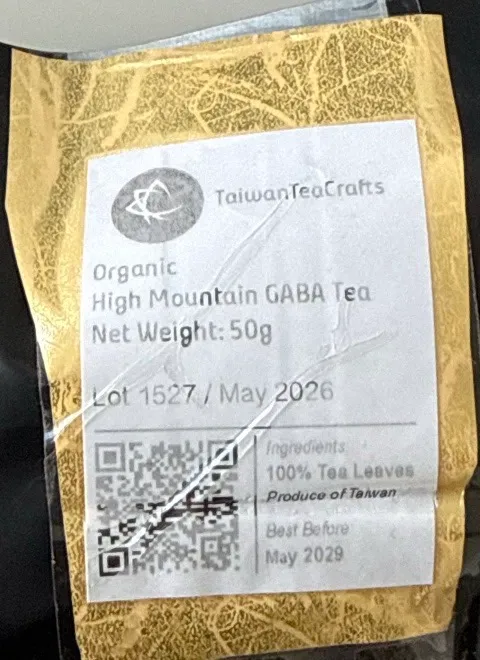
The label gives the name Organic High Mountain GABA Tea, a net weight of 50 g, lot 1527 / May 2026, 100% tea leaves as the only ingredient, produce of Taiwan and a best-before date of May 2029. The Taiwan Tea Crafts logo and a QR code are printed beside them. The pouch is a black zip bag with a small clear window, and the label sits on a gold band with a leaf pattern. What the label leaves out: the mountain, the height, the cultivar, and whether the tea is an oolong or a green tea; the seller’s page, below, gives these. The label also does not say what “May 2026” stands for, but the seller’s table gives May 2026 as the picking date.
What the seller says about this lot
The facts in this section come from the seller’s product page for this tea as it read on 14 November.[1] I am reporting them, not vouching for them.
The page is headed “Late Spring 2026 Production”. The seller says it works every spring in Shibi with a long-time tea-grower partner, who also makes its high-mountain “fragrant oolong”, and that since the pandemic it has made this tea in spring, which it says gives a livelier tea. It describes everything in the tea as more concentrated, as you would expect from high-mountain leaf. Its tasting note compares the aroma and taste to ripe wild strawberries, calls the astringency velvety and balanced by a slightly sour fruitiness, and speaks of a thick, smooth texture, a long, fresh aftertaste and a tea that is generous in the cup and in the number of infusions. The seller adds that the tea is sold fresh, with no baking stage.[1] How roasting differs from oxidation is on my oolong roast page.
A background tab says the partner’s garden is at 1,300 m, and that since 2024 the seller has received this tea every spring, around May, from the partner’s second spring picking.[1]
The seller’s table, titled “Additional Information”, lists: organically grown; style of tea: GABA oolong tea; picking date: May 2026; oxidation level: “oxygen deprived, medium”; baking level: none; terroir: Shanlinxi; administrative region: Nantou County; picking style: hand picked; cultivar: Qing Xin; garden elevation: 1300 m.[1]
What “high mountain” means
What follows is general background about high-mountain tea in Taiwan, the group this lot belongs to, not a claim about this lot.
Wikipedia says high-mountain, or gaoshan, tea refers to several varieties of oolong that come from the mountains of central Taiwan and grow at altitudes above 1,000 metres. Among its examples are Alishan, Dayuling and Yu Shan, as well as Wushe and Lishan, and it says the high humidity and natural rainfall of the high ranges in Nantou and Chiayi counties suit the tea plant. The leaves are usually picked by hand and grow slowly in the thin air, so the yield is low, and high-mountain teas are generally described as sweet, fresh and low in bitterness. The same article also mentions high-mountain green teas, described as tender, green and sweet.[2]
Taiwan’s government Tea and Beverage Research Station, in a page written in Chinese, lists high-mountain oolong as its example of a light-aroma, ball-shaped oolong. It puts the oxidation of Baozhong and high-mountain oolong at about 8 to 25 percent and says that, because the oxidation is low, the liquor is pale and the aroma light.[3] For what those percentages mean, see what oolong is made from.
How GABA tea is made
GABA tea goes through an extra step: the leaves are stored in an oxygen-free chamber filled with nitrogen. Wikipedia says the method was created in Japan in 1984, that GABA built up in green, oolong and black teas made under those conditions, and that Taiwanese tea makers also adopted it widely.[4] The pack of this tea does not describe how it was made. The seller’s table gives its oxidation level as “oxygen deprived, medium”,[1] and the seller’s description of the step for the other tea is on the GABA Green Tea page.
Questions about this tea
What is high mountain GABA tea?
It is the name printed on this pack: GABA tea, which went through the oxygen-free step above, from a lot the seller calls “high mountain”. The seller gives the garden as 1,300 m in Shanlinxi, Nantou County,[1] and Wikipedia counts tea grown above 1,000 metres in central Taiwan as high-mountain tea.[2]
Is it an oolong or a green tea?
The seller’s table calls it a GABA oolong tea; the pack itself does not say.[1] Wikipedia describes high-mountain tea mainly as oolong, although it also mentions high-mountain green teas.[2] For me, GABA and the soft oolongs belong with green tea, the milder side of my shelf, not with the strong pu-erhs.
How is it different from the GABA Green Tea you drank with it?
Both come from Taiwan Tea Crafts in 50 g pouches, and we used 6 grams of each. The GABA Green Tea gave six infusions and a grip on the tongue from the fifth. This one gave five infusions, and what I remember is its aroma of berries and jam. With both, I would use more leaf next time. By the seller’s tables, lot 1535 is from Baguashan at 200 m, from the Qi Yu cultivar, with the oxidation level “oxygen deprived”, and lot 1527 is from Shanlinxi at 1,300 m, from Qing Xin, called a GABA oolong, with “oxygen deprived, medium”; both were picked in May 2026 and have no baking stage.[1][5]
Does it have caffeine?
Yes, as with any GABA tea: the leaf is from the tea plant, and Wikipedia says the Japanese GABA tea kept the caffeine it had before the extra step.[4] Wikipedia’s range for tea in general is 30 to 90 mg in a 250 ml cup.[6] The pack gives no figure; more is on my GABA tea page.
Does high mountain GABA tea help with sleep or stress?
I cannot say. The research I checked, a 2020 review of 14 trials of GABA taken by mouth (not tea), found limited evidence for stress and very limited evidence for sleep.[7] The longer answer is on my GABA tea page; this page is not medical advice, so ask a doctor about health questions.
What I do not know about this tea
- How oxidised the leaf is in figures: the seller says only “oxygen deprived, medium”.
- Whether the “May 2026” beside the lot number on the pack is the picking date: the seller gives May 2026 as the picking date, and the pack does not say what its own date stands for.
- The water temperature of that evening.
- The organic standard behind the word on the label: the seller’s table says only “organically grown”.
About these sources
Anyone can edit Wikipedia, so its articles on high-mountain tea, GABA tea and tea are general references, not trade standards. Taiwan Tea Crafts sells this tea, so I use its pages only for what they say about its own teas, and I have not checked their claims about the gardens. The Taiwanese station’s page is in Chinese; the lines taken from it here are translated for this page. The PubMed entry is the abstract of a review of research on GABA taken by mouth, not on tea.