This is the Organic GABA Green Tea from Taiwan Tea Crafts, lot 1535, that we drank by Al Qudra lake in Dubai on 12 November. The wider picture is on my GABA tea page.
Sunset at Al Qudra lake
We sat by the water at sunset with the camping set I take with me: my dark kettle and my cups made of titanium. We had two teas from Taiwan Tea Crafts that evening; the other one, a High Mountain GABA, has a page of its own. I put in 6 grams.
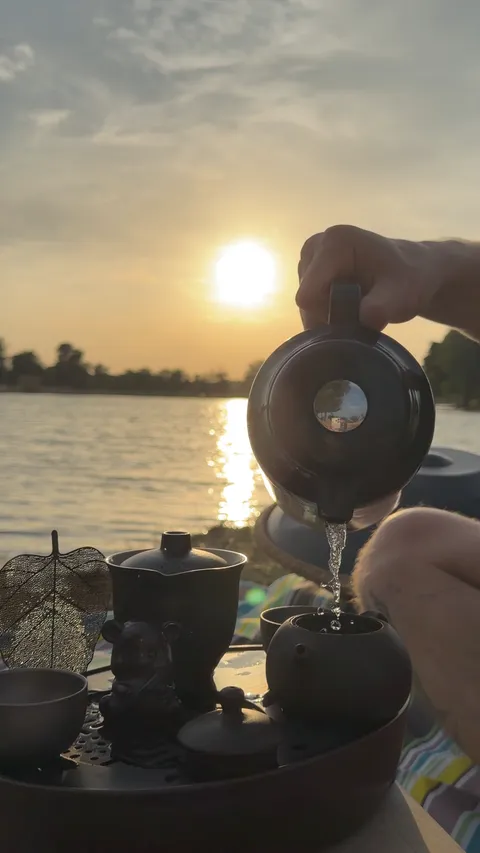
That night, in a voice note, I said: we drank tea today and really liked it. Tasty, fragrant, aromatic; it opened up nicely, and the aroma reminded me of flowers. We held the infusions for about 30 seconds, a minute, a minute and a half, then two. We’re planning to make many reviews like this: honest ones, about whether a tea is tasty or not, whether we liked it, whether the leaf falls apart. (The note doesn’t say which of the two teas the timings and the flowers were about, so I don’t tie them to one of them.)
The sixth infusion
We made six infusions of this one. In a short video I recorded at the lake, at the sixth infusion, I called it a wonderful tea. The grip on the tongue began to appear on the fifth infusion, and by the sixth you could feel it well, but the tea needs a little more leaf so that it holds. Next time I would put in 7.5 to 8 grams, and then, I think, the grip would appear from the fourth infusion. Overall it’s a good tea, a pleasant one, and we liked it.
The water temperature that evening isn’t recorded, so there is none on this page (what I know about water is on my water for tea page).
What is on the pack
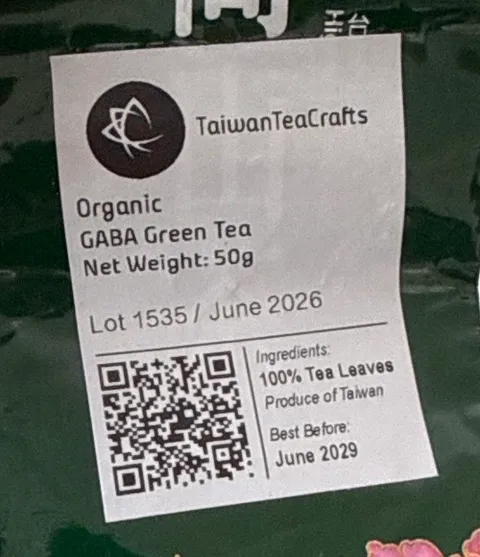
The label reads: Organic GABA Green Tea, net weight 50 g, lot 1535 / June 2026, ingredients 100% tea leaves, produce of Taiwan, best before June 2029. It also carries the Taiwan Tea Crafts logo and a QR code that leads to the seller’s page for this tea. The foil pouch is green, with a large flower design. The label does not say when the leaf was picked: the “June 2026” beside the lot number may be a lot date, a packing date or something else, and the label does not say which.
What the seller says about this lot
The facts in this section come from the seller’s product page for this tea as it read on 14 November.[1] I am reporting them, not vouching for them.
The seller presents lot 1535 as its second batch of 2026, made in May from leaf of the T-22 Qi Yu cultivar. It calls the cultivar promising and a hybrid of Jin Xuan (T-12) and Qing Xin oolong. The page compares the aroma to Taiwanese plums and to shi jia (釋迦), which it calls apple custard or apple sugar fruit, and describes the taste as a creamy, custard-like sweetness with a slightly sour apple fruitiness.[1]
The seller also says the leaves wilt indoors for a short while, spend many hours bagged in vacuum chambers in what it calls “oxygen deprived oxidation”, and are then panned to stop the oxidation and dried.[1]
The seller’s table, titled “Additional Information”, lists: picking date: May 2026; oxidation level: “oxygen deprived”; baking level: none; terroir: Baguashan, Nantou County; picking: by hand; cultivar: Qi Yu, TTES No. 22; garden elevation: 200 m.[1]
Wikipedia dates Jin Xuan to the early 1980s in Taiwan, says it is also called #12 or “Milk Oolong”, and describes its flavour as light, creamy and floral.[2] The seller’s “T-12” matches that number. My notes on milk oolong are on a page of their own.
How GABA tea is made
GABA tea goes through one extra step: the leaves are stored in an oxygen-free chamber filled with nitrogen. In Wikipedia’s account the method was created in Japan in 1984. The researchers produced a tea in which almost all of the amino acid glutamic acid had turned into GABA, with the catechin and caffeine content unchanged, and a large amount of GABA built up in green tea after six to ten hours in such a chamber. They then tested green, oolong and black teas made under the same conditions and found that GABA built up in all of them. Taiwanese tea makers also adopted the method widely.[3] The seller of this tea describes its own step in other words: leaves bagged in vacuum chambers, which it calls “oxygen deprived oxidation”.[1]
Questions about this tea
What is GABA green tea?
It is tea that went through the oxygen-free step above and is sold as green tea. GABA is short for gamma-aminobutyric acid, the compound that builds up in the leaf during that step. Wikipedia’s account of the Japanese work starts with green tea, and it adds that Taiwanese makers also adopted the method widely.[3] “GABA Green Tea” is the name printed on this pack.
Is GABA tea made in a vacuum or with nitrogen?
Wikipedia describes storing the leaves in an oxygen-free chamber filled with nitrogen.[3] The seller of this tea says the leaves spend many hours bagged in vacuum chambers.[1] Both ways keep oxygen away from the leaf. I do not know which method was used for this lot, and I am not saying that either account is wrong.
Is it green tea or oolong?
The pack says green tea. The seller’s table gives the oxidation level only as “oxygen deprived”, without a figure.[1] The seller names Jin Xuan and Qing Xin oolong as the bush’s parents, and Wikipedia calls Jin Xuan a variety of oolong tea.[2] But a cultivar describes the plant; it does not by itself say how the leaf was processed. The seller adds that “GABA” and “Green” in one name describe a mixed, “hybrid” way of processing, not a blend of teas.[1] For me, GABA and the soft oolongs belong with green tea, the milder side of my shelf, not with the strong pu-erhs.
Does it have caffeine?
Yes. The leaf comes from the tea plant, and Wikipedia says the Japanese GABA tea had the same caffeine content as before the extra step.[3] For tea in general, Wikipedia gives 30 to 90 mg per 250 ml cup.[4] The pack gives no figure for this tea; more on caffeine is on my GABA tea page.
Does GABA green tea help with sleep or stress?
I cannot tell you that, and this page is not medical advice. The one summary I checked, a 2020 review of 14 trials of GABA taken by mouth (not tea), found limited evidence for stress and very limited evidence for sleep.[6] The longer answer is on my GABA tea page; ask a doctor about health questions.
What I do not know about this tea
- The water temperature we used that evening.
- How oxidised the leaf is in figures: the seller says only “oxygen deprived”.
- What the “June 2026” beside the lot number on the pack means: the seller gives May 2026 as the picking date, and the label does not say what its own date refers to.
- Which organic standard the word “organic” on the label refers to.
About these sources
Anyone can edit Wikipedia, so its articles on GABA tea, Jin Xuan tea, tea and Nantou County are general references, not trade standards. Taiwan Tea Crafts sells this tea, so I use its page only for what it says about its own tea, and I have not checked its claims about the garden. The PubMed entry is the abstract of a review of research on GABA taken by mouth, not on tea.