In short: purple tea owes its colour to anthocyanins [2; 3], and one purple tea plant from Yunnan is Zijuan [1; 3]. I drink purple pu-erh often, mostly in the morning, and I brew it strong. My guide to pu-erh gives the wider picture.
The first cup
I remember the first time a friend poured it for me. It was in 2023 in Turkey (more about tea there is in my Turkish tea notes). I was renting a villa in Göynük, near Kemer, about ten kilometres before you reach it. That’s where we met. He came with this tea and poured it for me.
I think what mattered more was that we drank it together, how he talked about this tea and how he guided me. Maybe after a story like that your taste buds take the tea differently. That’s my observation.
Tea walks around Fethiye
My friend practises yoga and lives in Fethiye. He drinks purple pu-erh often, and now so do I. I have friends there who are real tea people; wherever we walked, we drank tea. We usually took purple pu-erh with us, and some green pu-erh too. Another of our tea days above Fethiye, in March 2025, is in my milk oolong story.
In November I took it again, in its red tin, as one of three teas for a tea day in the mountains near Al Ain, and the heat stopped us (more in too hot for a tea picnic).
How it tastes to me
Tea gives a certain state one way or another, and for me that state comes through the taste (more in does pu-erh get you high?). You can leave this purple pu-erh in the teapot for three minutes, and when you pour it out it looks almost black and grippy. But when you drink it, it’s so soft that nothing puckers your mouth.
It reminds me in some way of plain black tea, though I usually don’t like black tea. Here there is a note of earthiness, and that note is what carries the grip on the tongue. The taste of this tea unfolds in an incredible way. I usually drink it in the morning, because for me it is quite invigorating.
A tea for a guest
Purple pu-erh is my favourite, really. I have treated a lot of people to it. One of them was a friend of mine who loves really black pu-erh: he boils up half a cake and stews it with an immersion heater, even now. He has a strange way of drinking tea. Now he has bought himself little cups too: I gave him some advice, he drank tea with me, saw what tea ware I have and bought himself a travel set. And the purple pu-erh, well, I don’t know, he said it was strange, not very strong.
But that is exactly what I like about it: it isn’t very strong. Some teas can practically knock you to the ground, so that afterwards you want to talk, to move. I like the opposite. Purple doesn’t have that; it doesn’t grab you, it settles on you slowly, softly, in layers, and you come into that state layer by layer.
I take this very carefully: I would look at what mood a guest is in, what state, and whether I want to calm them down or perk them up. Tea helps with that. Not that it gets you drunk, but I think it can lift you a little or calm you a little. I drink ivan chai, and GABA: GABA calms me down. When I have had some pu-erh, it gives me a little boost, like coffee. After a couple of phrases I would understand what state the person is in, whether they need settling down or getting going, and from that I would dip into my tea library and pick something.
How I brew it
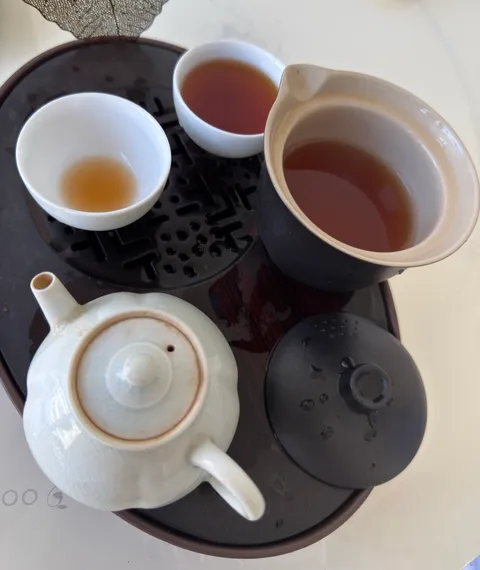
With purple I go a bit harder: I like a grip on the tongue. I put in 10 grams, and when I’m in a good mood and want it stronger, 12. My teapot, the white one, holds about 220 ml (see choosing tea ware), and the black one is about the same. I pour water of around 95 °C onto the leaf, and then 90 °C (more on water in choosing water for tea).
The first infusion I simply pour away; it warms up the teaware. I hold the second for a minute to a minute and a half, then three infusions of a minute and a half each, then two or three minutes, and by about the seventh you can hold it even longer. You can leave it for as much as five minutes; we jokingly call that “babulya”, grandma. In all it holds about eight infusions. All of this is by eye: I don’t time anything.
I like my tea strong. I’m telling you what I drink, my own experience.
How it reaches me
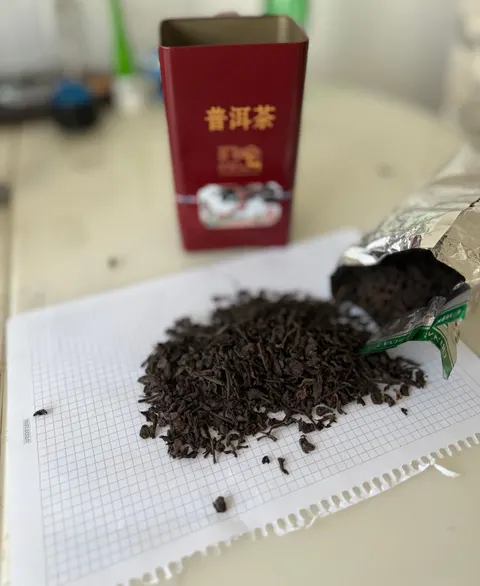
I buy it as purple pu-erh from a supplier in Moscow. It comes to me like this: loose leaf in a red tin, with a foil bag inside. When it cools down a little in the gaiwan, you can actually see a slight purple tint. I see that purple shade clearly with my own eyes, but I don’t think the camera picks it up. It shows when you look at the surface of the tea, the way you look at the surface of water: a slight purple shimmer. I’d bet a hundred percent that there is a little purple in it. And there is less sediment. The tin shows the characters 普洱茶, the Chinese name of pu-erh tea [1]. My other teas are gathered in my tea collection.
A Zi Ya bag from my shelf
My collection has one more tea with “purple” in its name: a 25 g sample bag of Zi Ya from the same tea shop in Minsk as the five shengs on my sheng pu-erh page (my review of the shop). The label reads “Шэн пуэр (зеленый)”, sheng pu-erh, then “Цзы Я”, “Фиолетовая Почка” (“Purple Bud”), 2013, 380 g and 85–90 °C. The seller describes a loosely pressed cake with a dark, violet-tinted leaf, a copper liquor and no bitterness [7]. That is the seller’s description, not my tasting notes, and I am not saying that this bag is the tea in my red tin.
What makes tea purple
Purple tea owes its colour to anthocyanins, pigments that dissolve in water [3]; their shade changes with acidity and can run from red and pink through purple and blue to black [2].
Wikipedia names one purple tea plant from Yunnan: at Nannuo, in Menghai County, a variety named zĭjuān (紫娟, “purple lady”) has buds and bud leaves with a purple hue [1]. A 2016 paper in Scientific Reports calls ‘Zijuan’ a somatic mutant picked out of the Yunnan Daye cultivar, a form of the assamica tea plant. Its young leaves and stem are strikingly purple, while mature leaves show almost none of the colour; its anthocyanin content is reported to be roughly three times that of other Chinese purple cultivars, and cold and long hours of light made the leaves build up more of the pigment [3]. These are general facts about purple tea; I am not saying that the tea in my tin is Zijuan.
One seller, Seven Cups, describes its raw pu-erh from Zijuan trees in Jinggu County, Yunnan: the fresh leaf is purple-red, the dried leaf looks black and the soaked leaf shows deep blue-green, which is why people in Yunnan sometimes call it “three-color” tea. The infusion is pale with a purple tint, gentle and clean, with milder astringency than other raw pu-erhs [4].
How purple pu-erh is usually brewed
Sources differ, and the right settings depend on whether the tea is raw or ripe, so read the page of the seller you buy from first.
- My Zi Ya bag and the shop’s page: 85–90 °C; the shop adds that the tea suits boiling over a fire and drinking infusion by infusion [7].
- Seven Cups, for its raw Zijuan: 100 °C, 5 g for 12 oz (about 355 ml); the first infusion 3 minutes, then at least five, timed at 3, 3, 5, 8 and 10 minutes [4].
- Yunnan Sourcing, for pu-erh in general: 95–100 °C, about 6 g per 100 ml; one rinse of about 20 seconds for raw pu-erh, two of about 15 seconds for ripe; most pu-erh takes 10 to 20 infusions [5].
- Wikipedia, for pu-erh in general: 85–99 °C; gongfu infusions of 12 to 30 seconds, then 2 to 10 seconds more each time [1].
- My own way, above: around 95 °C, then 90 °C, 10 to 12 g for about 220 ml (about 4.5 to 5.5 g per 100 ml, my calculation), about 8 infusions.
Questions about purple pu-erh
Is purple pu-erh really purple?
The plant can be: in ‘Zijuan’ the young leaves and stems are strikingly purple, while mature leaves show almost none of the colour [3]. In the cup it is paler: one seller describes the infusion of its raw Zijuan as pale and tinted purple [4], and in my gaiwan I see a slight purple tint when the tea cools a little.
What does Zi Ya mean?
Zi Ya is a spelling of Chinese words in Latin letters. The shop that sold me a sample translates “Цзы Я” as “Фиолетовая Почка”, Purple Bud. That fits the Chinese 紫芽: 紫 is “purple” and 芽 is “bud” or “shoot” [6].
Is purple pu-erh raw or ripe?
That depends on the tea. The Zijuan tea from Seven Cups is a raw pu-erh (sheng) [4], and the label on my Zi Ya sample bag says sheng too. The front of my red tin shows 普洱茶, “pu-erh tea”, so I do not say which kind it is. How the two kinds are made and brewed is on my shu pu-erh and sheng pu-erh pages.
Is purple pu-erh smooth or earthy?
For me the tea from my red tin is soft, so that nothing puckers my mouth, yet it has a grip on the tongue, and an earthy note carries that grip. Seven Cups calls its raw Zijuan gentle and clean, with milder astringency than other raw pu-erhs [4].
Does purple pu-erh have caffeine?
The leaf of pu-erh contains purine alkaloids, among them caffeine and theobromine [1].