In short: no. Pu-erh is tea. People expect it to hit them like weed or amphetamine, and that doesn’t happen. My pu-erh guide has the wider picture.
No, it’s a legend
Does pu-erh get you drunk? No, that’s complete nonsense, rubbish. A legend. Does it change my state? Yes, it tones me up. But that it gets you drunk, or somehow high like a drug, or intoxicates you, there is nothing like that. In good company it gives a certain state: you want to talk, you feel a kind of liveliness. It’s like drinking a good coffee, a mug of americano; you can roughly compare the two.
It relaxes me. At times it does the opposite and gives me energy; it depends on how you tune in.
My birthday, and then yoga
On my birthday a friend opened a green pu-erh. He said it was something exclusive, that I would hardly taste one like it anywhere else. Afterwards I really wanted to talk and to move, so we did some yoga. I caught a great state from that tea.
After a sound-healing evening
When I play for friends in the park, we drink tea afterwards, and it’s almost always a green pu-erh. I try to brew it stronger, so that it properly wakes people up.
The 2009 cup that went wrong
Once someone treated me to a black pu-erh, from 2009 I think. We brewed it, and I put in about 12 grams. It was bitterish, I drank it on an empty stomach, and then we drove off in the car. It hit my state: weakness, I started to feel sick, saliva kept coming, a state I couldn’t make sense of, and a strange feeling in my head. That is one story, not a rule.
Twelve grams in the evening
Has pu-erh kept me awake? Yes, it has happened. I brew about 12 grams of pu-erh and then I can’t fall asleep: I want to chat, I feel that lively. So after 6 in the evening I definitely don’t drink pu-erh myself; after 7, maybe only if guests come. These days I don’t drink tea right before bed; if I have a light GABA, about 5 grams and only a little, it’s earlier in the evening.
My morning
I get up at 6, wash, brush my teeth, and drink water over about 15 minutes. Then coffee with a little sandwich, and off to sport. After sport comes tea and something to eat. I like to drink tea before food: once you’ve eaten, the taste buds don’t take in the tea as well. In the morning I like pu-erh.
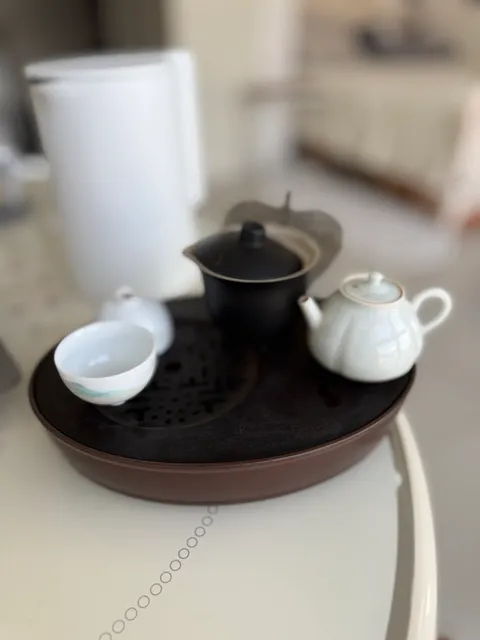
I don’t really hold tea ceremonies, but I have a tea board, and I pour. For green pu-erh just for me it’s about 7.5 to 10 grams in my small white teapot, and I drink it slowly.
Where the expectation comes from
I don’t think people are making mistakes. They are given instructions. Tea has been hyped a lot lately, especially on Russian-language social media pages, and well-known rappers sang that pu-erh gets you high. Many people don’t really know what tea is: they learn how to brew it and then wait for it to hit them like weed or amphetamine. And that doesn’t happen. I think that is the whole problem.
Expectation changes the taste too. I have drunk 20-, 40- and 50-year-old pu-erhs, and if nobody told me, I couldn’t pick out a 40-year-old tea blind. Maybe you catch that note because you know the age.
What “tea drunk” means in two sources
The phrase “tea drunk” translates the Chinese 茶醉 (cházuì) [Path of Cha], and it is used in two quite different ways. This section is not about my experience.
Chinese Wikipedia has an entry on 茶醉, also called 醉茶. It describes discomfort caused by drinking too much tea or tea that is too strong [Wikipedia (zh): 茶醉]. English-language tea sellers use the same words for something pleasant: Path of Cha, a tea seller, calls tea drunk a state that some people reach with strong brews of certain teas, often made the gongfu way, and describes feeling alert, creative and blissful, yet peaceful and relaxed [Path of Cha]. That is a seller’s description; I don’t repeat its explanation or its advice on how to reach the state.
What the sources say about caffeine
Pu-erh is tea, and tea contains caffeine: Wikipedia lists caffeine and theobromine among the purine alkaloids in pu-erh leaves, without a figure for pu-erh itself [Wikipedia: Pu’er tea]. For tea in general it puts caffeine at roughly 3% of the dry leaf, or 30 to 90 mg in a 250 ml cup, depending on the tea, the brand and the brew; one study it cites measured 22 to 28 mg per gram of black tea and 11 to 20 mg per gram of green tea [Wikipedia: Tea]. For coffee it gives 50 to 175 mg for a typical 6-ounce cup [Wikipedia: Caffeine]. The cup sizes differ, so these numbers are not an exact comparison; my own comparison is the americano above.
Questions people ask
Does pu-erh get you high?
No. In my words, that is complete nonsense, a legend. It tones me up, and in good company it makes me want to talk; the closest comparison I have is a good mug of americano.
Can pu-erh make you “tea drunk”?
The phrase is used in two ways: Chinese Wikipedia uses it for discomfort after too much tea or tea that is too strong, and the seller Path of Cha for a pleasant, alert and peaceful state [Wikipedia (zh): 茶醉; Path of Cha].
Is pu-erh like coffee?
My own comparison is a good mug of americano. In numbers, Wikipedia gives wide ranges for both a cup of tea (30 to 90 mg per 250 ml) and a cup of coffee (50 to 175 mg per 6 ounces), so I don’t compare them exactly [Wikipedia: Tea; Wikipedia: Caffeine].
Can pu-erh keep you awake?
It has kept me awake: after about 12 grams I can’t fall asleep. I don’t drink pu-erh myself after 6 in the evening.
About these sources
Anyone can edit Wikipedia. Its Chinese entry on 茶醉 has few references, so I took only its opening definition, translated into English with AI assistance. Path of Cha sells tea and so has a commercial interest; I used it only for how it describes the phrase “tea drunk”. The caffeine figures are ranges that depend on the tea, the brand, the brew and the cup size, so they show the scale and not what is in my cup.
Read next: A practical guide to pu-erh tea · Purple Pu-erh (Zi Ya): Notes From a Daily Drinker · Shu Pu-erh (Ripe Pu-erh): Notes From Pavel’s Tea Table · Sheng Pu-erh (Raw Pu-erh): How I Drink It, From Pavel’s Tea Table · GABA Oolong Tea: How I Drink It, From Pavel’s Tea Table · Caffeine in Your Day: Read the Label and Make a Simple Map.