Ashtanga Vinyasa is a modern yoga method built around established sequences of postures, linked with movement and breath. Repetition is central: students return to the material they are learning rather than following a newly arranged flow every class. How that material is taught depends in part on whether the class is led or Mysore-style. Sidnell, research on the Ashtanga method
Yoga · History & class formats
Ashtanga Vinyasa yoga and its two main class formats
Prepared by Good & Steady · Sources checked
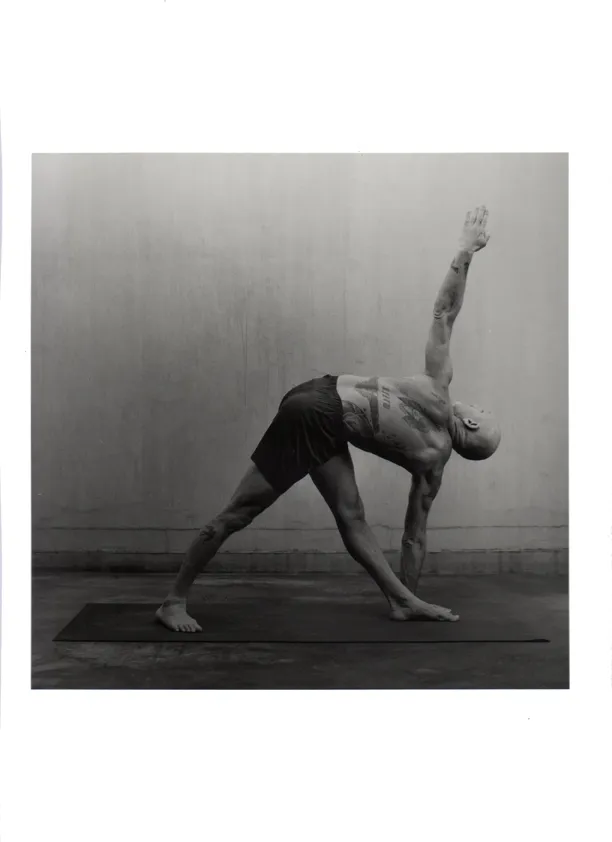
A standing twist from Barry Silver’s 2011 photo series catalogued as Ashtanga yoga. One still does not show the full sequence.
A posture in ashtanga yoga (32).jpg — Barry Silver. CC BY 2.0. WebP conversion and proportional resizing; no crop or retouching.

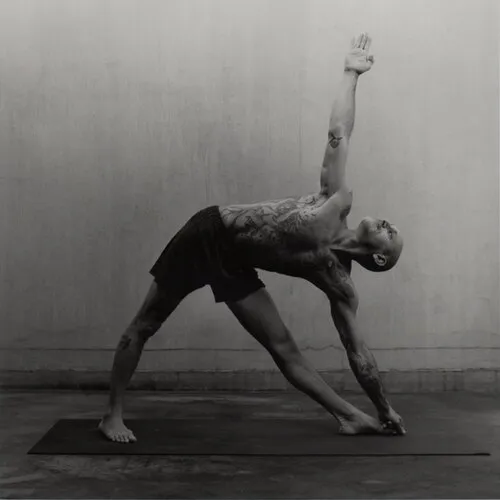
Another standing posture in the same series. These are editorial examples, not a beginner sequence to copy.
A posture in ashtanga yoga (34) (cropped).jpg — Barry Silver; crop by Felino Volador. CC BY 2.0. WebP conversion and proportional resizing; no crop or retouching.

A modern method with an older name
This school is associated with K. Pattabhi Jois, who studied with T. Krishnamacharya and taught in Mysore, now also called Mysuru, in southern India. Scholar Jean Byrne identifies Jois as its modern founder and examines the importance of teacher-to-student transmission in the tradition. That modern lineage should be distinguished from claims that a particular present-day sequence has survived unchanged from antiquity. Byrne, Gurus of Modern Yoga
“Ashtanga” means eight-limbed. In Patanjali’s Yoga Sutras it refers to a wider framework that includes ethics and meditation as well as posture. The contemporary Ashtanga Vinyasa school takes inspiration from that framework, but the name of the philosophy and the name on a studio timetable do different jobs. Internet Encyclopedia of Philosophy
The lineage’s history also includes sexual abuse by Jois, acknowledged publicly by teachers who studied with him. A statement published on teacher Petri Räisänen’s website addresses that harm and earlier silence. Teacher ancestry should never replace questions about consent and accountability in a present-day school. Statement on Pattabhi Jois
Mysore and led classes
In a Mysore-style class, students practice the portion of the sequence they have learned while the teacher works with individuals around the room. People can be doing different postures at the same time. New material is introduced gradually, with attention to posture, breathing and a designated gaze point. Ashtanga Yoga Central describes starting new students with a short sequence and adding to it through subsequent visits. Ashtanga Yoga Central
A led class has a different rhythm. The teacher calls the postures and movement counts, often in Sanskrit, and the group follows together. A led Primary Series class may assume that you already know much of the sequence. “Primary” names the first series; it does not, by itself, promise an introductory lesson. Check the actual prerequisites. University of Virginia Ashtanga program
Mysore-style also needs clarification. The University of Virginia describes its Mysore class as suitable for all levels, with the sequence learned bit by bit and individual instruction from a teacher. Ask how the particular school brings beginners into the room and whether it offers or requires an introduction first. Self-paced practice still involves a teacher and an agreed structure. University of Virginia Ashtanga program
Repetition and individual teaching
The established sequence gives the practice continuity. Within it, the amount a student practices, the pace of learning and the available variations depend on the teaching arrangement. Current schools may explicitly adapt practice to the student’s level while maintaining the method’s sequencing. Ashtanga Yoga Shala class description
Props are worth discussing rather than assuming they are forbidden. Sun Dog Yoga, for example, lists blocks, straps and other props alongside its Ashtanga Vinyasa and Mysore offerings. A specific studio’s practice is better evidence than a blanket rule about the whole tradition. Sun Dog Yoga FAQ
Questions worth asking
- Do beginners start in Mysore, an introductory course or a led class here?
- How much of the sequence does your led class assume I know?
- How do you agree on variations, props and when to introduce more material?
- How do you ask permission for hands-on assistance, and who handles concerns?
For individual posture names, the Good & Steady pose library is a useful reference. It is not a substitute for learning the sequence and transitions from the teacher responsible for your class.