Chair yoga uses a chair as a seat, support, or both. The name describes how a practice is arranged more clearly than it describes a single lineage or fixed sequence. A class may stay seated throughout, include standing options using the chair, or offer several versions of the same activity. Accessible Yoga School’s published teaching program explicitly includes seated practice and supported standing, alongside meditation and other elements of yoga. Accessible Yoga School: Chair Yoga for Everyone
Yoga · History & class formats
Chair yoga and its adaptable setup
Prepared by Good & Steady · Sources checked
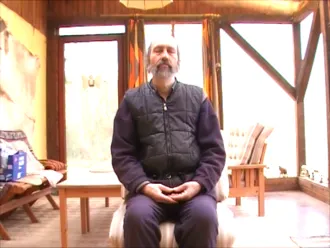
Yogi Nils seated during a chair-yoga demonstration in 2014. This cropped still does not show the feet or a full setup.
10.Meditation.png — Nobody60. CC BY-SA 3.0. WebP conversion and proportional resizing; no crop or retouching.

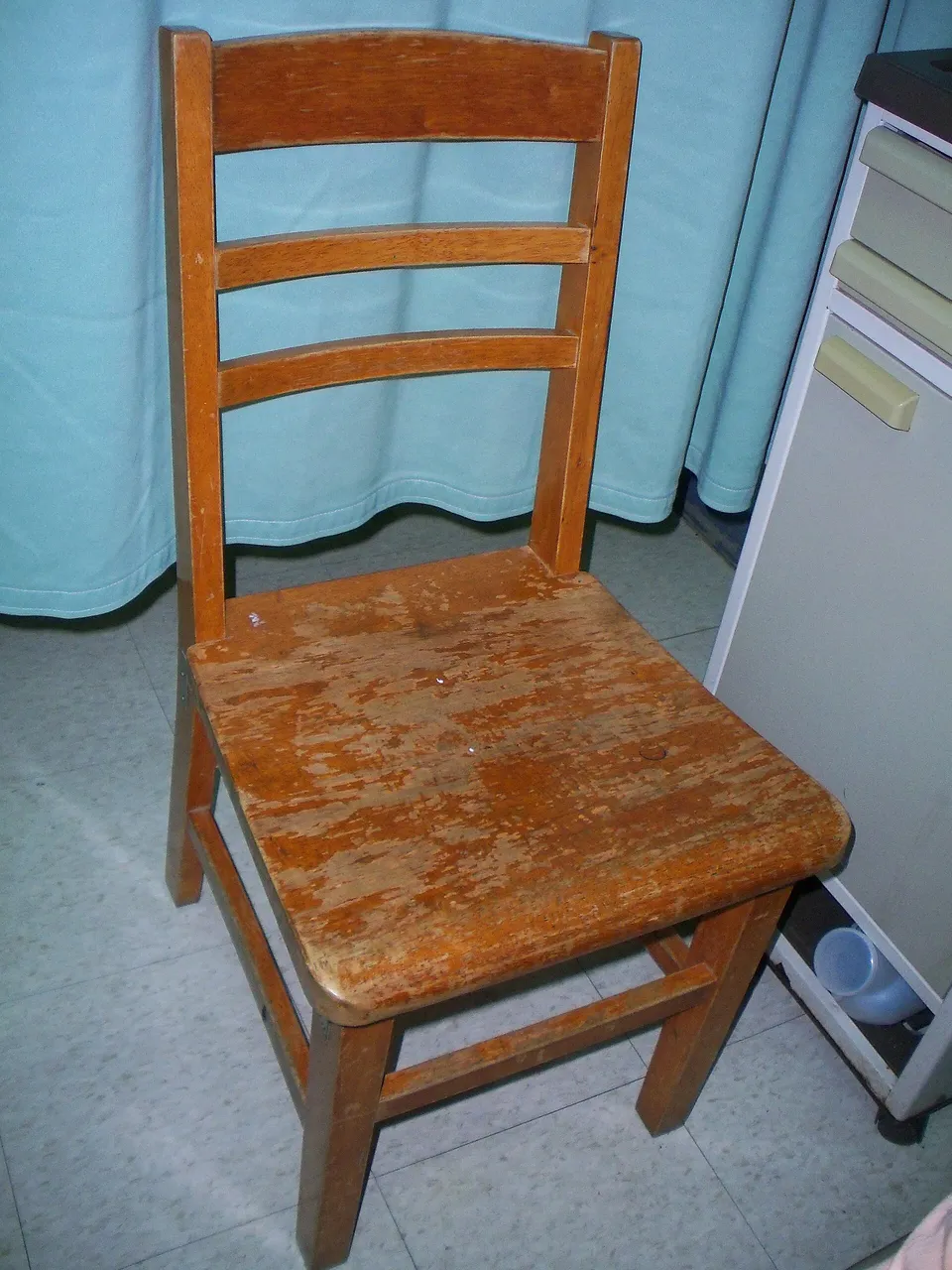
An empty four-legged wooden chair. This photograph is an equipment example, not a safety endorsement of this particular chair.
Wooden Chair in Three Persons Room, Internal Medicine Ward, NTUH East Campus 20101202.JPG — 玄史生. CC0 1.0. WebP conversion and proportional resizing; no crop or retouching.

A format with several teaching histories
Some teachers work within a named method. Lakshmi Voelker’s official biography dates the creation of Lakshmi Voelker Chair Yoga to 1982 and relates it to adapting practice for a student in her thirties who could no longer get down to the floor. That is the method’s own origin account. It should not be expanded into proof that she invented every use of a chair in yoga, or that chair-based practice belongs to one age group. Lakshmi Voelker: About the method’s founder
Chairs also appear among the props used in Iyengar yoga, where they are part of a wider vocabulary of support and exploration. An Iyengar class that uses a chair is not necessarily the same thing as an all-seated community chair class. These overlapping uses are a reason to read the description rather than assume every class shares a standard curriculum. Iyengar Yoga UK: To prop or not to prop
What a class may include
A chair can provide a setting for movements of the arms and trunk, adapted postures, breath awareness, and meditation. For example, a published description of the Gentle Years Yoga program includes adapted movement, breathing practice, and periods of relaxation and concentration. Those elements give a fuller picture than the assumption that chair yoga is simply a collection of seated stretches. Tew and colleagues: Gentle Years Yoga class structure
Pace and duration depend on the teacher and setting. Some classes place more emphasis on movement; others devote longer periods to quiet attention. Accessible Yoga School’s sample practices range from short sessions to an hour, and its program distinguishes the needs of wheelchair users, older adults, and mixed groups. None of those examples establishes a universal class length or an exclusive audience. Accessible Yoga School: Practice formats and audiences
The chair is part of the setup
Ask what kind of chair the class requires. In its published Chair Yoga for Everyone course, Accessible Yoga School lists sturdy chairs, with at least one without arms, as well as blankets, a bolster, a strap, and blocks. That is a course-specific equipment list, not a rule that everyone needs two chairs and every prop to begin. Accessible Yoga School: Course equipment
A wheelchair, an armchair, and a studio chair are different setups; the word “chair” does not establish that the same instructions suit each one. Ask whether the session is designed for remaining in your usual seat or assumes moving to another chair.
What to clarify with the teacher
The most important question is often whether standing or getting down to the floor is expected. If staying seated matters to you, ask explicitly rather than relying on words such as “accessible” or “gentle.” You can also ask:
- What experience does the teacher have with the adaptations you want?
- Are seated alternatives demonstrated alongside standing options?
- Are movements adapted by changing their range, breaking them into parts, or offering another action?
- Is breathing practice part of the class, and can you choose simply to observe your ordinary breath?
- How are individual choices and consent to physical assistance handled?
Our pose library can help with names, but a floor-based illustration is not a prescription for a seated adaptation.
Chair yoga does not need to be framed as a preliminary stage that everyone should eventually leave behind. The useful question is whether this particular class offers a way of participating that works for you, with clear instruction and meaningful choices.