Yin yoga gives each posture time. Students settle into a position, stay for a sustained period, and make a measured transition before the next one. In teacher Bernie Clark’s description, drawing on Paul Grilley and Sarah Powers, the emphasis is on manageable sensation rather than the deepest possible shape. Stillness does not mean every moment feels effortless. YinYoga.com: What is Yin Yoga?
Yoga · History & class formats
Yin yoga and its slower approach to practice
Prepared by Good & Steady · Sources checked
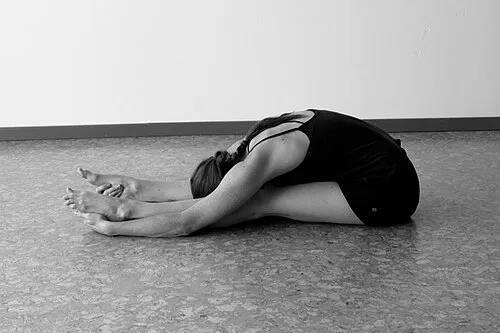
Caterpillar, specifically identified as Yin yoga by the source. The photograph does not show duration or how the pose feels.
IMG 0222 2- Caterpillar.jpg — Christy Collins; copyright holder Bernie Clark. CC BY-SA 3.0. WebP conversion and proportional resizing; no crop or retouching.

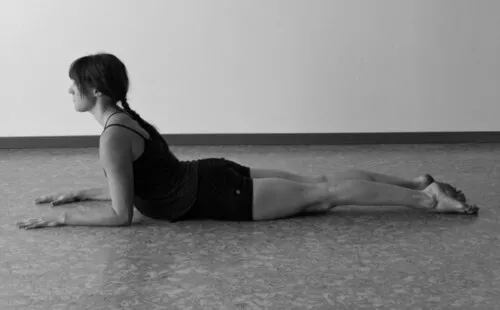
Sphinx, another Yin posture documented by the source. The pictured range is an example, not a target for every body.
IMG 0549 2 Sphinx.jpg — Christy Collins; copyright holder Bernie Clark. CC BY-SA 3.0. WebP conversion and proportional resizing; no crop or retouching.

Where the modern style comes from
The modern teaching story involves several people rather than one uncontested invention. In Clark’s account, Grilley studied with Paulie Zink, whose Taoist Yoga included both sustained positions and movement. Grilley developed classes focused on the long-held component; Sarah Powers helped spread the approach, and Clark credits her with the name Yin Yoga. This is a practitioner’s account of the modern teaching network. It should not be read as independent proof that today’s class format was practiced unchanged in ancient China or India. YinYoga.com: Original Yin
Teachers also bring different frameworks to the room. Powers’s own account describes an approach combining long-held floor poses, inquiry, flow yoga, Buddhism, Taoism, and psychology. A Yin class may therefore include reflective teaching as well as postures. References to meridians or subtle energy belong to particular explanatory traditions; they need not be presented as established anatomical facts. Sarah and Ty Powers: About
What a class can feel like
Clark describes holds that vary with the person and posture, followed by a gradual exit and a pause. There is no universal timer every student must meet. Ask how the teacher introduces adjusting or leaving a position, rather than treating an advertised duration as a target. YinYoga.com: Practice principles
The postures are commonly floor-based. A session might explore seated folds, reclining shapes, or supported variations rather than a flowing series of standing poses. Props are part of the practice too: Clark discusses cushions, blocks, bolsters, straps, and blankets, with their use determined by the intended position and the individual student. Their presence does not turn a Yin class into a different style. YinYoga.com: Using props
Paul and Suzee Grilley organize Yin postures around five families, including Caterpillar, Dragonfly, and Twist, with variations within each. This is their teaching framework, not a list every class must complete. For help with unfamiliar posture names, our pose library is a reference rather than a ready-made Yin sequence. Paul and Suzee Grilley: Five Yin archetypes
Yin and Restorative are different choices
Both can involve stillness, but the teaching emphasis differs. Yin commonly includes an intentional, moderate stretch or other physical sensation held over time. In the Lasater approach to Restorative yoga, props support gentle positions for rest without seeking a stretch. A class labeled “Yin and Restorative” may deliberately contain both approaches. Ask what the teacher means by each part rather than assuming the labels are interchangeable. YinYoga.com: Definition, Restorative Yoga Teachers: Method description
What to clarify before booking
Useful questions are concrete:
- Is the class entirely Yin, or does it include flow, meditation, or Restorative practice?
- Are all positions on the floor, and what alternatives are available?
- How are holds introduced to newcomers, and can students change position before the group?
- How does the teacher use props to vary the sensation within a hold?
- Does the teaching include spiritual language, music, or extended periods of silence?
- Are hands-on adjustments offered, and how is consent requested?
The most useful description of a Yin class explains how it is taught. “Slow” tells you about pace; it does not settle questions about intensity, access, or teaching style. A clear conversation with the teacher can fill in those details before you arrive.