“Hot power yoga” contains two descriptions. Hot refers to the room being heated. Power usually points to an active contemporary approach, but its exact meaning depends on the teacher or school. A class can use either label or both. Understanding them separately is more informative than treating them as a single ancient tradition.
Yoga · History & class formats
Hot and power yoga
Prepared by Good & Steady · Sources checked
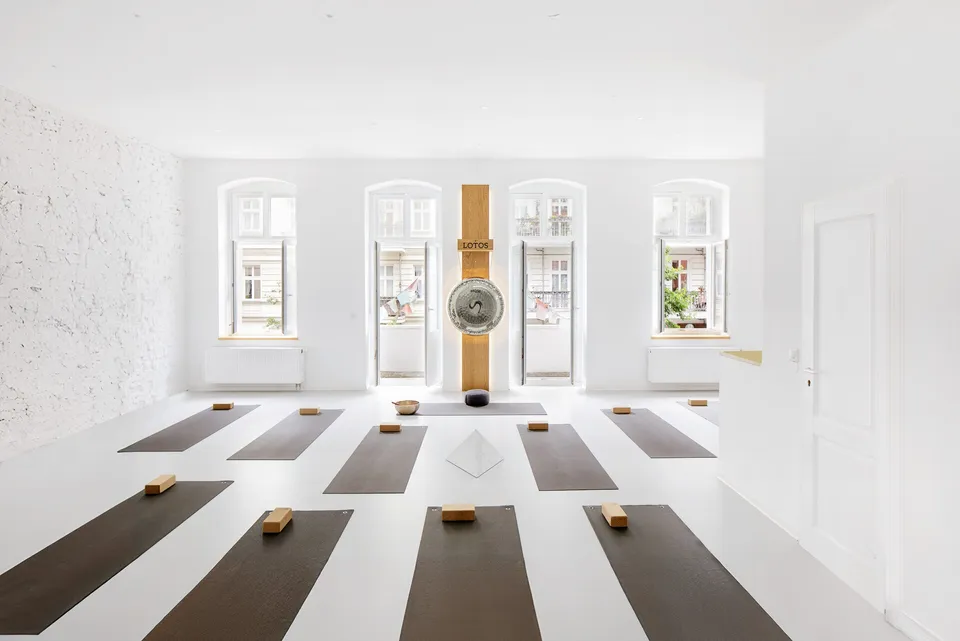
An empty yoga classroom. A photograph cannot establish the temperature, intensity, or whether a class is labelled hot or power yoga.
20240614 Lotos Yoga-0208 sRGB 2000px 72dpi.jpg — LotosYoga. CC BY-SA 4.0. WebP conversion and proportional resizing; no crop or retouching.


A water bottle beside a home exercise mat. This is preparation context, not a photograph of hot yoga or proof that heat is safe.
People do exercise at home while using a water bottle and a yoga mat on the floor.jpg — Nenad Stojković (Shixart1985). CC BY 2.0. WebP conversion and proportional resizing; no crop or retouching.

Where the labels come from
Power yoga is closely associated with the modern international yoga world. Beryl Bender Birch’s Power Yoga was published in 1995, a useful documented marker in the history of the name. Her school’s own account describes a method influenced by Ashtanga sequences and adapted for her students. That is the history of her approach, rather than evidence that every class now called power yoga follows it. Publisher record · The Hard & The Soft Yoga Institute
Bryan Kest’s website also uses Power Yoga as the name of his teaching approach. It acknowledges the term’s wider use for vigorous classes, while its own catalogue includes gentler sessions. Multiple uses of the same name are a reason to read a provider’s description closely. This article does not assign a single undisputed inventor to the generic label. Bryan Kest’s explanation
Heated classes also include distinct methods. Bikram’s official description specifies 26 postures and two breathing exercises, in a set order, over 90 minutes at 105°F, approximately 40.6°C. These details describe that system; they are not a definition of all hot yoga. A heated vinyasa class may use a changing sequence and a different duration or temperature. Bikram’s stated format · Hewett and colleagues: Published research protocol
What a class may be like
In a power class, expect the teacher’s description to explain whether movement flows continuously, includes longer holds, or follows a recognizable sequence. Baron Baptiste, for example, describes Journey Into Power as a consistent sequence whose intensity can be adapted. Other teachers arrange their classes differently. “Power” alone does not promise a particular set of postures, level of instruction or room temperature. Baptiste sequence framework
In a hot class, the room conditions are an additional part of the experience. Modo Yoga Etobicoke, for example, describes classes around 40°C with roughly 40 percent humidity, while noting that conditions can vary. That is a specific provider’s description, not a temperature standard for every studio using the word hot. A Modo studio’s class information
These examples show why two useful details can disappear behind a short timetable label: how the class is organized and what environment it uses. A fast sequence and a heated room are separate features, even when they appear together.
Equipment and room details
The class may use mats, towels, blocks or other props, but the useful list is the provider’s actual one. Ask whether equipment is supplied, whether the sequence includes props, and what facilities are available outside the heated room. The answers say more about the visit than a generic photograph of a sweaty studio.
Heat is not evidence of a better session or a measure of personal progress. NCCIH notes that hot yoga carries particular risks of overheating and dehydration. That brief caution is important context; this article does not assess an individual’s ability to take part or present heat as a treatment. NCCIH yoga information
Questions that clarify this format
- What are the expected temperature and humidity?
- Is the class a fixed sequence, an adaptable framework or a different flow each time?
- How are unfamiliar movements explained, and what experience does the session assume?
- What is the arrangement for pausing or leaving the heated room?
- Which equipment is supplied, and is an unheated version of this class available?
The answers turn two broad labels into a more concrete description. If you want to look up a posture name afterward, the Yoga Pose Library can help with vocabulary. It does not reproduce a hot or power class, and its entries should not be read as a sequence for one.